








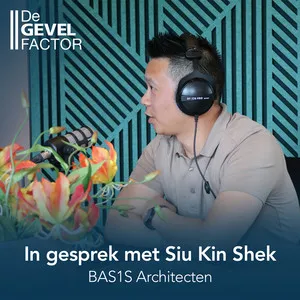
1: In conversation with Siu Kin Shek, founder/co-owner of BAS1S Architecten
Does a supplier need to demonstrate its sustainability performance?
Presenter Jerry Helmers and his sidekick Arjen van Hoof of Trespa International talk to the visibly passionate architect Siu Kin Shek of BAS1S Architecten in Poeldijk. As well as discussing the beautifully completed De Boetzelaer sports complex, Shek argues that suppliers today absolutely must be able to demonstrate their sustainability performance.
At the same time, every architect wants to know how much sustainability affects their creative freedom. The Trespa Standard and the Second Life Concept also come up in this engaging podcast with an architect who knows what he is talking about.
Een zakelijke vraag aan Trespa International B.V.? Get in touch
Full transcript
Alle hoofdstukken (20)
- Introduction to the episode
- Introducing the guests
- Statements for the architect
- The role of the architect and the supply chain
- BAS1S Architecten and the path into the profession
- Swimming pool De Boetzelaer and the design brief
- From design concept to material selection
- What makes good advice from a supplier?
- Sustainability in the design process
- The Trespa Standard
- Trust, evidence and responsibility
- Intrinsic motivation and second life
- Should the government regulate this?
- When do you rule out a supplier?
- Creative freedom and sustainability
- Ambassador for the Trespa Standard
- From individuals or through regulation?
- Fire safety and making test results public
- Two-minute closing remarks
- Closing the episode
Introduction to the episode
Jerry Helmers Welcome to De GevelFactor, for architects and façade builders who want to make design choices based on independent and fair standards. De GevelFactor is a partnership between Trespa and Louwers Media Group.
Jerry Helmers My name is Jerry Helmers and I’ll be your host. Joining me for this episode are Arjen van Hoof, technical specialist at Trespa, and architect Siu Kin Shek of BAS1S Architecten. Enjoy listening.
Introducing the guests
Jerry Helmers As I said, Arjen van Hoof and Siu Kin Shek are here at the table. A very brief introduction. Siu Kin, you’re the owner of BAS1S Architecten. Where is your practice based?
Siu Kin Shek We’re based in Poeldijk, in the beautiful Westland region.
Jerry Helmers In the beautiful Westland. A bit of promotion for the region straight away, of course.
Siu Kin Shek Absolutely.
Jerry Helmers Yes, because everything you’ve designed there is part of the landscape.
Siu Kin Shek For the most part, yes.
Jerry Helmers For the most part. OK, we’ll hear more about that later, but now we know who you are, because first I’m going to put some statements to you. Arjen, technical specialist at, well, I was almost going to say, the best company in the Netherlands.
Arjen van Hoof Yes, I think so.
Jerry Helmers You think so. You looked a little taken aback when I said…
Arjen van Hoof Yes, I thought maybe you meant Louwers Media, but in this case I’d say Trespa.
Jerry Helmers Trespa, yes. I don’t want to… OK, good.
Statements for the architect
Jerry Helmers I’m going to put a number of statements to you. Well, actually, I mainly want to put them to the architect here today. Are you ready?
Siu Kin Shek I hope so.
Jerry Helmers Here’s the first one. Architects should take a tougher stance on greenwashing by manufacturers. Agree or disagree?
Siu Kin Shek Agree.
Jerry Helmers Agree, you agree with that. Here’s your second statement: the focus on circularity limits my creative freedom.
Siu Kin Shek Disagree.
Jerry Helmers Disagree. And here’s the third and final one: without transparent data, I can’t make responsible material choices.
Siu Kin Shek Agree.
Jerry Helmers Agree. For listeners, I think there was a moment of hesitation there, judging by your expression.
Siu Kin Shek Yes, that’s right.
Jerry Helmers All right. Perhaps you can come back to that later. Arjen, you’re sort of my sidekick today. I have a statement for you too. Agree or disagree? I’m curious to see how quickly you can answer, because the statement is: the architect is the only person who keeps the whole picture in view.
Arjen van Hoof Oh, I didn’t see that one coming. No.
Jerry Helmers Do you agree or disagree? The architect is the only person who keeps the whole picture in view.
Arjen van Hoof Disagree.
Jerry Helmers Disagree. It was the word ‘only’.
Arjen van Hoof I’d like to come back to that.
Read the full transcriptCollapse transcript17 more chapters
The role of the architect and the supply chain
Jerry Helmers Well, it sounds like you want to come back to that straight away.
Arjen van Hoof I’d certainly like to, yes.
Jerry Helmers Go ahead, then, and explain your point. And while you’re at it, tell us what your role at Trespa is. That’ll give listeners a chance to get to know you and your expertise.
Arjen van Hoof Sure. I disagree with that statement. Why? I think there are other parties in the supply chain that should do that too.
Jerry Helmers Which parties, then?
Arjen van Hoof Well, if we look at responsibility in the supply chain, for example, a contractor. A contractor or an installer can do that too. I do agree that the architect has the whole picture in view and needs to keep it that way. I just disagree with the idea that the architect is the only one.
Jerry Helmers We’re not recording this on video, but listeners really ought to see your furrowed, doubtful brow right now. But I understand your dilemma. Tell us a bit more about what you do at Trespa. What’s your role? I understand you’ve been there for ten years.
Arjen van Hoof Nearly ten years, yes. I’m a technical specialist, so I’m essentially a technical extension of our account managers, among others.
Jerry Helmers An extension of the account managers. So they come to you with all sorts of tricky questions they can’t answer themselves.
Arjen van Hoof That’s pretty much it. I hope they’re not listening, but that’s often how it goes.
Jerry Helmers We just shouldn’t promote this podcast, then they’ll miss it. It’s more than that, though. You’re a sounding board.
Arjen van Hoof That’s how I like to put it.
Jerry Helmers Did you know our guest today?
Arjen van Hoof Not personally. Of course, I know some of his projects.
BAS1S Architecten and the path into the profession
Jerry Helmers OK, that’s a good link to you. Once again, welcome, Siu Kin from BAS1S Architecten. Tell us who you are, where you come from and what you stand for as an architect.
Jerry Helmers Yes, I don’t want to ask difficult questions. Architects can be a little unconventional sometimes too.
Siu Kin Shek Definitely, definitely. Siu Kin from BAS1S Architecten, as mentioned earlier. We’re a regional practice based in the Westland. We do a lot of projects in the region. That’s also part of how our practice has put down roots here.
Jerry Helmers Yes, and how long have you been around?
Siu Kin Shek That’s an unusual question too.
Jerry Helmers Oh, I do ask difficult questions.
Siu Kin Shek BAS1S Architecten has been around since 2012. It grew out of my former business partner and me. Before that, the practice had a different name, Kees Breumhoff Architect. That was my partner’s father. So we’re a relatively young practice with a long history.
Jerry Helmers OK, it’s 2025 now, so this year is actually the 12.5th anniversary under that name.
Siu Kin Shek I suppose it should be.
Jerry Helmers Yes, when can we pop the champagne?
Siu Kin Shek You’ll get an invitation.
Jerry Helmers Ah, OK. What made you want to become an architect?
Siu Kin Shek That’s another unusual question. When I was young, I really had no idea what I wanted to do. My family in Hong Kong worked in construction. So I finished secondary school and asked my father what I should do. My parents run a restaurant. I said, ‘Well, I don’t want to go into hospitality. Please, let me do something else.’ And he said, ‘Look, your family’s in construction, so go into construction.’ That’s how it all started. First I did a vocational course in construction, with plenty of hands-on work. Then I went on to study construction at a higher professional level. Eventually I thought, ‘Yes, but I actually enjoy designing much more than the actual building work.’ So I continued my studies.
Jerry Helmers So it turns out you became an architect because you studied construction. We can assume, then, that you know something about how things are built and have a good understanding of what happens in the supply chain.
Siu Kin Shek I think I do.
Jerry Helmers You think you do.
Siu Kin Shek No, definitely. I also think architects are shaped in different ways. In the Netherlands, architect is of course a protected title. You need to obtain a particular qualification to call yourself an architect. But there are practical architects and highly artistic architects. That’s also what makes the profession so interesting.
Jerry Helmers So which are you? A practical architect or an artistic one?
Siu Kin Shek I’d say I’m a practical architect.
Jerry Helmers But I have to say, you have designed something quite artistic.
Siu Kin Shek Absolutely, one doesn’t rule out the other.
Swimming pool De Boetzelaer and the design brief
Jerry Helmers One doesn’t rule out the other. No, look, to be completely honest, we did have a preliminary chat. Because in this podcast we’re also going to talk about De Boetzelaer swimming pool in Monster. You designed it.
Jerry Helmers In Monster, you designed it. Can you briefly explain what the client’s brief was? Who was the client? The swimming pool itself or the municipality?
Siu Kin Shek The swimming pool itself, actually.
Jerry Helmers What specifically were you asked to do?
Siu Kin Shek A little background on the swimming pool: it had been damaged by fire and was completely destroyed.
Jerry Helmers When did that happen?
Siu Kin Shek Just before we started designing it. In 2019.
Jerry Helmers In 2019, OK. A date to put it in context.
Siu Kin Shek It was completely destroyed, so we had to get the swimming pool operational again as quickly as possible. That brought various challenges, including financial ones, as well as the question of how the pool should establish its place in the municipality. So it was really important for us to consider how we could make this concept, a new swimming pool, take root in the Westland.
Jerry Helmers So you were literally starting from scratch and rebuilding it.
Siu Kin Shek Yes, as a good architect should, that’s exactly what you do. The only thing left after the fire was the large competition pool.
Jerry Helmers And the new design was built around it.
Jerry Helmers It’s obviously very hard to visualise something on a podcast, but can you describe what it looks like? Give listeners a reason to look it up on Google and see that beautiful image. To be honest, I haven’t been there myself yet, but from what I’ve seen, it looks absolutely stunning.
Siu Kin Shek That’s good to hear.
Jerry Helmers Yes, that was a little publicity for you.
Siu Kin Shek Yes, thank you. Well, at the start of the year we were really trying to work out what we should create. So we immediately asked ourselves: what does De Boetzelaer need after the fire? A rock in a storm.
Jerry Helmers A rock in a storm.
Siu Kin Shek Yes, a rock in a storm. That became our concept. We tried to visualise it and use that metaphor to develop a design. Based on the concept, we shaped the façade, or rather the building’s overall mass, to look as much as possible like a real rock. A rock is made up of different planes, hollowed-out sections and things like that.
Jerry Helmers It’s never great.
Siu Kin Shek: Exactly, it’s never a uniform whole. It’s something very dynamic. You can look at it from different angles, hollow out a section and then something else happens. It has an effect on the light, the shadows and so on. So it was a really great concept to work with. We translated it into De Boetzelaer and looked for materials that would work for us in bringing it to life.
From design concept to material selection
Jerry Helmers It seems like quite a complicated project to me. I mean, you can design something, but…
Siu Kin Shek: We’re talking about 3D façades, after all.
Jerry Helmers Yes, that’s right.
Siu Kin Shek: We wanted the façade to make a statement, to look as much like a rock face as possible. There are lots of different ways to do that. We chose to bring that kind of 3D visual effect into the façade… Initially, we did a lot of research into whether we could make the façade genuinely 3D, so that it actually projected outwards. But we faced several challenges, including financial and budgetary ones. In the end, we also chose to make the building completely flat. So yes, when you drive past, it’s still a flat wall, but you experience it as a 3D effect that comes right towards you.
Jerry Helmers And, okay, how do you go about… You have budgetary challenges, but ultimately you also have to ask: which material are you going to choose?
Siu Kin Shek: That’s right. As I mentioned earlier, we’re a fairly pragmatic practice. We’re always looking for solutions. You’re not in that 2% niche of projects. So you always look for…
Jerry Helmers Hang on, what do you mean by that 2%?
Siu Kin Shek: That niche market where money is no object.
Jerry Helmers Yes, okay.
Siu Kin Shek: So you start looking at how you can achieve your goal with, and this may sound a bit odd, minimal resources. Then we thought: if we make a really clean-lined box and clad it with panels, can we achieve our goal? We then started looking at cladding panels and asking which suppliers could work for us.
Jerry Helmers Listeners will have guessed for years that you chose Trespa. But how did you come to that decision? Was it literally just a quick phone call and that was it, or was there a whole advisory process…
Jerry Helmers I’m looking at Arjen too, but perhaps you should answer first.
Siu Kin Shek: What does that process look like from a practice’s perspective? I think you decide to use cladding panels and then start looking. Very simply, you use Google and ask around your own network: what do we want to use? We thought Trespa was a good supplier. A well-known supplier, really, because I hope everyone thinks of Trespa as a product.
Jerry Helmers I can see Arjen beaming. Yes, everyone thinks of Trespa.
Siu Kin Shek: No, I think the main point is that, as I say, everyone refers to Trespa as a product. As a brand, really. And I think you’ve done a very good job of promoting it over the years. As far as façade panels are concerned, I think Trespa is one of the major players we’re keen to contact to see what you can do for us.
Jerry Helmers So what questions do you ask in a conversation with Trespa? You make initial contact, have a phone call, perhaps go to Weert in person, however it works. What questions do you ask?
Siu Kin Shek: We already had an idea, because the product wasn’t new to us. As we just mentioned, we wanted to use different orientations and colours across the panels to create a kind of 3D effect. Our first step was to ask for advice: we’re thinking of these colours, will it work as we’ve envisaged? Then someone from Trespa, Tjerd in this case, came to our office. He gave us advice and some more background on the product, because we have a bit of basic knowledge about it. But he also came up with an idea. I thought that was really great: a good collaboration, exploring what else was possible beyond what you had already come up with.
What makes good advice from a supplier?
Jerry Helmers Arjen, what makes advice good?
Arjen van Hoof Well, I’d almost say it’s simply honest advice. In this case, it might be worth picking up on what was said: that Trespa is seen as a product. Trespa is actually a brand of HPL.
Jerry Helmers Even a brand.
Arjen van Hoof Yes, it’s a brand, but the brand is seen as a product. There are some significant differences in quality. So in that respect, I’m pleased to hear that we stand out. But what my colleague will certainly have explained is that there are major differences in quality. Those are, of course, things we would bring up when giving good advice.
Jerry Helmers But you’re saying there are major differences in quality?
Arjen van Hoof Yes. I think an architect chooses a particular appearance and naturally wants it to stay the same for as long as possible.
Sustainability in the design process
Jerry Helmers But sustainability is also something we talk about a lot these days. You said the project started for you in 2019. Eventually, the whole issue of sustainability also came up. What’s your approach to sustainability? Were there specific questions you asked as part of the initial advisory process with Trespa? Did you discuss it? Or were there perhaps specific requirements from the client in that area that you had to meet?
Siu Kin Shek: Definitely. Bear in mind, it was 2019. The BENG requirements weren’t in force yet, of course.
Jerry Helmers No, not until 2021.
Siu Kin Shek: Yes, but the client had already asked us: we want a building for the future, we want to create a sustainable building and we want to see how close we can get to being energy-neutral.
Jerry Helmers Yes, so what is sustainability? Anyone who follows the media will probably come across the word sustainability five times a day. What does sustainability mean to you?
Siu Kin Shek: To me personally, sustainability is an umbrella term. It covers a lot of different aspects.
Jerry Helmers Which aspects do you apply to the De Boetzelaer project?
Siu Kin Shek: For De Boetzelaer, it was mainly about energy and energy consumption.
Jerry Helmers Energy consumption. Can you explain that in a little more detail?
Siu Kin Shek: Making it as energy-neutral as possible and generating as much of its own energy as possible. That also relates to the building itself, in terms of insulation and things like that. So we tried to take into account, to some extent, the things we all have to calculate these days.
Jerry Helmers Okay, but how do you get those calculations? Could Trespa provide a good answer? How does that work? I’m looking at Arjen too. Who’d like to comment? Arjen or Siu Kin, how do you get those calculations?
Arjen van Hoof I’m happy to respond in a moment, but perhaps it would be good…
Siu Kin Shek: Trespa gave me more advice about the product. Seventy per cent of the product was made from wood, which was really what made us think: that’s a sustainable product, and it fits with our own approach to sustainability for De Boetzelaer. I have to admit, at the time we didn’t go into the energy consumption involved in manufacturing a product. Those are things we consider now.
Jerry Helmers How did that change come about?
Siu Kin Shek: It’s simply a matter of how what we consider standard has evolved, both in terms of regulations and what you’ve experienced in your own design projects.
The Trespa Standard
Jerry Helmers Yes, I can see Arjen itching to speak. I think you want to make the link with the Trespa Standard.
Arjen van Hoof Yes, very much so. It’s certainly familiar to us that times change. That led us, as a supplier, to decide it was time to set a standard. We want to say: this is how we do things. And we want to challenge the whole market to do the same.
Jerry Helmers Explain specifically what the Trespa Standard is. Had you heard of it before, Siu Kin?
Siu Kin Shek: To some extent.
Jerry Helmers Well, then we need to explain the rest as well.
Arjen van Hoof I’ll explain it as simply as possible. The Trespa Standard is basically the standard we set ourselves, what we expect of ourselves. We want to be able to substantiate everything, whether it’s sustainability, fire safety or anything else, with facts. And those facts must be verified by third parties. We see a lot of greenwashing in the market. The word has already come up in the statements. We see a lot of suppliers making all kinds of claims about sustainability, but then leaving out the actual evidence. As a manufacturer, we believe providing that evidence is incredibly important. We simply want to set a kind of standard for the rest of the market. We’d be delighted if everyone did it just as well.
Jerry Helmers But if that evidence were missing, it would be turning into a bit of a marketing gimmick?
Arjen van Hoof I think it would.
Jerry Helmers Greenwashing.
Siu Kin Shek: What do you think of substantiated data? I think it’s simply an essential part of what we need. Ultimately, you also need some proof for the authorities or your client.
Jerry Helmers Yes, legislation and regulations also seem to be getting stricter in that area.
Siu Kin Shek: Yes, definitely. There’s a reason we call the Netherlands a country of rules. So yes, you have to comply, full stop. Otherwise, you can’t operate in the country. But I have to say, sometimes it feels like a lot to have to provide everything. Still, as I said, it’s an essential part of the process.
Trust, evidence and responsibility
Jerry Helmers But isn’t this also about trust within the supply chain? As an architect, you want to make your design as good as possible, and your client says: that’s what we’ll do. You need to have something to base it on. So you need to be able to rely on something, in this case perhaps the Trespa Standard. How does that work?
Siu Kin Shek: As you say, it’s about trust, about a supplier being honest in what they claim. We’re not going to check whether your report is accurate or anything like that. But a supplier has to be able to demonstrate it.
Jerry Helmers Certainly.
Siu Kin Shek: Definitely, yes. I think that forms the basis for the material choices you make when you want to deliver a sustainable project.
Jerry Helmers Is that a huge responsibility being placed on you? I’m looking at Arjen again. A supplier ultimately has to be able to demonstrate it. You’ve taken a step of your own by creating the Trespa Standard. Do you want to be near the top of the pyramid when it comes to taking responsibility?
Arjen van Hoof We want to take the responsibility that is needed. What I really mean is that the things we do… As a supplier, we are at the start of the process of making a product. We need to provide the supporting evidence. If anyone can do that, it’s the manufacturer. We know where the raw materials come from and what happens to them. The thing is, we do see companies in the market taking this a little too lightly, simply by claiming that things are sustainable. Sustainability is quite a broad concept in the Netherlands. We still don’t all know exactly what it means.
Jerry Helmers Exactly.
Arjen van Hoof I sometimes say that English has two terms for sustainability alone. In the Netherlands, we put it all under one term. And those meanings vary enormously. The same applies within those terms, if you look more closely. So I do think you need to say what you do. At Trespa, we believe it’s very important to do the right thing and provide transparent evidence to back it up. And the only way to do that is to have someone looking over your shoulder.
Intrinsic motivation and second life
Jerry Helmers For you, is sustainability about striving for circularity and perhaps creating a second life for products? Does that come from intrinsic motivation, or would you also say: well, it’s a matter of laws and regulations, so I comply with them?
Siu Kin Shek To some extent, yes. I find sustainability a slightly difficult concept. I’m also trying to work out exactly what we mean by it. Of course, it covers a lot of themes: circularity, biodiversity, climate adaptation, biophilic design, all terms that come under the heading of sustainability. For me personally, the most sustainable thing is to keep a building standing for as long as possible. But that’s my personal view of sustainability.
Jerry Helmers Did you think about that, for example, when designing De Boetzelaer?
Siu Kin Shek Definitely. Of course, we also look at the lifespan. That’s when Trespa’s second life programme came up. We thought it was interesting. I don’t have a specific use for it in mind, but we have clad a building with a material that lasts for a certain number of years. I’m very curious to know whether, say, in fifty years, when it needs replacing, or something like that, we could still do something with it. In the end, they all claim that we’re storing energy in products. But I want to avoid shifting the problem, pushing it further down the line. So I’m curious about what other options are available. That was partly why I looked at Trespa: what else could we do with a kind of second life programme?
Jerry Helmers Okay, what is the second life programme?
Arjen van Hoof With the second life programme, we take back panels that have already served a full life on a façade. We take them back and give them a second life. It’s as simple as that.
Jerry Helmers Is it really that simple?
Arjen van Hoof Yes, it is, really.
Jerry Helmers So will we see them on another façade?
Arjen van Hoof No, not on a façade. And I can explain why. It’s simply because the regulations in the Netherlands don’t go far enough at the moment.
Jerry Helmers What would need to change in those regulations?
Arjen van Hoof I think the regulations could be a bit stricter. That may sound a little odd, given what we just said about the Netherlands being a country of rules, but in some areas they could be tighter. When it comes to sustainability and doing the right thing for the planet, I think we can be all too ready to gloss over certain things.
Should the government regulate this?
Jerry Helmers But then those people don’t have any intrinsic motivation, do they? It’s really quite illiberal to leave it to the government and say it should sort things out. Why can’t people do this themselves?
Arjen van Hoof That’s one of the reasons we, as a supplier, take responsibility ourselves for doing the right thing for future generations too. And we want to… It’s not as if we’re saying that we’ll only take back the panels we’re selling now in thirty or forty years’ time. If a project comes up now with Trespa panels that can be taken back, we’ll do that. And we’ll make sure they get a second life. That could mean all sorts of things. They could be used to make furniture.
Jerry Helmers It was a cycle shelter. Isn’t the cycle shelter in your car park in Weert also partly made from second life panels?
Arjen van Hoof Yes, absolutely. That one is, of course, at our own site, but there are several other initiatives.
Jerry Helmers Practice what you preach. If you don’t start doing it yourselves…
Arjen van Hoof Then it won’t happen. You have to set a good example too. We also set targets for ourselves and our account managers, so that we actively look for projects where we can take the product back at the end of its lifespan.
When do you rule out a supplier?
Jerry Helmers Of course. Siu Kin, at the start you said you agreed with the statement that ‘architects should take a tougher stance against greenwashing by manufacturers’. Would you go so far as to say here and now that manufacturers or suppliers who can’t prove their sustainability claims, so who can’t work on a fact-based basis, should be ruled out?
Siu Kin Shek Yes, I’m happy to say that, yes.
Jerry Helmers Okay. Has that happened already, or have I just given you an idea?
Siu Kin Shek No, I think it has. We always look at the products, and our choice of product is based on discussions with and advice from manufacturers, but also on their reports. In the end, we have everything assessed as well.
Creative freedom and sustainability
Jerry Helmers I’d also like to talk about creative freedom. As architects, you naturally want to preserve that creative freedom in every way possible. But earlier, in response to the statement ‘a focus on circularity limits my creative freedom’, you disagreed, so you don’t see any limitations there. Is that right, if you’re saying that creative freedom is truly independent of material properties, including sustainability characteristics?
Siu Kin Shek Yes, I think so. I think that’s part of our job as architects, to keep looking at that and exploring our creativity. You’re creative as a person, otherwise you wouldn’t choose this profession. I think all the sustainability aspects are simply given constraints. And within those constraints, you can push the boundaries and explore how to work with a product, and what the end result will be. I don’t feel that, if I were to choose Trespa, for example, or another product… That’s not how it works. We always choose the product that suits our design. I don’t think that limits my creativity. Quite the opposite. Take De Boetzelaer: we created a very distinctive building using a fairly standard product.
Jerry Helmers What advice would you give architects who might be listening to this podcast and might also feel in their hearts that we need to do more on sustainability? Would you, for instance, urge them not to work with manufacturers who can’t provide any fact-based sustainability figures? Do you want to put it that strongly? You were quite firm in your response to the statement.
Siu Kin Shek Yes, on the one hand I do. On the one hand, I think we have a responsibility to be creative and design a beautiful product. Manufacturers have their own responsibility too, as my colleague just said at the table. So why not? If you can’t prove it, we can all claim that we’re making something sustainable, even if that may not be true at all. Those facts are important to me.
Jerry Helmers So I heard a clear statement against greenwashing and all that marketing nonsense, to put it bluntly.
Siu Kin Shek Yes, ultimately. As I say, sustainability is already a very broad and wide-ranging concept, and some people may not be able to pin down exactly what it is. If we add even more noise without backing it up with facts, that becomes a rather strange story.
Jerry Helmers So documentation, certification and fact-based information on material choices have become more essential than ever?
Siu Kin Shek Yes.
Ambassador for the Trespa Standard
Jerry Helmers Arjen, could this architect become an ambassador for the Trespa Standard?
Arjen van Hoof One hundred per cent.
Jerry Helmers What message do you think he should be communicating to architects in the Netherlands?
Arjen van Hoof I think architects in particular need to talk to suppliers and look at the possibilities. They may also need to be critical when making a choice about which products to use and which not to use. On the other hand, I think manufacturers themselves need to be completely transparent.
Jerry Helmers They still need to take responsibility.
Arjen van Hoof Yes, absolutely. In the past, there have been all sorts of products, not so much façade products, but other things that we’ve discovered years later may be the most toxic substances we’ve ever seen. I think suppliers simply have to be transparent about that.
From individuals or through regulation?
Jerry Helmers Siu Kin, should legislation and regulations include much more about a standard, or do you ultimately feel that it should come from people themselves? Well, Trespa has taken some kind of initiative, let’s put it that way. What do you think?
Siu Kin Shek I think it’s also up to people themselves to take responsibility, of course. We can put everything into laws and regulations, but as we just said, the Netherlands already has so many. So it’s also about what you aspire to yourself. If you have a client who has no interest in it at all and doesn’t want to spend any extra money on it… I always say that we’re here to facilitate. But you don’t say, ‘Okay, then I won’t take on this commission.’ No, I try to make the client aware of what else is involved within the scope of the project: what other factors are at play? What opportunities do you have?
Jerry Helmers Where do clients still say, ‘Sustainability, whatever, just make something nice, and make it as cheap as possible’?
Siu Kin Shek Yes.
Jerry Helmers Okay, so you are going in that direction.
Arjen van Hoof I do think it’s difficult to keep an eye on things throughout the supply chain.
Jerry Helmers What do you mean by that?
Arjen van Hoof What I mean is that, for example, you could have a client who thinks sustainability is very important and is fully committed to it. The architect is close to the project, so they may understand it too. And it carries on like that. At some point, you get to a contractor, and the contractor might say, I’m making this up, ‘I don’t care.’
Siu Kin Shek Yes, but then it can’t…
Arjen van Hoof That’s the question I have. If there isn’t more of a standard that everyone follows, then I think your influence is reduced. And I very much agree with what you’re saying: you should be able to have an influence on that.
Siu Kin Shek: But you also have your own say in it. If there’s a partner in the chain, you’re constantly involved in the process.
Arjen van Hoof But do you think you can always influence it? Say a contractor says: ‘That’s nice, but I’m going with a different product.’
Siu Kin Shek: Yes, actually, you can’t. No, actually… We do keep a close eye on things. We do talk to them about it.
Jerry Helmers What do you do?
Jerry Helmers Where do you draw the line, Siu Kin? You say you talk to them about it, but do you also say: there’s a point where we won’t go along with this? It’s quite a moral dilemma.
Siu Kin Shek: Yes. No, I’m just thinking of a recent project where an alternative product was proposed that we didn’t agree with. So we said: no, that’s not happening.
Jerry Helmers That’s not happening.
Fire safety and making test results public
Jerry Helmers Okay, a very small aspect, although it can perhaps be a very big issue, when you look at the fire safety of façades and façade panels. There’s a sustainability aspect to that, too. How do you view fire safety?
Siu Kin Shek: To be honest, I take a fairly pragmatic view of it.
Jerry Helmers You’ll have to explain that. Fairly pragmatic.
Siu Kin Shek: No, look, we fall back on the rules in this area. The product has to meet certain requirements. I can have all kinds of opinions about it, but I also think it’s the manufacturer’s responsibility to demonstrate that a product meets a particular fire classification.
Jerry Helmers So your response now is that it’s the manufacturer’s responsibility to demonstrate that.
Arjen van Hoof I certainly think it’s the manufacturer’s responsibility to demonstrate that. We manufacture the product, so we have to carry out those tests. But I do think we should make all those test results public and show them. Be completely transparent.
Jerry Helmers Complete transparency.
Arjen van Hoof And not commercial documents that make for easy reading, but the actual document from the testing institute.
Jerry Helmers That also explains and supports your disagreement with the statement ‘the architect is the only one who keeps the whole picture in view’. This is the responsibility of the whole supply chain.
Arjen van Hoof Absolutely.
Two-minute closing remarks
Jerry Helmers We’re about to move on to the final two minutes of this podcast. And I can see Siu Kin looking delighted, because he knows these are his two minutes, when neither I nor sidekick Arjen will interrupt him. You know the deal, Arjen, we told you beforehand: he gets two minutes to say exactly what he wants. You can give your own practice a very shameless plug, or perhaps have one last go at turning that one listener into a client. We won’t say a word. So those two minutes are yours. We really see it as a little Loeki de Leeuw moment.
Siu Kin Shek: Great.
Jerry Helmers Are you ready?
Siu Kin Shek: I’m going to prepare myself. I’m going to use these two minutes, but not to blow my own trumpet. That feels a bit strange. No, let’s keep it in the spirit of the podcast. I don’t see sustainability as a restriction. I see it as an invitation to create better designs. Sometimes it forces you to make choices, but don’t be afraid of that. It’s largely based on lots of figures and reports, the things we’ve just been talking about, but just embrace them. Design for your own context, for your own client. Be happy with what you, as an architect, design.
Siu Kin Shek: So this is really more of an appeal to the new, fresh, young designers. Just try to embrace it fully, as I said. And create buildings that people love. Create buildings and environments that people love, so they’ll also take better care of the built environment. I think that’s the most valuable sustainability aspect there can be. So my appeal to all new, young designers is: always do your best. That’s something you should do anyway, but don’t see it as an obstacle. See it as good craftsmanship, something you have and are taught, including as part of your education. Simply make it an integral part of who you are as a designer.
Closing the episode
Jerry Helmers You came in just under the two minutes for your Loeki de Leeuw moment. So, well done, a great closing pitch with a lovely appeal at the end, especially for young designers. Thanks for joining us. It was great having you here in the studio in Weert today. Would you like to come back sometime? Or was the conversation a bit too intense for you?
Siu Kin Shek: No, I really enjoyed it. I actually… I was going to say, it’s the first time I’ve been on a podcast. Yes, it was great.
Jerry Helmers And it was quite fun with Arjen, wasn’t it?
Siu Kin Shek: Definitely, definitely.
Jerry Helmers Arjen, what did you think of this recording?
Arjen van Hoof Yes, really enjoyable. Great fun. Good to hear. A very fine appeal to designers.
Jerry Helmers Yes, I’m going to ask you a tricky question. What have you learned from the architect sitting here at the table that you’ll take away with you when you drive home tonight, or think back on this conversation?
Arjen van Hoof The ending, really, about creating beautiful buildings, buildings people love. Beautiful buildings that are treated that way, too. I’d almost say to future clients: find an architect like BAS1S.
Jerry Helmers So it did end up being a bit of an advert for you after all. You’re too modest to do it yourself, but Trespa will take care of that for you. Right, thank you both for joining us. And thank you, listeners, for listening to De GevelFactor, the podcast for architects and façade builders who want to make design choices based on independent and honest standards. Architects have come to the right place. De GevelFactor is a partnership between Trespa and Louwers Mediagroep.
Jerry Helmers My name is Jerry Helmers, and I was your host. Thank you, valued sidekick Arjen van Hoof. Technical production: Mark Schouten and Daan Halters. Project managers: Marco Beelen and Erwin Krekels. All from the Louwers Mediagroep studio in Weert. Until the next episode. That’s right, until the next GevelFactor.
Companies in this story
Keep following this
Get an email when a new story is published. No account needed.
- SubjectGeneral
- CompanyTrespa International B.V.







