








25 years of innovation in façade access
Text Roel van GilsImage Eurosafe
From fall protection to an integrated access strategy
Eurosafe was founded in Sheffield in 2000 by two English shareholders and one Dutch shareholder. What began as a fall protection specialist has grown over a quarter of a century into a leading technical service provider in safe working at height and in confined spaces. The company now has more than ten branches across Europe and employs over 400 people. The opening of its new headquarters in Zwolle, complete with a training facility, is the icing on the cake of its 25th anniversary celebrations.
Eurosafe has evolved from a project-based installer into a full-service façade access provider with a clear philosophy based on the Safety Circle. “Our role is highly varied and increasingly begins in the pre-construction or design phase of a building,” says Jan Kwanten, Business Development Director at Eurosafe. “We advise and guide all stakeholders in the construction chain, from architects and developers to contractors and end users. We start with a risk assessment, followed by an action plan that often includes a specification. This is linked to consistency in and around buildings. We can then install and maintain all these measures, or train people in how to use them safely.”
Reasonableness clause
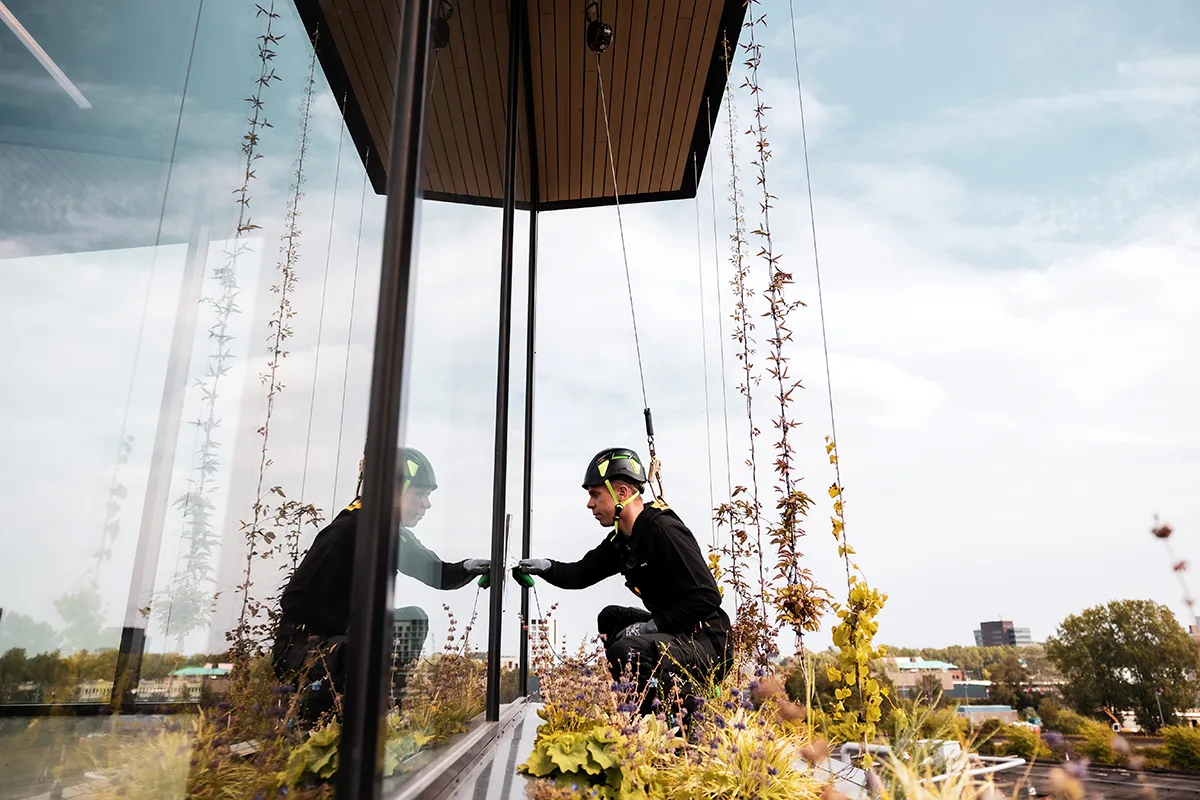
Rope access (rope techniques, ed.) is increasingly being used in the Netherlands for the maintenance and inspection of façades that are difficult to access. “It has been an established technique in the countries around us for much longer,” says Kwanten. “This is mainly due to access constraints and the fact that façades are becoming increasingly challenging. Rope access is used when conventional methods, such as mobile elevating work platforms, scaffolding or building maintenance units, are inadequate, for example because of space constraints or high costs. When weighing up the options, we apply the reasonableness clause, taking all interests and factors into account, whether operational, technical or financial. In urban areas and on complex façades, rope access is increasingly proving to be the most efficient solution. It demonstrated its value during maintenance work at De Resident in The Hague, where rope access saved several hundred thousand euros in scaffolding costs. That is not to mention the considerably shorter completion time and minimal disruption to the surrounding area.”
Hybrid structures
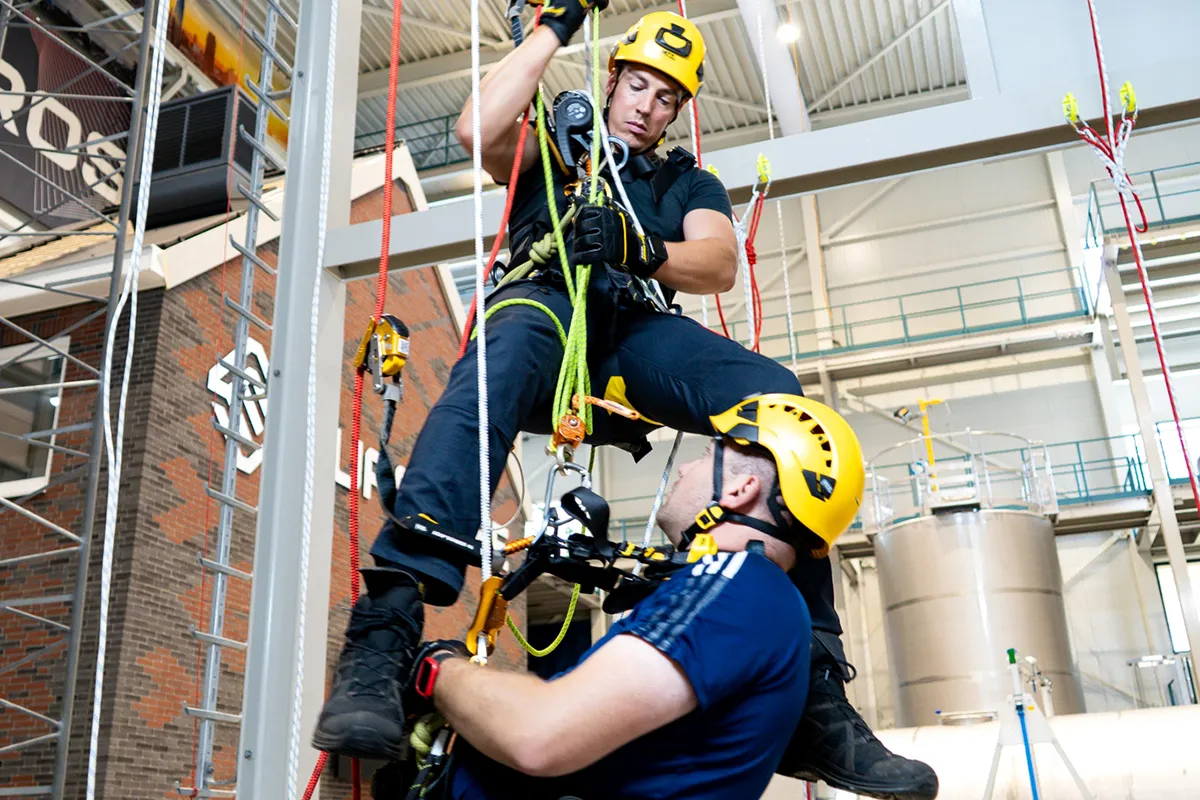
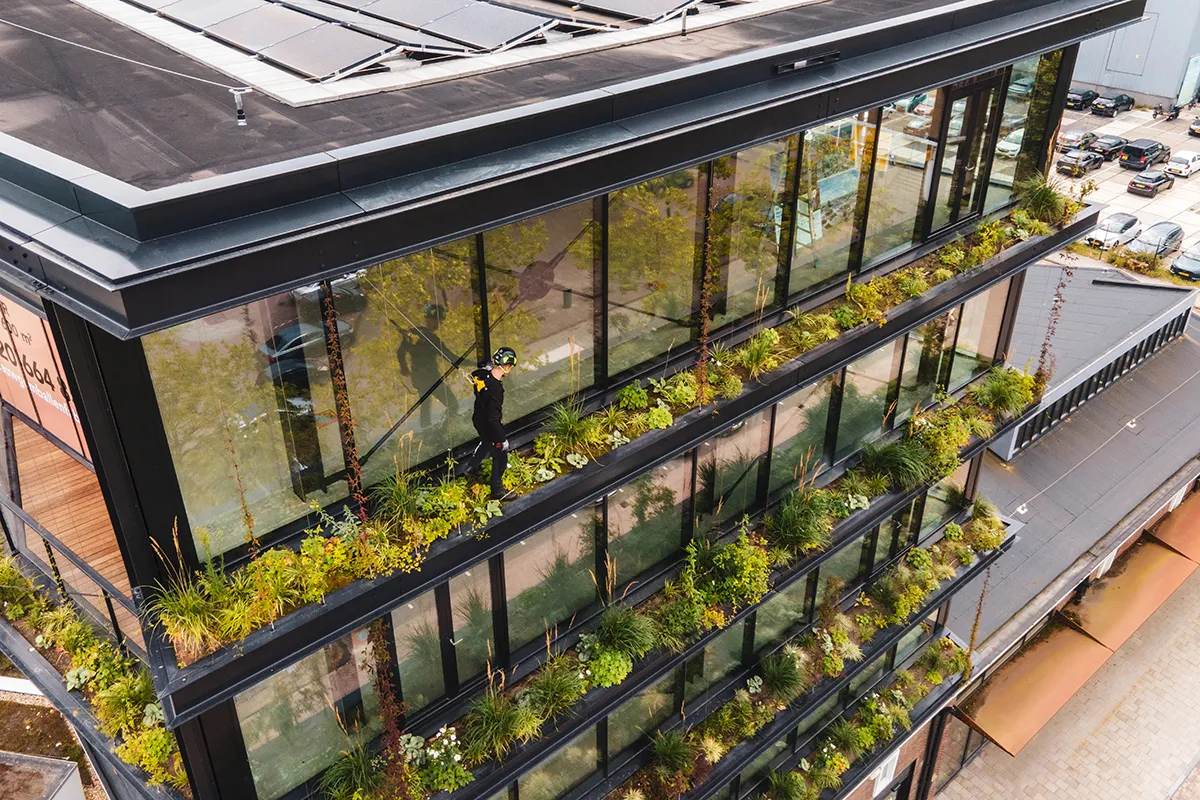
Eurosafe carries out a wide range of work, from façade inspections and window cleaning to supporting green maintenance and hanging advertising. Projects such as Wonderwoods in Utrecht, the Trudo Toren in Eindhoven and The CubeHouse in Amsterdam show the breadth of its work. In Antwerp, Eurosafe worked on the striking Paleis van Justitie and made a significant contribution to the façades of the Doktoren. “We make every façade accessible for maintenance, inspection or cleaning,” Kwanten emphasises. “We do this with our own people working on the façade, but also through a hybrid arrangement in which our people act as a standby rescue team during high-risk work. We also train employees of maintenance companies at one of our two fully IRATA-certified training centres, in Zwolle and Zevenbergen. In Zwolle, we even have a 20-metre-high training space, which makes the practical experience considerably more realistic.”
Kwanten concludes: “As physical facilities on site become fewer, the competence required of the employee increases. At Eurosafe, we combine that competence with experience, technology and service. That makes us unique in our field.”
Have a business enquiry for Eurosafe? Get in touch
Companies in this story
Keep following this
Get an email when a new story is published. No account needed.
- SubjectGeneral
- CompanyEurosafe







