








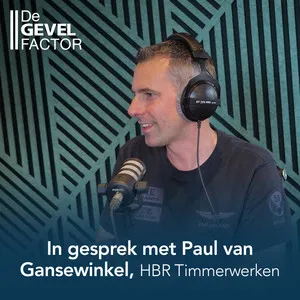
3: In conversation with Paul van Gansewinkel of HBR Timmerwerken
Can a contractor influence the architect’s design during construction?
How does material selection really work in practice? And how is an important issue such as sustainability taken into account? Presenter Jerry Helmers and sidekick Arjen van Hoof, technical specialist at Trespa, talk to Paul van Gansewinkel of HBR Timmerwerken.
Paul is asked, among other things, how important clear and reliable documentation is to his work and whether ‘De Trespa Standaard’ adds value in this respect. This also brought the Quality Assurance Act into the conversation. Is this law useful, or does it create new obstacles that place further constraints on work across the supply chain? To what extent does a company such as HBR Timmerwerken still have scope to influence what the architect has designed, for example, and here it is again, in terms of material selection?
‘Trespa Pura’ also gets a mention in the podcast, and for good reason. Paul chose this façade panel for his own home. But why?
A great podcast to listen to, full of inspiring and instructive experiences from the building site.
Een zakelijke vraag aan Trespa International B.V.? Get in touch
Full transcript
All chapters (26)
- Welcome to De Gevelfactor
- Introducing the guests
- Paul introduces himself
- Arjen introduces himself
- Do Paul and Arjen know each other?
- Starting the statements
- Statements for Paul
- Statements for Arjen
- What kind of company is HBR Timmerwerken?
- Why become a business owner?
- What is the hardest part of running a business?
- Product knowledge and regulations
- Finding expertise from suppliers
- Installation training and documentation
- Sustainability and choice of materials
- Greenwashing and proof of sustainability
- HPL versus Trespa
- Evidence for the Quality Assurance (Building) Act
- FSC and certification throughout the supply chain
- Sustainability in tendering
- Choice of materials for his own home
- Choice of Trespa Pura
- Aesthetics versus sustainability
- What do you expect from a supplier?
- Paul's two minutes
- Closing the podcast
Welcome to De Gevelfactor
Jerry Helmers Welcome to De Gevelfactor, for architects and façade contractors looking to make design choices based on independent and honest standards. De Gevelfactor is a partnership between Trespa and Lauwers Media Groep.
Introducing the guests
Jerry Helmers My name is Jerry Helmers and I’ll be your host. Joining me in the studio for today’s podcast are my sidekick Arjen van Hoof of Trespa and none other than Paul van Gansewinkel of HBR Timmerwerken. A very warm welcome. As I said, we’re here in the studio, in Weert, to be precise, at Lauwers Media Groep, recording another episode of De Gevelfactor. A very brief introduction. Paul van Gansewinkel. I’ll be putting a few statements to you shortly, but first we’d like to know a little about you.
Paul introduces himself
Paul van Gansewinkel Good afternoon. I’m Paul van Gansewinkel, co-owner of HBR Timmerwerken in Weert. I’m 40 and have been a co-owner for five years. We took over the business from my father-in-law. So it’s a real family business, with many long-serving skilled craftsmen who have been here for years.
Jerry Helmers So the traditional craftsmanship is still very much part of what you do.
Paul van Gansewinkel Yes, we do everything ourselves. We have 14 employees. I’m married and have three children.
Jerry Helmers Well, look at that.
Paul van Gansewinkel I live in Weert, so close to Trespa.
Arjen introduces himself
Jerry Helmers Close to Trespa, indeed. That could be a symbolic metaphor in itself. Close to Trespa. Arjen, tell us a little about yourself. You work in technical support at Trespa. What do you make of Paul’s symbolic metaphor? He’s close to Trespa.
Arjen van Hoof I’m Arjen van Hoof, 39, married with two daughters. I don’t live close to Trespa.
Jerry Helmers But you are close to Trespa.
Arjen van Hoof Yes, exactly.
Jerry Helmers Briefly, what do you do at Trespa?
Arjen van Hoof I’m a technical specialist, so I support the sales team and our customers on all sorts of things, but mainly on technical matters.
Read the full transcriptCollapse transcript22 more chapters
Do Paul and Arjen know each other?
Jerry Helmers I’m curious, do you know each other? Paul and Arjen, have you met before? Or is this literally the first time you’ve met, here in the studio today?
Paul van Gansewinkel I think it’s the first time.
Arjen van Hoof Yes, I think this is the first time we’ve actually met. I have to say I’ve heard Paul’s name, and especially the name of his company, come up quite often, because it’s so close to Trespa.
Starting the statements
Jerry Helmers All right, good. I’m curious to see whether I can get you into an interesting discussion later, or tempt you into one. But first, we’ll start with the statements. Paul, I’m going to put a few statements to you, and you can only answer agree or disagree.
Paul van Gansewinkel Ready? Yes.
Statements for Paul
Jerry Helmers Here goes. A contractor should have the courage to make material choices too.
Paul van Gansewinkel Agree.
Jerry Helmers Second statement. What I choose for my own home says more than a thousand words.
Paul van Gansewinkel Agree.
Jerry Helmers Without clear instructions, every material is a risk.
Paul van Gansewinkel Agree.
Jerry Helmers Three out of three.
Statements for Arjen
Jerry Helmers Arjen, would you like to respond to any of the statements now? Or would you rather have me put a statement to you and answer agree or disagree?
Arjen van Hoof Go ahead, give me a statement.
Jerry Helmers I thought it might be interesting to talk about the Quality Assurance Act. You’re trying to listen in from the sidelines, getting ready to think about your answer.
Arjen van Hoof I like to know where I stand.
Jerry Helmers Well, listeners, there’s a bit of cheating going on here. But here it comes, Arjen. The Quality Assurance Act means we need to keep better records.
Arjen van Hoof Agree.
Jerry Helmers So that’s a yes, then.
Arjen van Hoof Agree. I’m not allowed to say yes, I have to say agree.
Jerry Helmers Yes, very good. We understood you anyway. I’ve got another one for you. Manufacturers overestimate how well their documentation is understood on site.
Arjen van Hoof Underestimate how well?
Jerry Helmers I’ll read it to you again. Manufacturers overestimate how well their documentation is understood on site.
Arjen van Hoof Agree.
Jerry Helmers Agree. Right. At least we’ve all said agree. That makes it easy for me to remember.
What kind of company is HBR Timmerwerken?
Jerry Helmers Let’s move on to the introduction. Paul, can I describe you as a joinery factory? Or a joinery company? Who are your customers? Who do you work for?
Paul van Gansewinkel Well, we’re definitely not a joinery factory. A joinery factory has various machines for making things like window frames. We’re really a joinery company. We do structural carpentry work, such as roof structures for homes, including the overhangs, and a lot of façade cladding.
Jerry Helmers You said that’s one of your areas of specialisation. How do you become a façade cladding specialist? Does it happen naturally as you grow, was that how it happened for you?
Paul van Gansewinkel Well, it actually started before I even worked there. I first worked for another, larger contractor. Then I went to work for my father-in-law, so to speak. That’s when I really started working at HBR Timmerwerken. They did a lot of façade cladding at the time. Back then it involved more sheet material, lots of Trespa. These days there’s quite a lot of timber as well. That’s been a bit of a shift in the market in this region, so to speak. The company had plenty of expertise in how to build a good, durable façade.
Why become a business owner?
Jerry Helmers So you’ve learned the trade yourself, and you’ve now been the owner-director for about five years, if I’ve understood correctly. What made you embrace entrepreneurship and take the plunge?
Paul van Gansewinkel I’ve been saying since I was a little lad of about three that I wanted to become a contractor. So I’d almost finished my studies.
Jerry Helmers What were you studying?
Paul van Gansewinkel Building Engineering at MTS. Then I met my wife. After that I went on to study Construction Management at HTS. I’ve always said I’d start a business of my own one day.
Jerry Helmers All right.
Paul van Gansewinkel But then I ended up in a welcoming environment. So I started at the joinery company. We now have both a joinery company and a contracting business. The contracting business has been around for 35 years. Anyway, that’s what we took over.
What is the hardest part of running a business?
Jerry Helmers What’s the most challenging part of your work? Running a business means dealing with lots of laws and regulations. Everyone is calling for more building, building, building. There’s the nitrogen issue, to name just one. There’s plenty to deal with.
Paul van Gansewinkel The hardest thing at the moment is finding good staff. We can’t complain about our workload. We haven’t been badly affected by the nitrogen issue here in the region, in Limburg. It was much worse in parts of Brabant.
Jerry Helmers So that wasn’t where the challenge lay.
Paul van Gansewinkel At one point, our challenge was simply finding a polite way to turn down jobs, so that those customers would come back to us next time.
Jerry Helmers I see, so you had to use a bit of charm.
Paul van Gansewinkel Of course you want plenty of work now, but you also want plenty of work in five to ten years’ time. You can just bluntly say no, but that doesn’t work.
Product knowledge and regulations
Jerry Helmers Do your customers also judge you on your knowledge of the market? I mean, look at what’s happening with materials, for example. What choices do you make? I imagine you have to do quite a lot of studying to keep up with it all.
Paul van Gansewinkel Yes, you need to have a good grasp of your products.
Jerry Helmers How do you keep up to date?
Paul van Gansewinkel Mainly by reading the product specifications. How is it installed? What regulations apply? And regulations aren’t getting any easier these days.
Jerry Helmers No, it is complicated, that’s for sure.
Paul van Gansewinkel Well, the Quality Assurance Act has already been mentioned. It applies to us in a very broad sense, of course, because we also have a contracting business. Keeping track of so many different aspects takes a huge amount of time, constantly searching for the relevant rules.
Finding expertise from suppliers
Jerry Helmers Let’s make the link to Trespa. Are you also looking for an ally in the supply chain who can help you build up that knowledge?
Paul van Gansewinkel Yes, we’re certainly not afraid to ask questions. So when something new comes along or we face a challenge, we try to find someone who can help us with it. That could be a product supplier, for example.
Jerry Helmers Arjen, how do you share your knowledge?
Arjen van Hoof We sell our products through distributors. The distributor then delivers the materials to Paul.
Jerry Helmers Exactly, there’s an intermediary in between.
Arjen van Hoof Yes, exactly. So they certainly have a role to play too. As a manufacturer, we make our product specifications, installation guides and all the accompanying information, including certifications, as transparent and accessible as possible.
Jerry Helmers But are those documents clear and easy to read?
Arjen van Hoof That’s the responsibility of us as the manufacturer, and to some extent the distributor too: to distinguish what’s important. We have documents with installation instructions, which Paul familiarises himself with before starting installation.
Installation training and documentation
Arjen van Hoof We also provide installation training at our site in Weert. That is one way we can pass on our knowledge. And under the Quality Assurance (Building) Act, those less exciting documents also become important. It is our responsibility to share the right document and make it available.
Sustainability and choice of materials
Jerry Helmers But sustainability has of course become a major issue in recent years. Does it influence the choices you make?
Paul van Gansewinkel I don't know everything about it by any means. But there is of course a huge difference between Trespa and other HPL panels. I think Trespa is the name people most commonly use, but not everything is Trespa, even if it is an HPL panel.
Jerry Helmers But looking at it from a sustainability perspective, how much of a focus is it for your company?
Paul van Gansewinkel We try to advise people. Products are expected to be sustainable nowadays.
Jerry Helmers How do you know whether a product is sustainable?
Paul van Gansewinkel We take Trespa at their word.
Jerry Helmers Well, Arjan, they take you at your word.
Arjen van Hoof You can absolutely take Trespa at their word.
Jerry Helmers Go on, then.
Arjen van Hoof Trespa is a multinational, and sustainability is a high priority for us. But that means more than just making a product that lasts a long time. It also means doing the right thing for the planet.
Jerry Helmers Every company says that.
Arjen van Hoof Yes, absolutely. That is why we think it is important to be able to provide the facts and the evidence too. That is the basis of what we call the Trespa Standard.
Greenwashing and proof of sustainability
Arjen van Hoof What we at Trespa think is important is that not everything claimed in the market is true. There is a lot of greenwashing.
Jerry Helmers Greenwashing is pretending to care about sustainability when, in reality, you don't do a thing about it.
Arjen van Hoof Exactly. And what we think is important is this: of course, we can talk at length about how sustainable our product is, but it is even more important to us that we can provide the facts and the evidence.
Jerry Helmers Can you give us a really concrete example? You have a Trespa panel in your hands. How do we know it meets the Trespa Standard?
Arjen van Hoof We have documentation for all our products. And it is not generic. Let me take a step back. Paul was talking about HPL and Trespa earlier. Trespa is of course a brand. We manufacture HPL. We are proud of our strong brand name. But there are lots of HPL manufacturers who would love their products to be called Trespa, even though they are inferior in terms of quality and sustainability.
HPL versus Trespa
Arjen van Hoof What you see, then, is that these products are all put in the same category. Paul said earlier that Trespa is sustainable. But that can lead people to assume that other products are Trespa too, and sustainable.
Jerry Helmers So you’re saying manufacturers are piggybacking on that sustainability story.
Arjen van Hoof Yes, absolutely. And what we do is this: if a manufacturer is doing something about sustainability, they might have a marketing brochure, or perhaps an LCA or an EPD.
Jerry Helmers Those are documents that show the environmental impact?
Arjen van Hoof Yes. That is certainly a good step. But what we at Trespa do is go one step further. We want a separate document for every individual product.
Evidence for the Quality Assurance (Building) Act
Arjen van Hoof Under the Quality Assurance (Building) Act, Paul will soon have to prove that he installed the product in accordance with the relevant guidelines. Marketing documents telling you how fantastic we are won't help with that. What they ask for is evidence.
Jerry Helmers Paul, you said you were familiar with the Trespa Standard. Have you worked with it yet?
Paul van Gansewinkel Yes.
Jerry Helmers So you received a document setting out the sustainability characteristics of a specific panel?
Paul van Gansewinkel Yes. For example, projects carried out using FSC-certified products. We are FSC-certified too. Trespa is FSC-certified. So, in principle, there is already a chain of evidence from Trespa to the supplier, from the supplier to us, and from us to the main contractor.
FSC and certification throughout the supply chain
Paul van Gansewinkel So, in principle, we have already dealt with that. But as far as I know, everything from Trespa is FSC-certified nowadays.
Jerry Helmers So if it doesn't have the FSC logo, should you start having doubts?
Paul van Gansewinkel Yes. But it also needs to be fully documented.
Arjen van Hoof What often goes wrong with FSC is that the whole chain has to be FSC-certified. So we can sell an FSC product, but if the distributor isn't FSC-certified and Paul is, the chain is broken. Then it is of no use at all.
Sustainability in tendering
Jerry Helmers Do you think sustainability, backed up by data, can help you win tenders?
Arjen van Hoof I think it is mainly helpful under the Quality Assurance (Building) Act. Paul needs to be able to prove that he installed the product in accordance with the relevant guidelines.
Jerry Helmers But I'm asking about sustainability too.
Arjen van Hoof Ultimately, it has to be based on facts.
Jerry Helmers Paul, do you think it helps you win tenders?
Paul van Gansewinkel That's difficult to say. If you're working for a government body, it is important to be able to offer it.
Jerry Helmers Private customers probably don't ask for it.
Paul van Gansewinkel No, generally not. There are people who are really focused on it, but they are few in number.
Choice of materials for his own home
Jerry Helmers You also installed something on your own home.
Paul van Gansewinkel Yes, that's right.
Jerry Helmers Did you consider sustainability at the time?
Paul van Gansewinkel Yes.
Jerry Helmers How did that go?
Paul van Gansewinkel A few years ago, I almost completely demolished my house and rebuilt it. There was a design by an architect, but the choice of materials had not yet been fully worked out.
Jerry Helmers Okay.
Paul van Gansewinkel It was leaning towards timber. Timber is of course sustainable too. But when you consider the maintenance and how the product holds up, timber turns grey. We have a fairly modern house. We soon decided that timber wasn't for us.
Choice of Trespa Pura
Paul van Gansewinkel Then Trespa Pura came up. It had not been on the market for very long at the time. But it met our requirements.
Jerry Helmers So looks matter too.
Paul van Gansewinkel Yes. We wanted the look we have now to still be there in ten years' time.
Aesthetics versus sustainability
Jerry Helmers Are aesthetics and sustainability at odds?
Arjen van Hoof I don't think they have to be.
Paul van Gansewinkel I don't think so either. But you have to keep developing, with new products and innovations.
Jerry Helmers Because aesthetics remain important.
Paul van Gansewinkel Yes, perhaps increasingly so.
What do you expect from a supplier?
Jerry Helmers What do you expect from a supplier?
Paul van Gansewinkel That they continue to deliver quality, and provide a bit of support if something goes wrong with a product.
Jerry Helmers What do you mean by support?
Paul van Gansewinkel Something can always go wrong somewhere, during installation, for example, or in the production process. If we've built a façade and a customer calls three years later to say there's a problem, I want us to look together at what went wrong. If it was a production issue, someone needs to take responsibility.
Arjen van Hoof That is fully in line with our Trespa Standard. We want to communicate openly and transparently so that problems can be prevented as far as possible.
Paul's two minutes
Jerry Helmers Paul, you've got two minutes to speak. We'll keep quiet. You can say whatever you like.
Paul van Gansewinkel As a company, we stand for delivering a good product. We always try to find good partners. Trespa is a great partner for us. If there's an issue, we can get hold of each other easily. We always try to give customers good advice. Trespa isn't always what we recommend. We really look at each customer's specific requirements. That means you can deliver a good product and keep the customer happy.
Paul van Gansewinkel And of course, nobody does joinery as well as HBR Timmerwerken from Weert.
Closing the podcast
Jerry Helmers And that brings us to the end of this podcast. Paul, this was your debut on a national podcast. How was it?
Paul van Gansewinkel Brilliant.
Jerry Helmers Arjen, what did you think of your conversation partner?
Arjen van Hoof Great fun. And even though your company isn't just around the corner from Trespa, we like to keep in close contact with everyone.
Jerry Helmers Dear listeners, thank you for listening to De Gevelfactor, the podcast where architects and façade builders want to make design choices based on independent and fair standards. De Gevelfactor is a partnership between Trespa and Louwers Mediagroep. My name is Jerry Helmers, and I was your host. See you in the next episode.
Companies in this story
Keep following this
Get an email when a new story is published. No account needed.
- SubjectGeneral
- CompanyTrespa International B.V.







