








CFD wind load analysis for complex façades
Text and images WB&E Metal
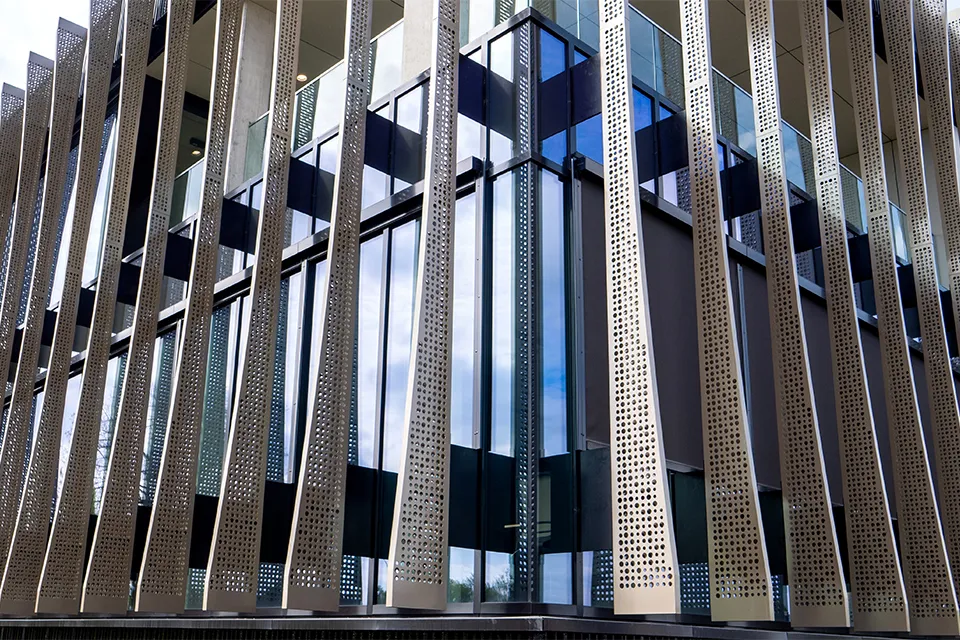
From standards to reality
At WB&E Façade Engineering, we believe that a reliable wind analysis is an essential starting point for every façade study. Wind has a huge impact on buildings and their façades, and it is crucial to accurately assess the forces of nature. Philip Willems, managing director of WB&E, explains: “Although established wind standards provide a good basis, they are often not sufficient for more complex building designs.”
According to Philip, the applicable wind standards mainly describe how wind behaves around simple shapes, such as rectangular volumes. But what happens when a building becomes more challenging architecturally and structurally? Think of organic forms, projecting elements or changes in level. “In such cases, applying the standard becomes complicated and its interpretation highly subjective. This is where Computational Fluid Dynamics (CFD) comes in, a method we regularly use to simulate wind pressures and flows more accurately.”
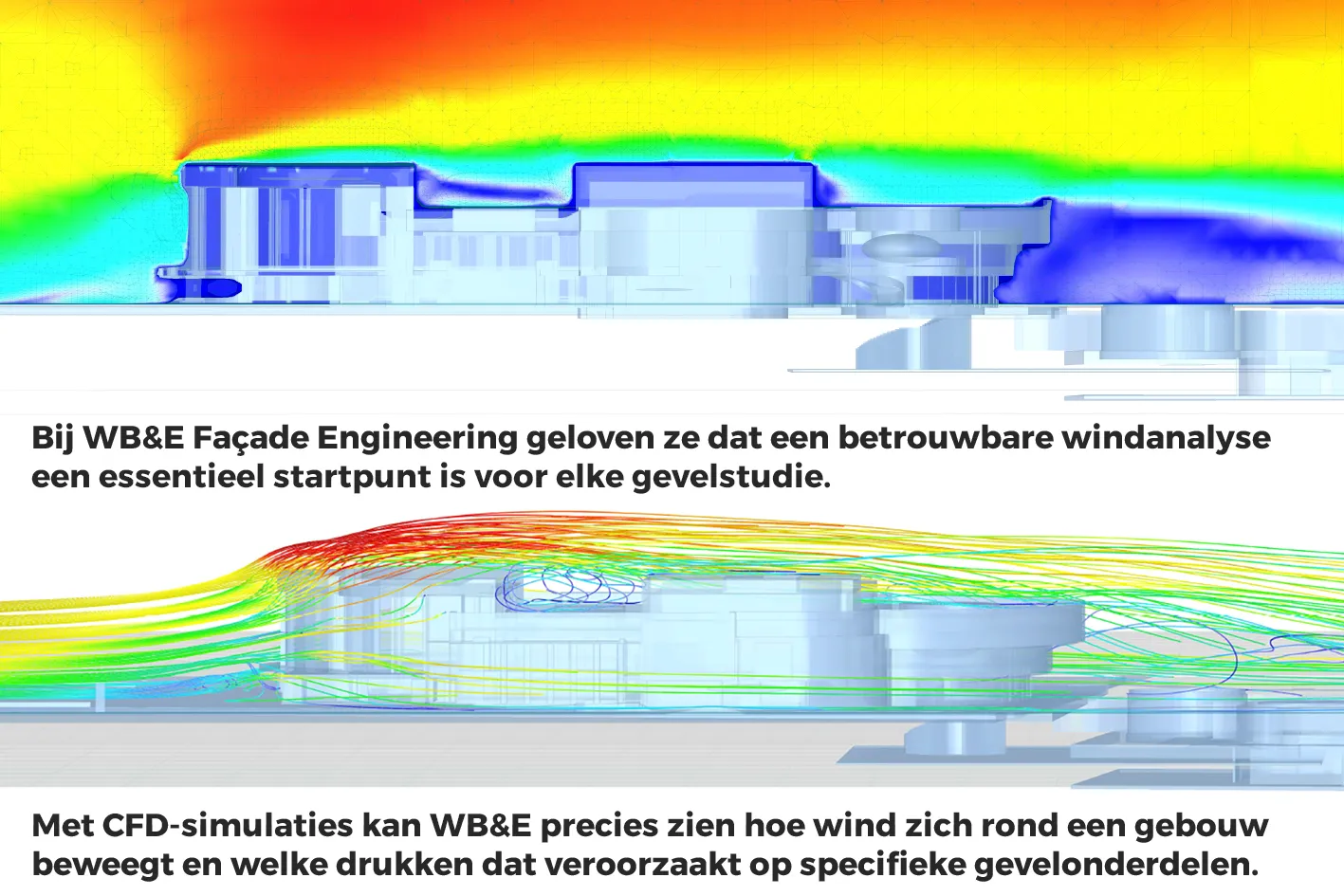
Standard wind code falls short
Philip considers the standard wind code a good starting point for simple geometries. “But in more complex structures, such as buildings with pronounced corners, cantilevers or openings, wind flows can cause unexpected effects. This can lead to peak loads on specific parts of the façade, or lower pressures in other areas.” According to Philip, blindly relying on the standards in such cases can lead to two problems. “On the one hand, there is a risk that certain façade components are not designed to be strong enough, creating safety issues. On the other, overdesigning materials can lead to unnecessary costs and waste. At WB&E Façade Engineering, we use CFD to avoid these risks and gain a clear picture of where reinforcement is needed and where it is not.”
CFD analyses
CFD simulations allow us to see exactly how wind moves around a building and the pressures it creates on specific façade components, says Philip. “Using a digital 3D model of a building and its surroundings, we simulate different wind speeds and directions, as prescribed by the standards. This enables us to accurately map peak pressures in critical locations, such as corners or roof edges. At WB&E Façade Engineering, we use these analyses not only to optimise our designs, but also to interpret standards more effectively. This allows us to discuss the results with inspection bodies and work together to find practical, achievable solutions.”
Sustainable and cost-effective design
CFD also helps us design façades cost-effectively and sustainably, Philip continues. “By knowing exactly where higher loads occur, we can use materials where they are needed instead of using the same high strength everywhere. This reduces the waste of raw materials and lowers material costs, without compromising safety. In this way, we contribute to sustainable solutions for every project.”
CFD simulations are therefore a powerful tool for going beyond standard codes and designing buildings that can withstand complex wind conditions, Philip concludes. “At WB&E Façade Engineering, we regularly apply these techniques to help façade contractors work more safely, efficiently and sustainably. Whether it is a clean-lined rectangular volume or an organic masterpiece, CFD helps us bridge the gap between standards and reality.”
Question about this story? Ask your question
Keep following this
Get an email when a new story is published. No account needed.
- SubjectGeneral







