








Future Facade: a look back
Text and images Roel van Gils
Aliplast’s hybrid system combines the best of both worlds
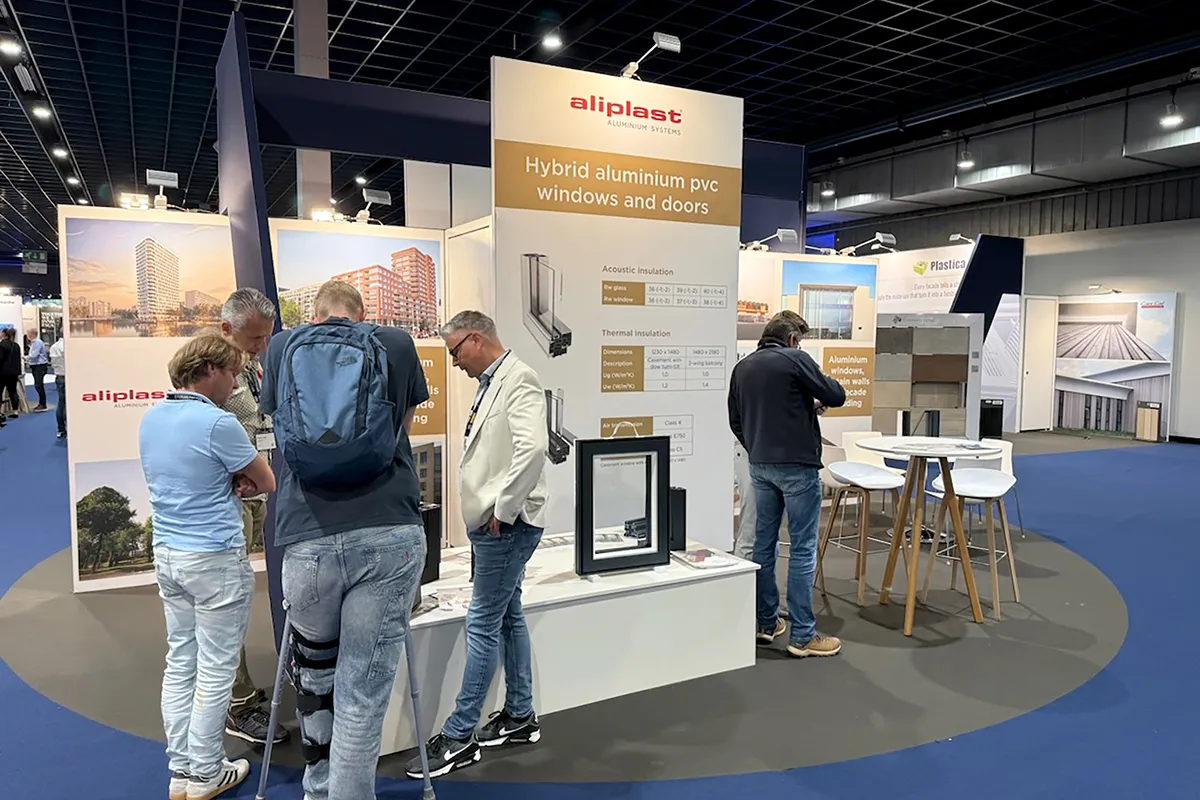
A Dutch first on Aliplast’s stand at Future Facade. “With the Refine system, we combine the best of both worlds,” says Marc Mulders, sales manager at Aliplast, with pride. “At the heart of the system is a plastic profile, fitted on both sides with an aluminium outer shell, which is itself slightly thicker than that of a traditional all-aluminium window frame. Combined with bonded glazing in the opening sash, this creates a very robust assembly. In terms of structural performance, the Refine system is almost on a par with an all-aluminium system, while also offering all the architectural advantages, such as slimmer detailing, clean lines and more colour options compared with plastic. The plastic core, meanwhile, makes the system easier and faster to manufacture than an all-aluminium system, giving it a more competitive price point. In the time it would typically take a façade contractor to manufacture one all-aluminium system, they can produce four windows using our Refine system. That is what façade contractors in Spain, where we have been supplying the system for five years, are demonstrating. They can significantly increase production with the same workforce. In view of the challenges ahead, it is a win-win.” The innovative Refine system did not go unnoticed by visitors and other interested parties. “We have even had a few competitors come by,” says Mulders with a smile.
Aliplast’s hybrid Refine system attracted plenty of attention on its stand.
Made in Austria: HPL panels from Fundermax
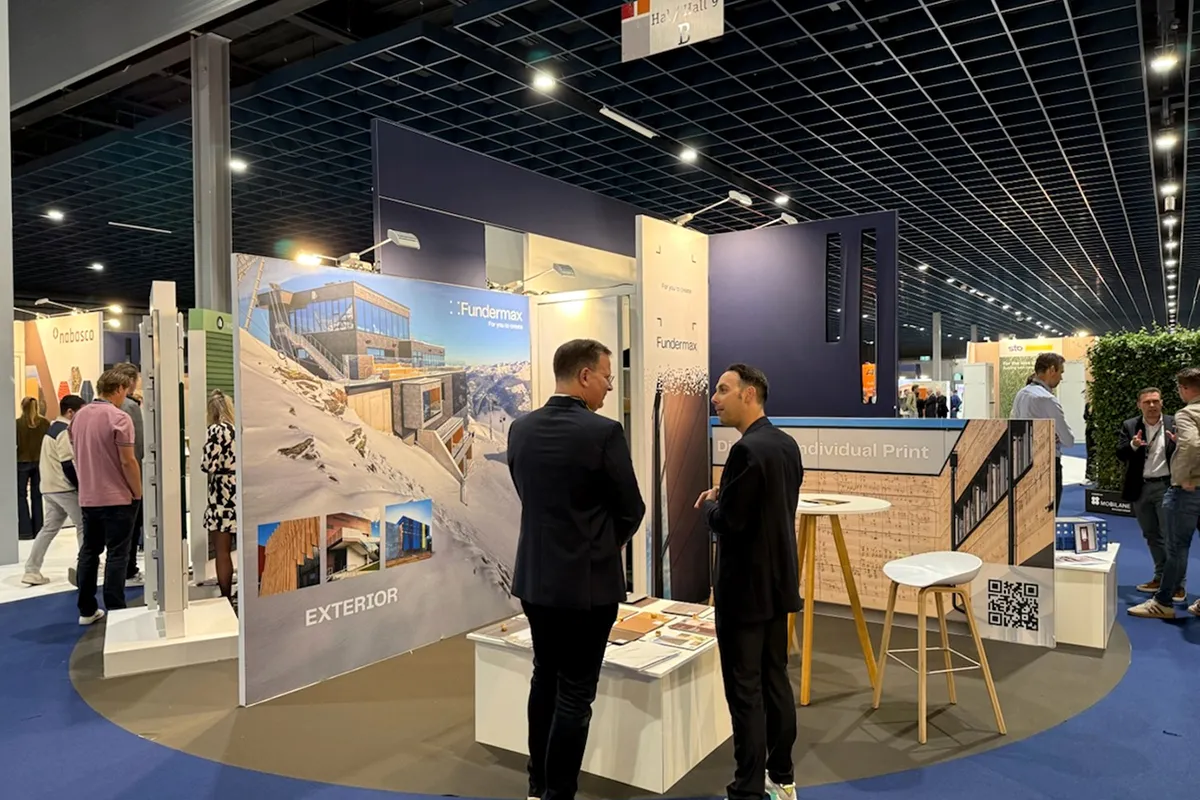
Key themes at Future Facade included sustainability and the circular economy. These have been central to Fundermax’s work for years. The Austrian family-owned company manufactures sustainable HPL laminates from natural raw materials at modern production facilities in Austria and Norway. “Our products have been available in the Netherlands for more than thirty years, but more recently we have established our own representation in the Benelux, based at the factory,” says Frank De Langhe, sales & prescription manager at Fundermax. Fundermax HPL panels are characterised by their special weather resistance, UV stability and exceptionally long service life. “Everyone knows the high quality of our products. Here at the exhibition, we are mainly highlighting our extensive service package and the option of bespoke work, even in very small batches. We are a privately owned family business, which means we are genuinely there for the customer. We are rightly proud of that. We have our own cutting service, for example, and can supply bespoke digital prints on request. This opens up new creative possibilities for architectural concepts and corporate design in façade design.” Fundermax’s digital printing is a proven technology, already used on numerous projects across Europe.
Made in Austria: HPL panels from Fundermax
Circular façade products on Innodeen’s stand
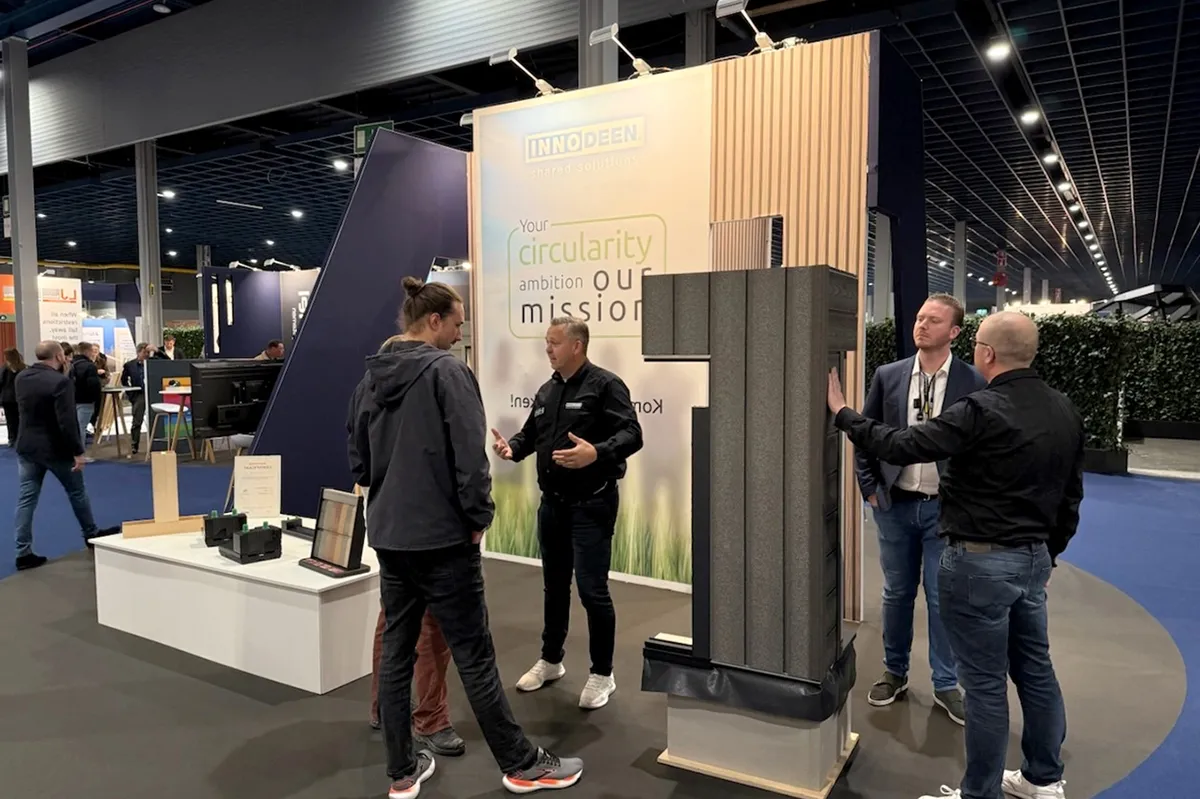
Innodeen presents itself as a manufacturer of innovative, sustainable bespoke solutions using recyclable plastics and biocomposites. Visitors to Future Facade could explore, among other things, its extensive range of DTS thresholds. “The thresholds are fully circular and made from 90 per cent recycled material,” says Roald Haneveld, technical adviser at Innodeen. “We supply versions for timber, plastic and aluminium internal and external frames. The thresholds fit perfectly with any detail, regardless of the rebate system.” Haneveld also drew our attention to samples of DBP Siding. “It is a biocomposite cladding made from 100 per cent residual waste according to a proven recipe, consisting of 70 per cent wood fibre and 30 per cent polypropylene (PP). The wood fibres come from unpainted demolition timber, end-of-life pallets and PEFC-certified waste streams, while the PP is selected from household PMD waste.” As if that were not enough, the stand also featured a mock-up of the weather-resistant DBP installation frame. “We manufacture installation frames to measure from Durodeen, a thermosetting plastic that is impervious to water and moisture and has a high insulation value. We can also add a rebate to the frame and colour the front black, eliminating the need for foil.”
Jansen AG bridges past and present
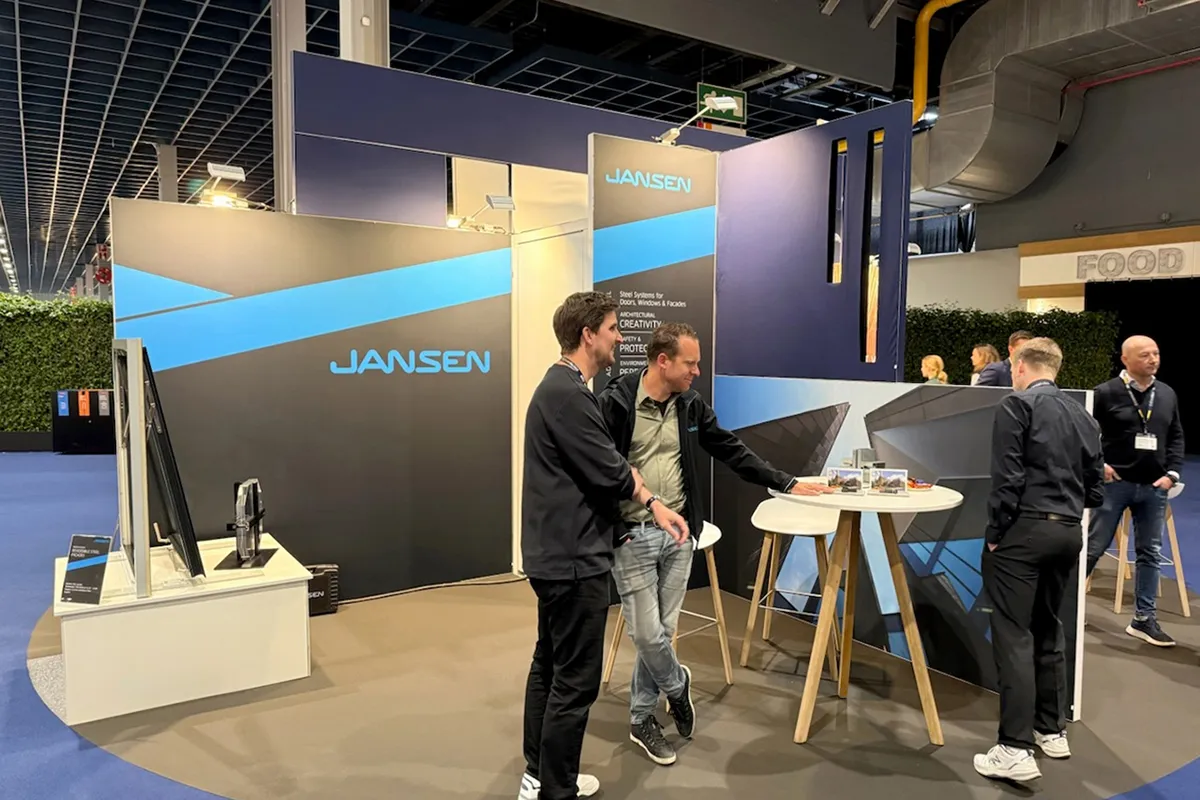
Did you know that the steel Jansen Viss profile has been around for almost sixty years, and that the system’s foundations are still highly relevant today? “The system has hardly changed over the years,” says an enthusiastic Thijs van Oostrum, architect adviser at Jansen AG, at the company’s stand during Future Facade. “The first version of the profile is still usable and can be adapted to current standards with minimal modifications.” This was demonstrated in the ‘Maze of Innovations’, where the Viss profile’s history was on display. “That does not mean we have stopped innovating our systems, but we do so with sustainability and circularity in mind. The familiar Viss groove has not changed over the years. We believe in ‘dry’ connections. Welding compromises reusability and structural performance.” At its own stand, Van Oostrum showed us the refurbished Janisol window profile, salvaged from a project dating back many decades. “We retained the non-thermally broken frame profile and upgraded it to a thermally broken profile. Another example of circularity in action.” Van Oostrum says that the original opening sashes could also be upgraded in this way, without affecting the design. Finally, he pointed out a Viss prototype with a face width of just 40 mm. “It is purely intended to gauge people’s reactions,” he added.
Eye-catching concepts from Schüco
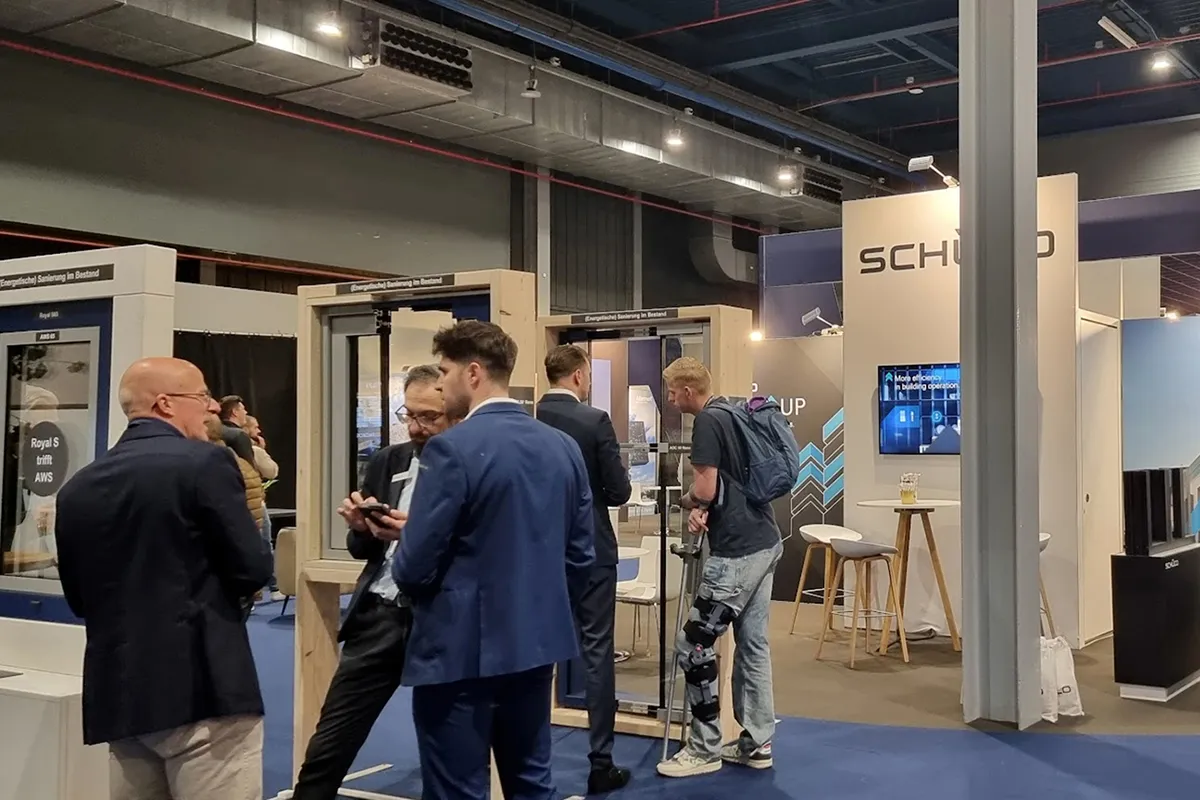
It was hard to miss Schüco at Future Facade. In addition to its sizeable stand, the systems supplier welcomed guests in its own lounge and featured prominently in the ‘Maze of Innovations’ with its groundbreaking Grid2Shell. “This structure can be used to build fully glazed curtain walls and rooflight structures,” says Michiel Prijs, Marketing Manager at Schüco Nederland. “The nodes can be engineered at different angles, making extreme parametric forms possible.” Schüco also presented a prototype of a cost-effective sliding door and an innovation still at the research stage, the Minimal Wall. “It is a smart combination of glass and aluminium that delivers extra load-bearing capacity through a special adhesive technology. This makes it an interesting development for façades with a lower material content,” says Prijs. As part of its Value Up strategy, Schüco also showcased three elements on its stand, each aimed at a different renovation scenario. And, as if that were not enough, the systems supplier also hosted the morning programme in the theatre on 8 May, featuring speakers of international standing from within the company. “We hope we have inspired visitors to work together to tackle the challenges facing the sector.”
Flexible façade solutions from Solarlux
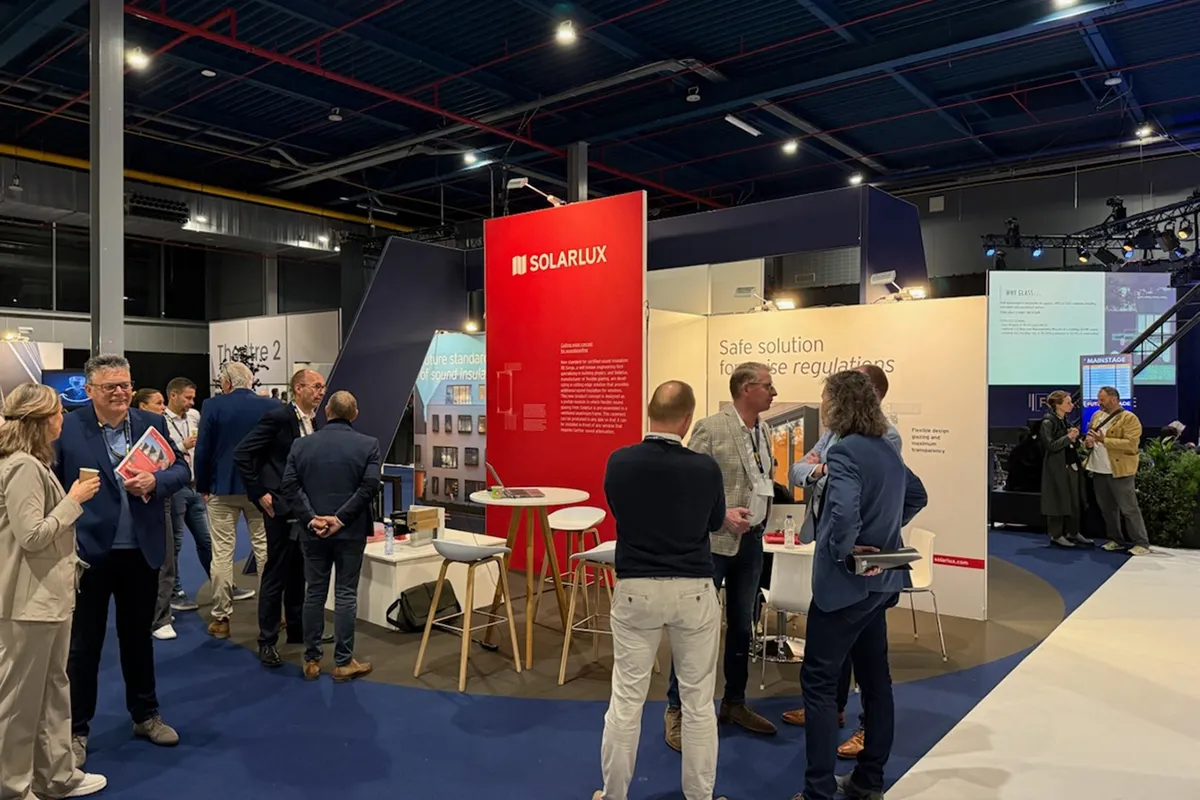
Solarlux presents itself as a pioneer in flexible façade openings. At Future Facade, it highlighted international legislation and regulations on noise levels at façades. “Noise control is a topical issue in construction, particularly in areas with heavy traffic or densely populated urban environments. However, the relevant legislation is not consistent across all countries, and even in the Netherlands there are regional differences,” says Eddy Weijers of Solarlux. “Our flexible second-skin solutions, such as the Modular system, balcony glazing and Ecoline M, address this. They not only drastically reduce ambient noise, but also improve thermal insulation and enhance the building’s appearance. And when combined with the cleaning hardware, the outside of the façade can be cleaned from indoors. This also helps save on maintenance costs.” With noise control in mind, Solarlux gave visitors a preview of its new Casement Window, a modular window assembly with double elements for both new-build and renovation projects. “This innovative concept allows the façade to be configured flexibly to suit individual requirements for acoustic and thermal insulation. The system provides additional sound insulation at the façade and can also be opened to ventilate the space behind it. It opens inwards, allowing it to be cleaned from inside.”
Swisspearl: creative with fibre cement
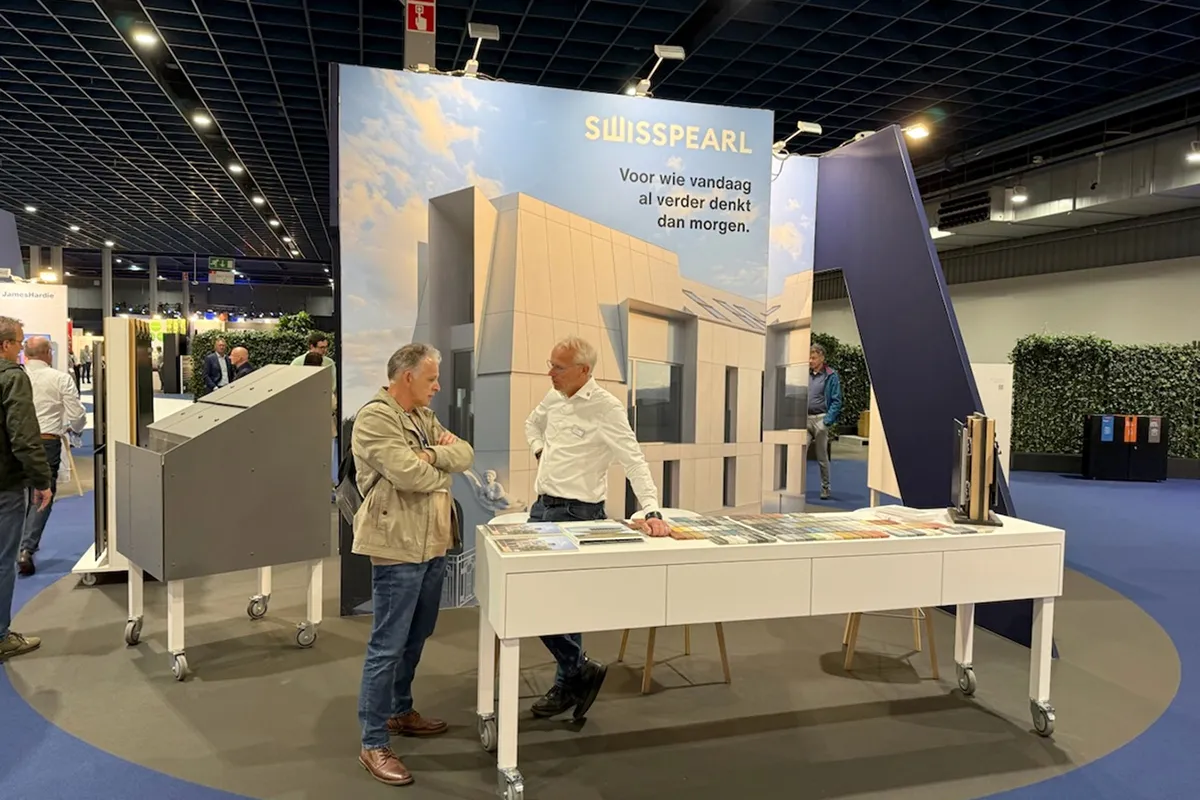
Swisspearl’s stand was busy throughout both days of Future Facade, not only with its fibre cement products but also with interested visitors. For years, Swisspearl has established itself as an artist in the fibre cement industry, using creative panels to give architects maximum design freedom. Its range also includes concepts that combine different functions, allowing architects to experiment with form, aesthetics and functionality. At the exhibition, the manufacturer presented several innovations in these areas, including the Tectolit 5e façade and the Closed Corner closed-corner solution. The Tectolit 5e façade is a concept in which the façade panel flows seamlessly into the roof, bringing the roof and wall into visual harmony. The concept also allows for flush integration of (coloured) solar panels in both the façade and the roof. Tectolit fibre cement panels can be used on roofs with a pitch of 15 degrees or more. With Closed Corner, Swisspearl now also offers a closed-corner solution for ventilated façade construction. At the corner of a building, the panels are mitred, so the edge of the panel is no longer visible and there is no need for a corner profile. Finally, Swisspearl offers maximum creativity with free-form shapes, in which the panels are formed by hand at the factory
Inspiring with the Trespa Standaard
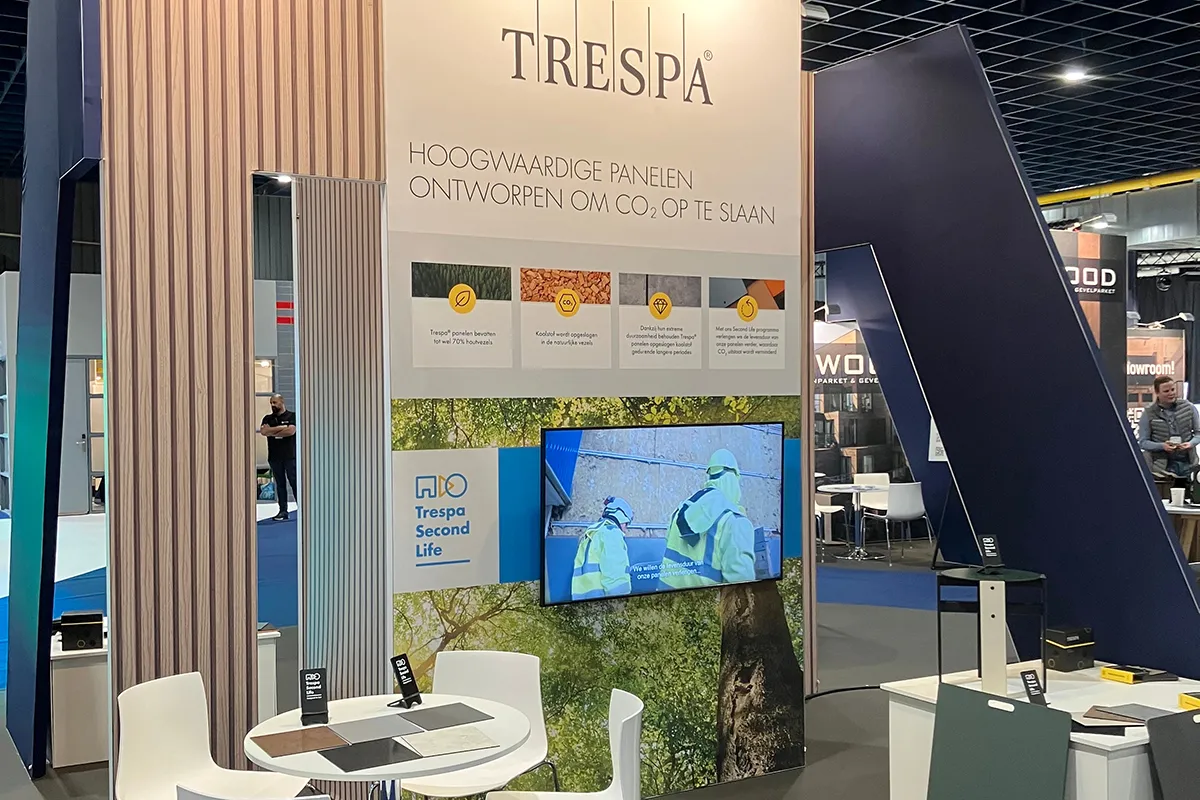
The Trespa stand was impossible to miss during Future Facade, positioned directly on the route from the entrance. “A strategic and deliberate choice,” says Marco Beelen, regional manager for the Netherlands, the UK and Ireland at Trespa. “We want to inspire architects, façade builders, designers and clients with our versatile products, but above all, equip them better to make responsible material choices. With objective and verified data. We call this the Trespa Standard, which makes everything verifiable through a proven environmental product declaration for each panel. Our products are basically made up of 70 per cent pressed wood fibres, which absorb and store CO2, helping to reduce CO2 emissions. Through our ‘Second Life’ programme, we retain that carbon for as long as possible. At the end of their service life, we take our products back free of charge and give them a second life in an application other than on the façade.” Visitors to the exhibition could experience the tangible results of the ‘Second Life’ programme for themselves. For example, some of the furniture on the stand was made from used sheet material. “This keeps the stored carbon locked away for longer and prevents waste.” Finally, Beelen gives us a glimpse of the product catalogue and says: “With our extensive range of designs, unique patterns, rhythms and depths, we can also meet the wishes of every creative mind. And that, for a lifetime, with virtually no maintenance.”
Visitors experience the Trespa Standard at close quarters.
Sustainably enhanced softwood from Gras Wood Wide
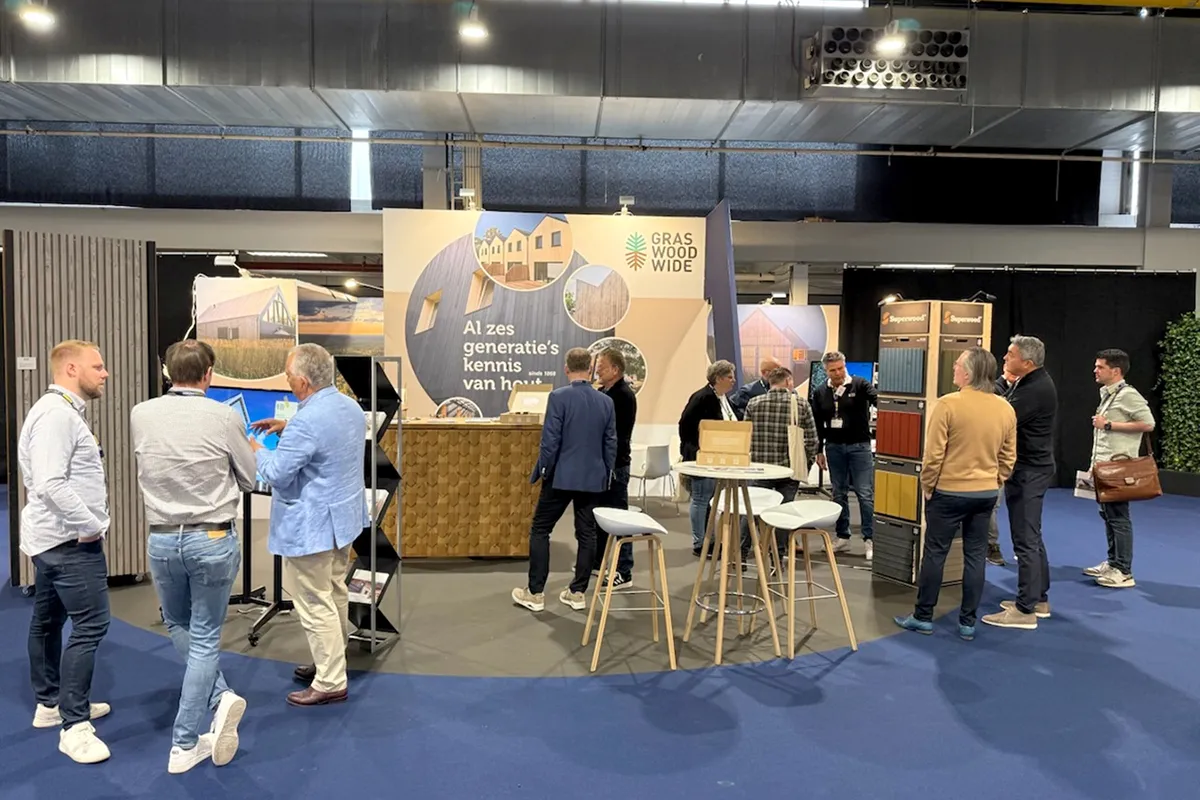
The pleasant scent of enhanced softwood spread across the Future Facade exhibition floor like an invisible current. It drew many visitors unwittingly to the spacious Gras Wood Wide stand, where the company presented its complete façade range, including a genuine first. “Lunawood is a product that has more than proved itself over the past twenty years. It is a worthy alternative to tropical hardwood, is harvested relatively close to home and is highly relevant in 2025, thanks in part to its excellent fire performance,” says Ruud Smits, sales manager at Gras Wood Wide. The new Superwood was launched at Future Facade. “It is a new product in the Gras Wood Wide range from a manufacturer in Denmark, for which we recently became the distributor in the Netherlands. Scandinavian spruce is treated for durability in a different way from Lunawood. It is impregnated under pressure right through to the core, using a CO2-neutral production process. The wood is then profiled and can be finished in virtually any colour. Superwood has a technical service life of around 60 years. The product has therefore been received with great enthusiasm. Before the exhibition, we shared some information here and there, and that has already led to a first project. It is being used on the façade of eleven homes in Venhuizen.”
Question about this story? Ask your question
Companies in this story

Keep following this
Get an email when a new story is published. No account needed.
- SubjectGeneral
- CompanyAliplast
- CompanyFuture Facade
- CompanyINNODEEN BV
- CompanySolarlux
- CompanyGras Wood Wide







