








How to get started with innovation

For many decades, construction has seemingly trundled along. Today looks like yesterday, and tomorrow like today. But appearances can be deceptive. Step by step, a great deal has changed over the past few decades.
Consider the many innovations in glazing, tighter insulation standards, the integration of building services into façades, high acoustic performance alongside ventilation openings and specialist glazing, the arrival of PV in façades, shifts and diversification in the use of materials, the adoption of BIM, and the list goes on.
Change is accelerating
More importantly, there is certainly no sign of it stopping any time soon. In fact, change is continuing at an ever-increasing pace. When it comes to climate change, we are only at the start of an exciting challenge. Circularity is already on the agenda, but it will keep us busy for many years to come. ‘You ain’t seen nothing yet’. Current questions include how we will cool our buildings. Night-time ventilation is more sustainable than active cooling. The same applies to lighting, which, like ventilation, is linked to the need to develop healthier buildings. I have covered fire safety in Gevelbouw several times, and the Grenfell fire in London made clear just how important it is for façades. As for process innovation, I see the need for industrialisation as an unavoidable challenge. We have to do it!
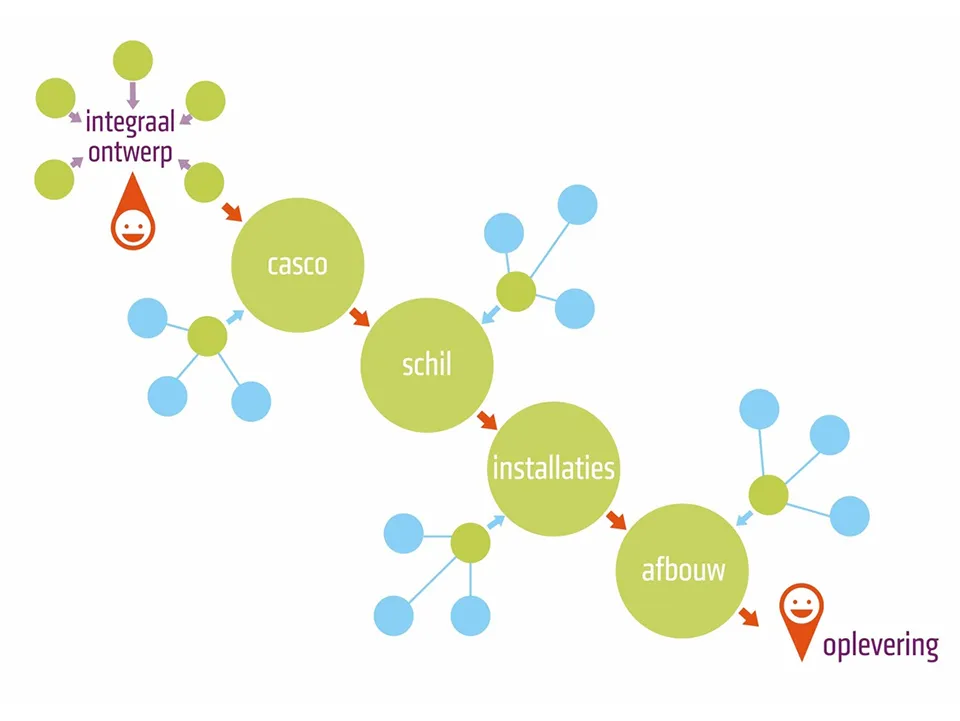
That is why, through Slimbouwen (see box), I have been advocating for years that buildings be divided into the structure, the building envelope, services and fit-out. The word ‘envelope’ itself makes clear the prominent role played by the façade in this breakdown. Slimbouwen enables off-site production and also strongly supports circularity. It is therefore no surprise that Slimbouwen is gaining ground.
Adapting is inevitable
My point here is that we need to be able to manage the major changes together. The construction process is fragmented, and everyone needs to be able to take part in the transition. Where that does not happen, roles will shift. Latent threats affect everyone. Architects and contractors will have less work if buildings are produced as industrial products. Or might industrialisation develop in a more differentiated way, with industrialised structures and bespoke façades and fit-out? The façade sector need not be too concerned about market volume. Alongside changes in construction technology, future challenges lie in safety and sustainability, industrial production, the integration of services, the development and organisation of circularity, and new business cases such as ‘façade as a service’. These are all major issues that everyone can prepare for. And must prepare for, because opting out is not an option. We have to adapt.
Knowledge
The key to keeping pace with major changes is ‘knowledge’. You gain knowledge through courses, reading, bringing in young talent, and, above all, actively engaging with trends and themes. Think things through regularly, take part in think tanks, conferences and so on. That is the first step. In doing so, you build awareness, which becomes the driving force that spurs you into action. Knowledge also gives you insight into the steps your company should take. It provides direction for your innovation project, while also giving you a sense of the obstacles ahead. This, in turn, is what drives you to start making changes in good time, rather than waiting until the need becomes urgent.
Change is a process
Change is a process in its own right, one that will unfold over several years. An action taken today may not have the desired effect for another three years or so. I am not talking about a minor adjustment, but about fundamental innovations. In theory, a technical change can be organised quickly. But if you need to bring an organisation and its environment, or system, on board, it takes a process-based approach. This includes unlearning old routines, taking courses and training, implementing IT changes, changing the way you work with customers and suppliers, making mistakes and overcoming them, and so on. Simply waiting can prove costly.
What comes before innovation
I have previously written several times about promising innovation processes. A structured approach, briefly outlined in the box, is the essential basis for a successful project. I have researched this.
It is worth preparing thoroughly for an innovation process and familiarising yourself with the theoretical models. I often discuss this with business owners, covering such things as objectives, the route to take, investment in time and resources, generating ideas and so on.
I realise that, from my perspective, this concerns a large group of companies, but from the market’s point of view, it is ultimately a minority. Most are not there yet. That is nothing to be ashamed of, it is simply reality. They only start making plans once they realise that they need to take action. There is little point in going into the ‘how’ and ‘what’ in depth if the ‘why’ has not been answered.
Build a vision of the future
The advice, then, is to set aside time to build a vision of the future. Ideally, draw on a sounding board of people from outside the company to explore the implications of emerging technologies, changing values among clients and users, who are often not the same people or companies, what is coming our way in terms of regulation, which trends matter, and so on. Read books on the subject, browse the internet, keep up with developments in technology and at relevant ministries, and so on. Sometimes it works very well to do this with other companies, and apart from the time invested, this stage does not cost much. Together with partners, I regularly organise awareness sessions, and there are all kinds of techniques for bringing together a group of complementary business owners and the external people involved to build a vision of the future. Above all, start reading about topics such as climate change, health, safety, new revenue models and forms of finance, and draw inspiration from them for your own business. You may need to make yourself focus on innovation, and encourage colleagues and business advisers to do the same. In that case, bringing in an expert can be very effective.
I hope this helps business owners, companies and readers take an accessible first step towards the essential task of preparing for the future.
Jos Lichtenberg
Emeritus professor at TU Eindhoven, Co-initiator of Off Road Innovations, Chair of Slimbouwen, Chair of Houtsystemen
Structured innovation
One aspect of structuring an innovation process is a logical step-by-step plan. Below is an example of a six-phase plan whose foundations I have been using for 40 years. The plan relates to product or service development, but can also help bring structure to innovation processes more broadly. It has six phases, with a go/no-go decision point between each phase. There is also a point of no return. You can spend some time going round in circles within a phase, but the intention is emphatically not to go back to a previous phase.
Slimbouwen
Slimbouwen is a process innovation that provides a stepping stone towards an industrial process. To achieve this, the process is divided into four parts: Structure, Envelope (façade and roof), Services and Fit-out. The parts are arranged so that they can be completed one after another, rather than overlapping. In a traditional process, for example, the building services contractor has to return to the site many times to complete the work. Slimbouwen provides a construction method that ideally allows the contractor to visit the site only once, to install the entire building services system in one go. The techniques that make this possible also encourage physical separation between the four parts. As a result, Slimbouwen projects are easy to adapt. At ‘end of life’, they can be dismantled, with their components separated as a basis for circularity.
Question about this story? Ask your question
Keep following this
Get an email when a new story is published. No account needed.
- SubjectGeneral







