








Pushing the boundaries of hardwood
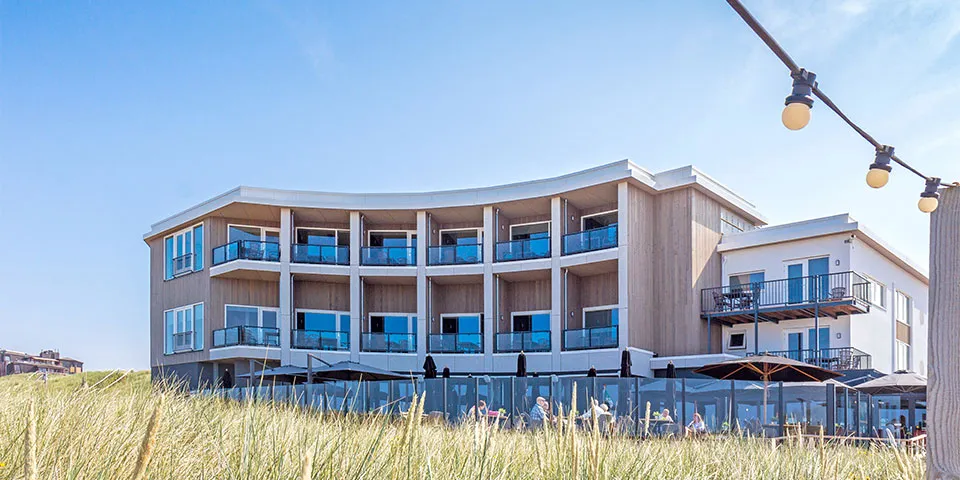
Over the years, Houthandel van Dam has grown into one of the Netherlands’ most pioneering hardwood importers. Its ambitions are impressive. A conversation with director Erik Leeuw about its sustainability ambitions, its exclusive partnership with the largest FSC concession in French Congo, and the position Fraké has now secured in the Dutch market.
Durability class 1
More than twenty years ago, Houthandel van Dam already saw a bright future for the thermal modification of wood. “We started by ‘improving the durability’ of spruce and pine,” Leeuw says. “Eight years ago, we added Fraké, which at the time was far from a commercial product. Fraké is a fast-growing species with a naturally low durability class of 4. Thanks to a specific thermal modification process, we are the only company able to supply Fraké in durability class 1. The wood also takes on an appearance similar to much more expensive American walnut. A win-win.”
Fraké is now widely used for façades and has taken the place of Western Red Cedar. (Image: Nadine Korringa)
Fire class D
Fraké is widely used for façades and, according to Leeuw, has now taken the place of Western Red Cedar. “In terms of both price and requirements (building regulations and fire performance), Fraké is an interesting alternative. In its standard form, ‘African oak’ already meets fire class D, but it can also be treated to meet class B, the most demanding application for ‘end use application’. We supply Fraké for façades in three tested façade build-ups that meet fire class D for ‘end use application’.”
More than twenty years ago, Houthandel van Dam already saw a bright future for the thermal modification of wood. (Image: Nadine Korringa)
A model of forest management
The source and origin of the wood are just as important to us, Leeuw continues. “We aim to use as much sustainably produced wood as possible and are always looking for the best quality. That is why we have an exclusive partnership with our supplier in French Congo. Congolaise Industrielle des Bois (CIB) knows how to manage a forest, and is a true model of best practice. For more than fifty years, they have harvested and regenerated the forest without ecological impact. There are no clear-cut areas.” Houthandel van Dam works with SWM, a major thermal modification company in Finland, to modify the wood.
Houthandel van Dam is currently carrying out a Life Cycle Assessment (LCA) of the wood. “We want to know exactly what the total CO2 emissions are, from the moment a tree is harvested to the delivery of a finished product to the construction site,” Leeuw explains. “This also involves measuring exactly how much CO2 the wood has absorbed during its growth. We expect the result to show net positive CO2 emissions, and hope to complete the process by the end of this year.”
Question about this story? Ask your question
Keep following this
Get an email when a new story is published. No account needed.
- SubjectGeneral







