The best façade is not automatically the most sustainable
Text and images Jaarbeurs B.V.
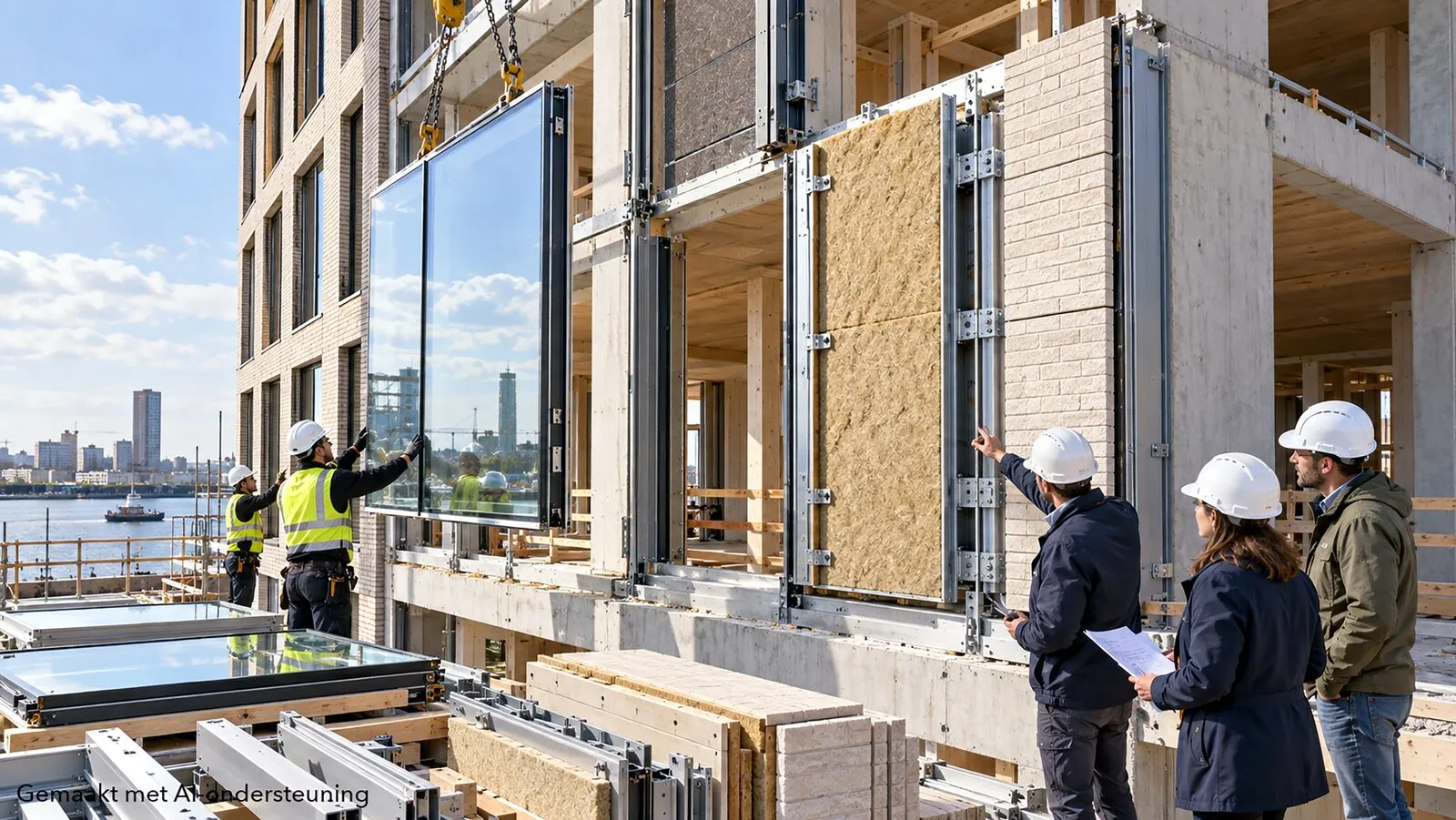
Over the past fifty years, the façade industry has solved almost every problem by adding something. More insulation, better glazing, extra membranes, coatings, solar shading, ventilation systems, sensors and complex fixing systems have made building envelopes more energy-efficient, comfortable and safe. That success now has an unexpected downside. The most technically advanced façades may be the hardest to dismantle at the end of their service life.
The paradox of better performance
Research by TU Delft highlights how increasingly stringent requirements for energy use, comfort and safety have led to façade systems that bring together ever more functions. At the same time, strategies for disassembly, reuse and high-quality recycling remain underdeveloped. The façade performs better in use, but that does not automatically make its components suitable for reuse.
This exposes a blind spot in the sector. Façade sustainability is still often demonstrated by a low U-value, favourable environmental performance or a high proportion of recycled material. Those figures do not always tell us what happens after thirty or forty years. Can the glazing be replaced separately? Can profiles be removed without damage? Will product information still be available? And who will be responsible for taking products back?
The surprising development is that Europe is making precisely these questions part of building performance. From 2028, the whole-life carbon impact of new buildings larger than 1,000 square metres must be calculated and stated on the energy label. From 2030, this will apply to all new buildings, and the Netherlands will also have to introduce limit values. Production, transport, maintenance, replacement, demolition and waste processing will all be included.
This means that the lowest energy demand is no longer the automatic winner. A complex façade system can perform excellently in use, yet still have an unfavourable impact if components need frequent replacement or are difficult to recover. Conversely, a simpler, repairable system may perform better over its entire service life.
Decisions before the design is fixed
This shift is changing roles across the construction supply chain. Architects can no longer consider materials, dimensions and appearance separately from connections and replaceability. Building companies must translate sustainability ambitions into a feasible façade concept. Contractors must now consider disassembly and future maintenance alongside scheduling and installation. Suppliers are expected to provide not only a product, but also reliable information about its origin, service life, repair and take-back.
This calls for earlier collaboration. If the supplier only comes on board after the tender, key decisions have often already been made. The façade of the future therefore does not start with the choice of materials, but with the question of which functions really need to be combined and which components must remain independently replaceable.
The next major innovation in façade construction may not involve adding anything at all. Perhaps progress lies instead in fewer components, straightforward connections and a façade that does not have to disappear after its first life.
The challenge for the façade industry is shifting from ever more technology to smarter design for the whole service life. Energy performance, material use, disassembly, reuse and maintenance must be considered together from an early stage. This changes not only the façade itself, but also collaboration between architects, building companies, contractors and suppliers. How the sector will translate this new reality into materials, construction methods and workable solutions will be a central theme at BouwBeurs from 1 to 5 February 2027. BouwBeurs is the largest trade event for the Dutch construction sector, bringing professionals together to explore innovation, circularity, digitalisation, industrialisation and future-proof construction.
Admission is free for Gevelbouw readers. Register at BouwBeurs.nl/registreren using code Gevelbouw.
Question about this story? Ask your question
Keep following this
Get an email when a new story is published. No account needed.
- ThemeFacade design and construction
- SubjectTheme