








Low-cost or most economical?
I have written for Gevelbouw before, sometimes about façade fire safety, sometimes about innovation in a broader sense. This time, the two subjects come together. Clients are setting new requirements, and fire safety, like other aspects that affect a building’s operation, is increasingly taken into account. Both façade system providers and clients, whether owners or users, can benefit from this.
What stands out is that professional clients are increasingly looking at whole-life costs. Not just construction costs, but operating costs during the use phase. Not just Capex, but also Opex (capital expenditure versus operating expenditure).
The traditional construction process
In a traditional construction process, selection is still mainly based on price. The client commissions a design and selects a contractor through competitive tender for its delivery. Once the contract has been awarded, the contractor can review the prices it used as the basis for its tender. Any reduction increases its margin and provides additional risk cover. As a supplier, you may feel as though you have been put through the wringer again, but given the context, this is an entirely logical process. The fact that price pressure can also come at the expense of quality has often been discussed and is widely recognised. Strictly speaking, the price is based on previously specified minimum requirements, but under price pressure both suppliers and clients are sometimes willing to make concessions. This is especially true when the winning contractor’s lowest bid still exceeds the client’s budget and savings have to be made.
MEAT
Increasingly, competitions define a selection process in which price is not the only criterion. Sustainability-related issues in particular are increasingly identified as areas in which bidders can score points, with those scores carrying a set weighting in the assessment. This alone gives façade contractors and suppliers reason to develop proposals supported by evidence. When operational benefits are also taken into account, this is known as the Most Economically Advantageous Tender (MEAT).
A member of the project team
More specifically, I want to emphasise in this article that suppliers with sound arguments are also welcome to contribute at an early stage. Perhaps this means helping to shape the façade requirements. The façade industry has a wealth of knowledge that is valuable to clients. It makes an enormous difference whether or not you are involved early. Do you sit back and wait for a contractor to request a price based on a few basic requirements that almost anyone can meet?
Or do you speak to a client and/or their architect at an early stage, explaining the choices and options available and the trade-offs they can make? This allows the client to draw up façade requirements with much greater awareness, or perhaps even to name you as their preferred supplier. In a Slimbouwen environment, where I was active as an initiator and where some 150-200 buildings have now been completed, the façade contractor is even a key member of the project team preparing the entire project.
Value
Benefits during the use phase may relate to aspects that are not always quantifiable. Everyone wants a more attractive building, but its value is difficult to justify economically. Even so, good design is highly marketable. Not everything has to be justified in commercial terms. The entire art world is not driven by costs. A painting costs money to buy and takes time to create, but its sale price is not based on those costs at all. Its value is determined by what the customer is willing to pay, and that is driven largely by sentiment, with little commercial justification.
Net present value
There are many topics relating to façades where operational benefits can be expressed as net present value. Total Cost of Ownership (TCO) is relevant here too. This may mean reduced maintenance or energy savings. Or it may mean greater comfort and better health, leading to lower absenteeism or better average user performance. Considerable research has already been carried out on this. Investment in flexibility, or adaptability, has also attracted growing interest. For this article, I want to highlight one particular topic: fire safety.
Fire safety
Buildings must meet fire safety requirements. Façades are particularly in the spotlight because several major fires in recent years have caused considerable human suffering and damage. In some cases, the façade acted as a kind of bypass for fire spread, despite the presence of a fire-resistant floor. A fire that should have been confined to one floor can then spread across several floors, with far greater suffering and damage as a result. A façade that performs better than required by the Building Regulations, and is probably somewhat more expensive than a standard product, can be fully justified if it prevents or reduces suffering and damage.
There is no certainty that a building will ever experience a fire. In fact, we all think it will not happen to us. Yet statistics show that the risk is real, and the larger the project, the greater the chance of an incident occurring somewhere. It is certainly possible to calculate the potential damage and the reduction in risk. To this end, a foundation was established just over a year ago, Stichting Economie van Brandveiligheid, which is actively carrying out research to develop a basis for economic decisions relating to fire safety. The fact is that designing for safety can genuinely reduce risks, which naturally brings operational benefits.
Let us assume that only material damage is involved. In analysing this, it is important to take into account that the damage is often much greater than expected. We usually think about the cost of repairing the building and replacing its contents, but processes take place inside the building. These may be severely disrupted for a time or come to a complete standstill. Customers may be unable to access services and go elsewhere, to competitors. The surrounding area may be affected by evacuations and traffic congestion. This can sometimes lead to claims. The area may need to be cleaned, and so on.
Examples show that, by calculating the probabilities of different fire scenarios and the realistic scale of the associated damage, a higher investment in the façade can be justified. And to return to the example
of decisions based on sentiment when buying art, safety also has an emotional value, namely a sense of security.
What does this mean for façade contractors and suppliers?
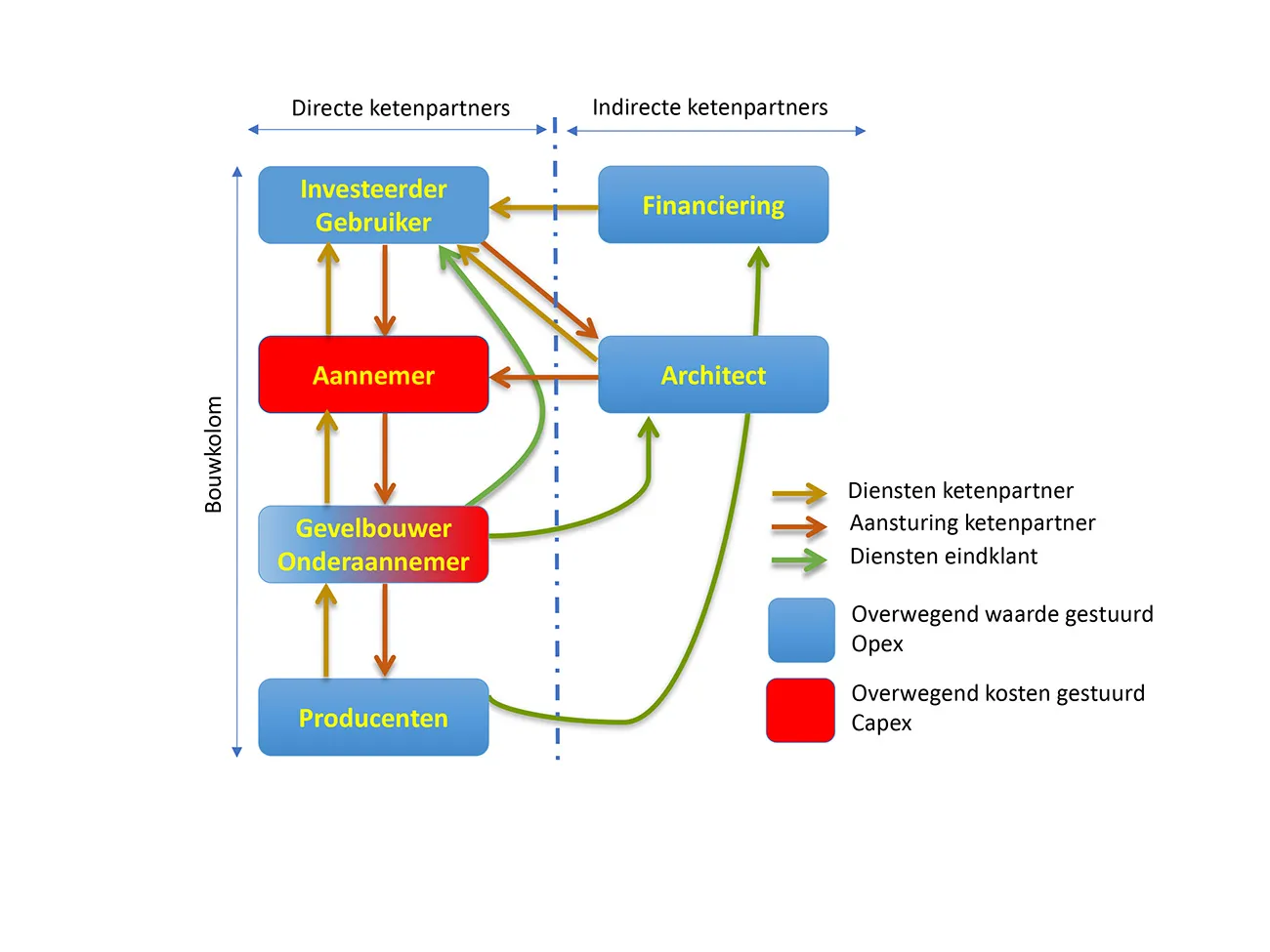
In a traditional construction process, this subject does not easily come up. But if, as a façade contractor or supplier of façade components, you can present a convincing business case, you can help the client choose a particular direction before the design is complete. At that stage, you often have no certainty of winning the contract, but you do become an important source of expertise and build a great deal of goodwill, making project partners more inclined to award you work. In a Slimbouwen process, suppliers can also be contracted at an early stage on the basis of their expertise and an open-book budget. In these projects, the client is interested only in parties that bring knowledge to the table.
The above has significant implications for suppliers. Many companies in the façade sector are primarily focused on delivery: engineering, manufacturing and installation. Companies that want to take a leading position, as described in this article, must also invest in developing expertise and in R&D, as well as in people who can communicate an integrated proposition to clients. This requires investment, but projects of this kind also deliver margins that justify it. In fact, more and more projects will make this way of working standard practice. You would be wise to be among the leaders.
More information?
Those wishing to explore this approach to the market can join Living Lab 040 (www.livinglab040.nl), a platform that addresses these kinds of themes and new business models alongside many other innovation-related topics. Anyone interested in the specific example of fire safety can contact www.economievanbrandveiligheid.nl. A course related to the example described above, ‘the economics of fire safety’, is currently running, and registration has recently opened.
Jos Lichtenberg is Emeritus Professor of Building Innovation at TU/e, initiator of House of Tomorrow Today and the Slimbouwen movement, and, together with Monique Donker, of Living Lab 040. He is also chair of Stichting Economie van Brandveiligheid.
Question about this story? Ask your question
Keep following this
Get an email when a new story is published. No account needed.
- ThemeSafe and verifiable facade construction
- SubjectGeneral







