








The value of fire safety
Fire safety can seem difficult to sell. The impact of a fire is enormous, yet the likelihood feels low. Almost everyone assumes it will never happen to them. But is that really true? In this article, I explore the relationship between likelihood and the scale of the damage. The ‘economics of avoided damage’ provides an incentive to take fire seriously, and to consider how façades can help reduce risks.
Many people spend € 15,- on a lottery ticket every so often. The prospect of becoming rich overnight is tempting, despite the negligible chance of winning the jackpot.
By the same logic, it would make sense to invest a modest amount to reduce the likelihood and impact of fire damage.
In practice, when undertaking building work, we only meet the absolute minimum requirements: the Building Decree. Our regulations are not designed to limit material damage at all. With many weaknesses, they are aimed at reducing the risk of loss of life.
Industrial fires
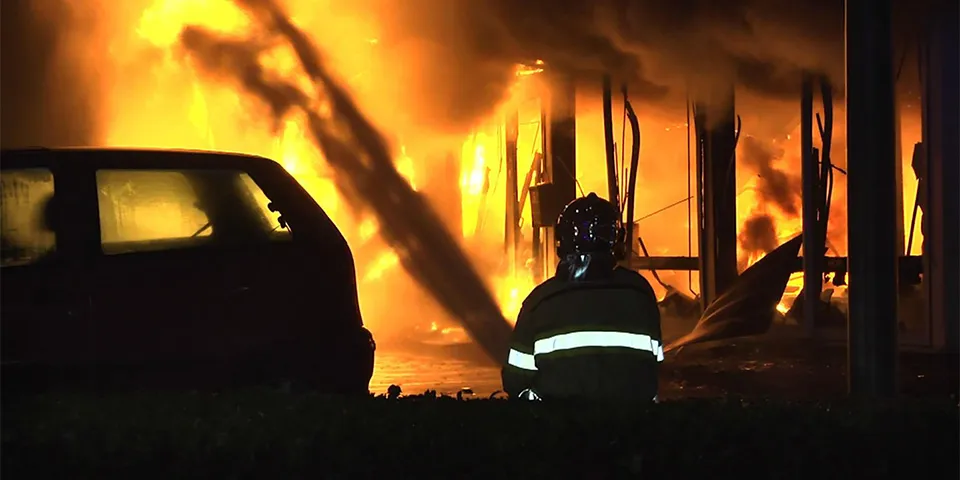
In many cases, industrial fires have the opportunity to take hold at night. There is no one on site to intervene early or raise the alarm. Fortunately, such incidents do not often result in casualties, but the damage is usually enormous, often many times greater than the insured amount. Industrial premises may contain combustible or explosive contents or stock, and there may also be a risk of smoke gas explosions due to, among other things, the building materials used. To avoid putting firefighters at risk, a deliberate, controlled burn-down scenario is often adopted, resulting in a total loss.
It is always assumed that the insurer will cover the damage, but is that necessarily the case? The insurer will first investigate whether the building complied with the specifications on which the policy is based. Was the façade built to meet fire safety requirements, or were savings perhaps made on the choice of materials at the last minute?
Were PV panels installed on a roof that does not meet fire safety requirements? Was the façade or roof later penetrated to install air conditioning? And was this properly reported? Were the insurance conditions, such as those relating to the outdoor storage of fire hazards, complied with?
Unable to recover
Even if the structural damage is fully covered, what about production equipment, machinery, computers and stock? These may be insured on a replacement-cost basis, but the company will have to move into another building, and machinery has a lead time.
Being unable to deliver ‘temporarily’ leads to reputational damage and enormous loss of revenue. Customers switch to competitors, while salary costs continue for as long as deliveries are not possible.
There may also be claims relating to environmental pollution, or from neighbours who suffer damage from smoke or other causes.
All in all, it is hardly surprising that half of the businesses that experience a serious fire fail to recover and cease trading within five years. The resulting financial and emotional damage affects the business owner, as well as employees and their families. Taking out adequate insurance and reducing risks are therefore also matters of CSR (Corporate Social Responsibility).
Likelihood multiplied by impact
The impact can be immense, but from a business perspective the calculation is, of course, ‘likelihood multiplied by impact’. The likelihood is indeed not very high, but it is considerably greater than the chance of winning the jackpot in the state lottery. To give you an idea, here are some figures:
Between 2000 and 2016, there were an average of 109 fires a year in the Netherlands causing damage in excess of € 1.000.000,- (as well as around 14.000 fires causing damage below € 1.000.000,-). The average total insured loss from the 109 major fires was € 467 million per year (source: NIVRE). That is in the order of 60% of the total direct damage of around € 800 million per year caused by fire (source: CBS StatLine).
And what about the wider social cost of a fire? Asbestos that has to be removed, toxic smoke that spreads, firewater that contaminates the soil, traffic disruption, the fire service having to respond, and so on. Loss of revenue and reputational damage have already been mentioned.
In the fire safety sector, it is generally thought that the actual damage is four times higher than the amount insured.
The IFV (Institute for Physical Safety) recently published an informative report on this subject (Eikenaar et al., 2018).
A building on fire
The Building Decree is not primarily intended to reduce damage. Nor does it guarantee personal safety. When called out, the fire service responds immediately, expecting to find a localised fire in a building after a few minutes. This might be a room or dwelling in a residential building, or a fire compartment in an industrial building. But at Grenfell Tower in London, two years ago, the façade system, with combustible façade and insulation materials, acted like a fuse, and by the time the fire service arrived, the fire was already completely out of control. This was not a fire inside a building, but a building on fire. Fire service equipment and response plans are not designed for this. The fire service does, of course, take action, but the situation can quickly become uncontrolled. In industrial buildings, where a fire has often been burning for some time before it is reported, ‘a building on fire’ is a frequent occurrence.
The façade as a medium
When a building is poorly designed from a fire safety perspective, the façade is often a source of fire spread. Poor façade design or connections can easily bypass internal compartmentation. With some attention to detail and material selection, this risk of fire spread can often be eliminated at relatively little extra cost.
The value of avoided damage
Suppose you face an annual 1 in 1,000 chance of a major fire, in which a significant part of the business burns down, causing damage of € 1.000.000,- multiplied by a factor of 4 (see above), or € 4.000.000,-. This gives you an expected annual loss of € 4.000.000,-/1,000, or € 4.000,-. Suppose a one-off additional investment of € 25.000,- (2.5% of the insured value) halves the likelihood of a fire. And suppose that, in cases where a fire does occur, the damage is limited to 50%. Statistically, you are then left with half of half the damage, or an expected annual loss of 0.5*0.5*4.000,-= € 1.000,-. That amounts to a benefit of € 3.000,- per year. Over a 40-year lifespan, this adds up to € 120.000,-. This is a highly profitable investment, though each case must be considered individually. This article is about the approach, and the example illustrates the value of this kind of reasoning. Any reduction in the insurance premium has not even been included.
Responsible
It is therefore economically justifiable to invest in fire safety. For façade suppliers, contributing their expertise offers an opportunity to stand out. Despite a higher price per square metre, it can be a positive point of difference for clients.
References:
• Eikenaar, dr. T and drs. C. Tonnaer, edited by R. Hagen MPA (2018), The social impact of fires, IFV, Arnhem, 28 June 2018
• VIVRE
• CBS Statline

Jos Lichtenberg | Emeritus Professor, TU Eindhoven | Chair, stichting Slimbouwen | Adviser and product developer, including through Off Road Innovations
‘The Economics of Fire Safety’ Platform
An independent fire safety platform is currently being established around this topic. The platform will soon publish a manifesto to promote the thinking set out in this article more widely across education, research, government and, of course, the market.
The group is still growing and comprises prominent stakeholders from research, education, property owners, residential consumers, the insurance sector and the fire service. The platform is supported by a number of manufacturers.
Question about this story? Ask your question
Keep following this
Get an email when a new story is published. No account needed.
- ThemeSafe and verifiable facade construction
- SubjectGeneral







