Fire class B and thermal insulation combined in a sandwich panel
A tough challenge? Certainly. Impossible? Definitely not! Increasing fire-resistance requirements for façades, set by the Building Decree and trade association VMRG, are driving the ongoing development of products such as sandwich panels. But if the products used in a façade have to meet a certain fire classification, how can you ensure they also meet the required insulation values without creating an extremely thick panel?
“One direct consequence of the devastating tower fire in England is that we have noticed English customers frequently using stone wool insulation in their panels, making it possible to supply a fire-resistant product. But Dutch customers are not so keen on stone wool,” says Willem-Jan Korsten, managing director at Weerter Paneel Industrie (WPI). “This is partly because the insulation values required in the Netherlands are higher than those in England,” he explains. “With a higher fire classification, it is harder to achieve the required thermal insulation value under the Building Decree.”
Rigid foam: high insulation value and European Fire Class B
“That is why we are more likely to turn to rigid foam as an insulation material. Despite its limited thickness, rigid foam insulation boards offer exceptionally high thermal performance.” Korsten explains that rigid foam ‘in itself’ is fundamentally combustible and therefore does not meet Fire Class A or B. “Teqtix Phenolic Solutions B.V. makes a foam called Insulphen, with very high compressive strength. The product has an extremely high density (80 kg/m3) and has recently achieved Fire Class B under the European classification system. When rigid foam is upgraded into products such as sandwich panels, which often have non-combustible finishes, the foam is enclosed. The result is a product that delivers high insulation values, retains dimensional stability and comfortably meets the required European Fire Class B.” Korsten calls it a win-win situation.
Proactive
He has noticed that, for most of the projects WPI is commissioned for, he can already be fairly certain that this type of sandwich panel should be used in the building. “Responsibility for this actually lies with our customers, but from now on we will proactively ask what requirements the building has to meet. We think it is important to give this proper consideration so that we can advise the customer on the right product.”
Certified sandwich panel
“As new products continue to come onto the market, including ones that can be bonded, we can improve our products,” Korsten explains. “We can only join the components of our sandwich panels by bonding them. Hard materials are easier to bond, so that is what we looked for. The result is this sandwich panel. It is not extremely thick, yet achieves high insulation values and meets European Fire Class B. Naturally, our panel has been thoroughly tested and meets all the specified requirements. We have therefore added another certified panel to our range.” Korsten adds: “This is typical of WPI’s approach: we combine the properties of different products to arrive at a solution that meets the customer’s wishes or the requirements set out in legislation and regulations. The possibilities are endless. In this case, we have contributed a façade component that keeps interiors cool in summer and warm in winter, while preventing fire from spreading.”
Attractive design, with a focus on sustainability and fire safety
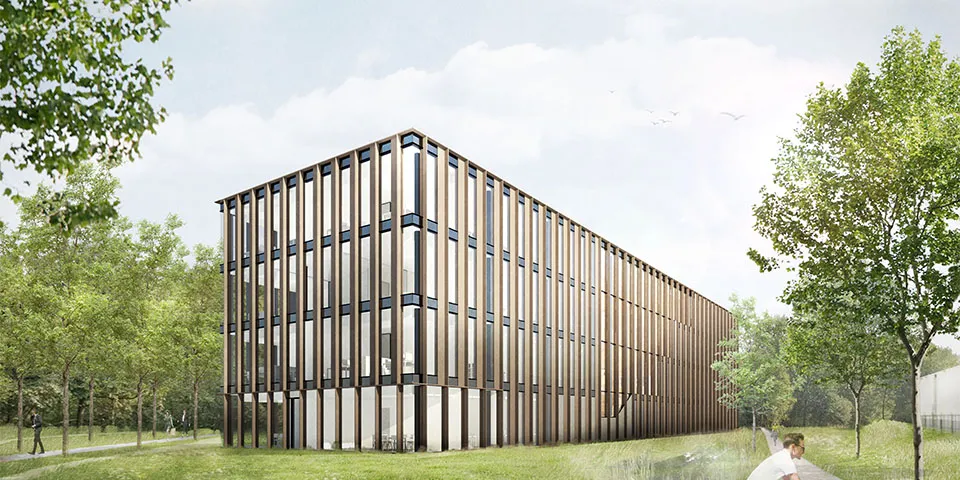
Korsten concludes by naming a few impressive projects where WPI’s special sandwich panels have been used. “For Hermeta, both aluminium and glass sandwich panels were installed at the PKC-defensiegebouw in The Hague, where European fire-resistance class B was required. We are also supplying our unique sandwich panels, on behalf of Van Iersel Geveltechniek, for the entirely green campus of Byondis, a biotechnology company in Nijmegen.”
Question about this story? Ask your question
Keep following this
Get an email when a new story is published. No account needed.
- ThemeAn energy-efficient and comfortable building envelope
- SubjectPanels & profiles