








Environmental data, why it matters

On 4 March 2026, VMRG hosted the online expert session ‘Environmental data, why it matters’. Environmental data provide insight into the environmental impact of building components. Henk Zoontjens, director of VMRG, discussed the subject with Jeroen Boersma, senior product specialist at Kawneer, and Martijn van Hövell, consultant at SGS.
Why do we compile environmental data?
Martijn van Hövell: The reason we compile environmental data is to calculate the Environmental Performance of Buildings (MPG). This calculation is mandatory when applying for an environmental permit for most new-build projects. The MPG uses the Environmental Cost Indicator (MKI) of the construction products used in the design and construction. The MKI for each product is determined on the basis of a Life Cycle Assessment (LCA) and recorded in the National Environmental Database (NMD).
What are the PCR and the Dutch supplement?
Jeroen Boersma: Product Category Rules (PCR) are a set of standardised rules, guidelines and requirements that define how the environmental performance of a specific type of product should be calculated and reported. The European PCR for windows and doors assumes that everything is included in a single product, including glass, hardware and so on. We made this more flexible with the Dutch supplement, which now also allows a window frame to be assessed separately. The Dutch supplement to the European PCR gives companies clarity on assumptions and terminology, aligned with Dutch practice and consistent with European standards. The aim was to create a level playing field.
What is a Life Cycle Assessment?
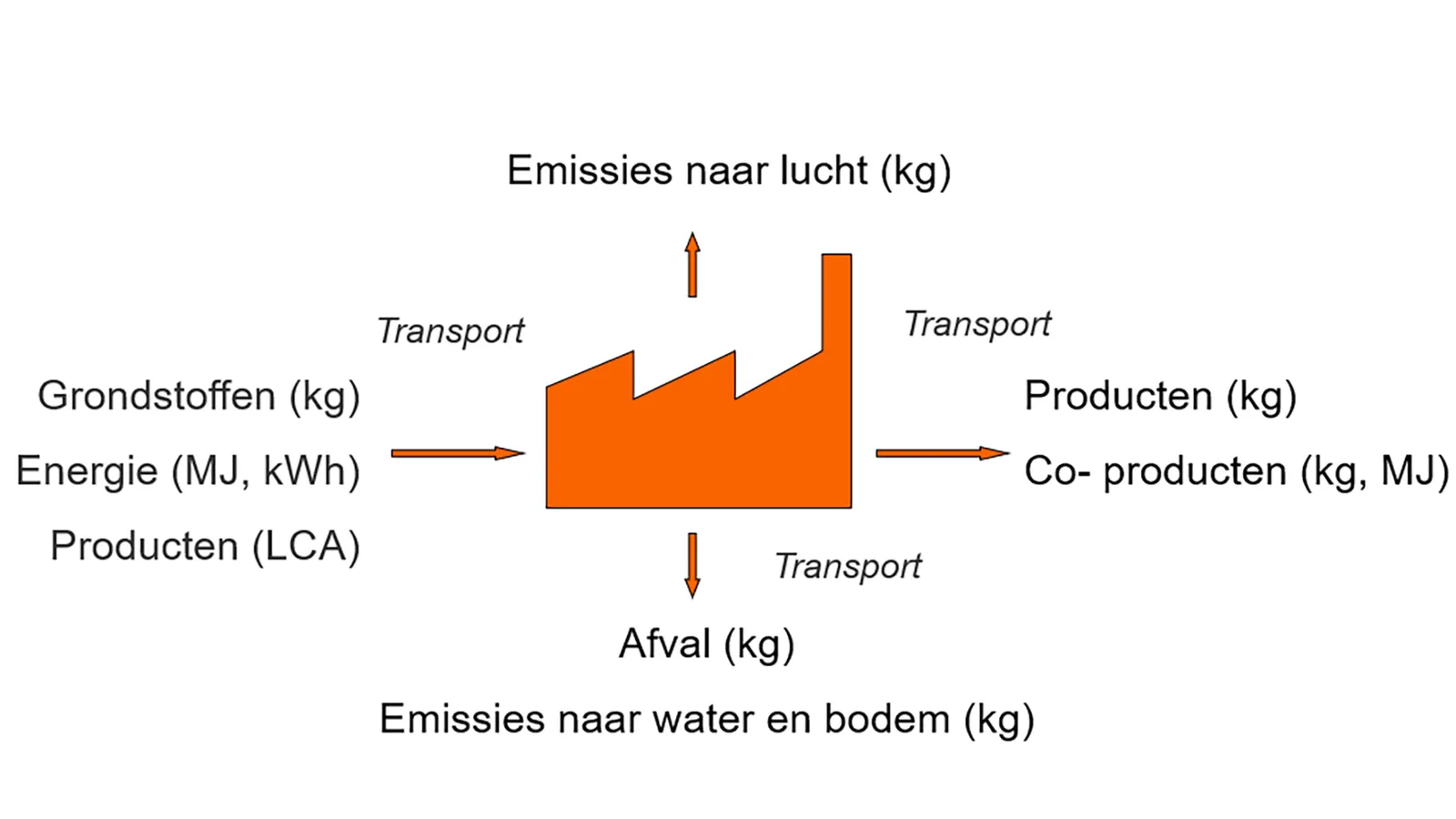
Martijn van Hövell: The Life Cycle Assessment (LCA) calculation method was developed to determine a product’s impact on the environment. The results of these calculations can be used to improve products and production processes. An LCA calculates the environmental impact at each stage of a product’s life cycle. For each process step, we determine the incoming raw materials, materials and energy, and the outgoing products, co-products, emissions and waste.
What information is included in the National Environmental Database?
Jeroen Boersma: The MKI in the NMD is expressed as a single figure, calculated by multiplying 19 environmental impact categories by weighting factors to arrive at a monetary value in euros. This is unique to the Netherlands. The NMD contains a product description, a unit, for example per square metre of façade, and the MKI value. Data are classified according to their function in a building and their representativeness. There are three categories: category 1 cards are company-specific, category 2 cards are industry averages, and category 3 cards are generic material or product cards.
VMRG has produced category 2 cards for VMRG Keurmerk aluminium window frames, fixed and tilt-and-turn, > and ≤2.3 m². VMRG brought in SGS to provide a generic insulated aluminium profile. Why was this necessary?
Martijn van Hövell: It is particularly difficult to analyse aluminium profiles for each individual manufacturer. The data in the LCA database are often old, typically 5 to 10 years out of date. So we looked at how an aluminium profile is made in Europe: where it comes from, the impact of the aluminium and its composition. The way aluminium is modelled in the database also does not entirely reflect how window profiles are made. For example, scrap is melted down: we account for this once, when billets are cast. Then, in module D, which determines the benefits and burdens of material that can be reused or recycled, the NMD assumes that scrap has to be melted down again to cast ingots. This assumption is incorrect. Scrap is cast directly into billets together with primary ingots. Aluminium alloys also differ considerably from those represented in the ecoinvent LCA database. For example, ecoinvent assumes that alloys contain copper, whereas window profile alloys do not. This is how we arrived at a weighted aluminium profile with a more representative score, which also turns out to be better than what was previously available. This has a positive impact on the industry cards.
What can we conclude from the LCA process VMRG has undertaken?
Jeroen Boersma: The MKI is based on a model, and a model can never fully reflect reality. General data are often estimated conservatively. Good work has been done to rem model aluminium based on data from current practice in our industry. Martijn van Hövell: Remodelling aluminium can bring many benefits. The European Aluminium data we used are more recent, provide better insight and reflect the current state of the art. As a result, more representative data can be used for each process step, leading to better scores.
Question about this story? Ask your question
Keep following this
Get an email when a new story is published. No account needed.
- ThemeCircular facades with lower environmental impact
- SubjectGeneral







