








Fire safety in the renovation of occupied buildings
Fire safety is receiving more attention than ever. The fire at Grenfell Tower in London has had a major impact. Under pressure from the House of Representatives, high-risk buildings in the Netherlands are now being identified. The façade is at the centre of attention. So awareness has improved, but is it enough? Sadly, the answer has to be no. In recent years, I have voiced my criticism in several places. Politicians are slow to act, and we trust our regulations too unquestioningly. If the regulations say it is fine, it must be fine. Unfortunately, reality is more nuanced.
One downside of the uproar surrounding residential buildings over 20 m tall is that it can give the impression that there are no other fire safety problems. Buildings under 20 m are not necessarily safe. Assembly buildings such as theatres, cinemas, schools and conference centres would certainly benefit from stricter requirements, but loopholes in the regulations and a lack of enforcement of issued permits can have far-reaching consequences here too. And what about the increase in fires at commercial premises? Fortunately, they cause few casualties, but they do result in extensive indirect and economic damage. Fires in livestock sheds, meanwhile, cause immense animal suffering, and in those cases there are casualties.
I am currently working on an article about fire safety when renovating residential buildings that remain occupied during the works. This is something we will face frequently over the next 10-20 years. After all, we are going to carry out major energy-efficiency upgrades to our buildings and wrap their façades in a thick winter coat. If we get it wrong now, we will get it wrong on a large scale. There are also increased risks during construction.
The reason for this sneak preview is an online consultation currently being run by the Ministry of the Interior and Kingdom Relations (BZK) on an amendment to the Besluit bouwwerken leefomgeving. In broad terms, the amendment concerns the coordination of safety. One component is ‘Safety during renovation of a building that remains in use’. The question posed is: Do the construction or renovation works, including temporary support structures and the site layout, affect fire safety, escape routes or the locations available for emergency services in or around the building that remains in use?
This is one of five questions in the so-called risk matrix. If the answer to any of them is yes, the permit applicant must complete a more detailed risk matrix.
Looking around construction sites, I would be tempted to say that the answer to this question should always be yes. There are, of course, exceptions.
Renovation work in itself brings a significant increase in risk. Activities such as welding, grinding, soldering, laying roof coverings and stripping paint with heat, combined with combustible materials, greatly increase the risk of fire. This is especially true because work is often under pressure. Instructions are not understood by construction workers with limited Dutch. Not that it makes much difference, since the ‘box-ticking exercise’ nature of the process means that hardly anyone reads the instructions anyway. As a contractor, you have to make a particular effort to ensure that the information gets through to employees and subcontractors. Even then, things do not always go to plan.
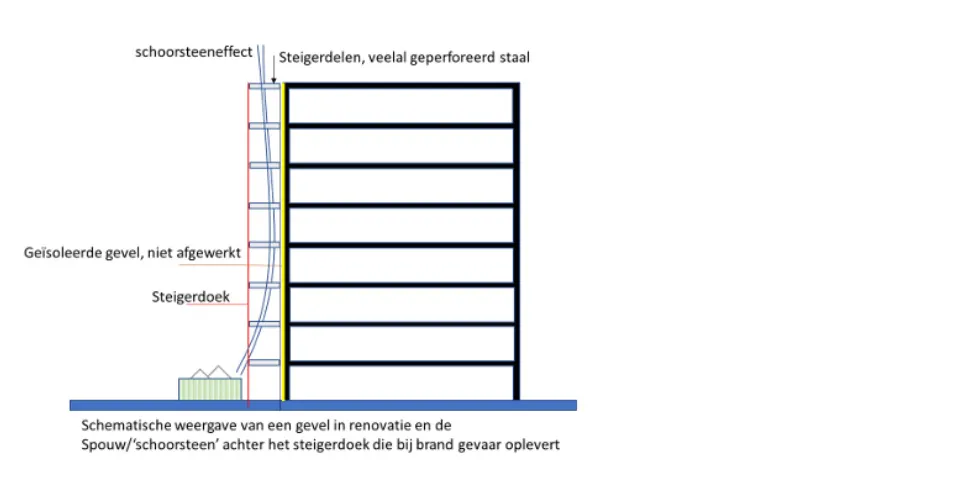
Materials are also stockpiled on site. Supplies are preferably kept close to the building being renovated, sometimes because space is limited. The same applies to skips. If the materials being stored are combustible, this is an obvious risk. People smoke on scaffolding, after all, and young people still find lighting fires a persistent source of amusement. Not to mention instances where materials awaiting installation are temporarily stored on the scaffolding (see photo). The hazard can sometimes lie in scaffold sheeting attached to the scaffolding or in materials fixed to the façade. The fire risk only falls once everything is finished. The scaffold sheeting may itself be combustible and contribute to fire spread. Combined with an unfinished façade containing combustible materials, it creates a cavity that can produce a chimney effect in the event of a fire (see schematic cross-section of a building surrounded by scaffolding).
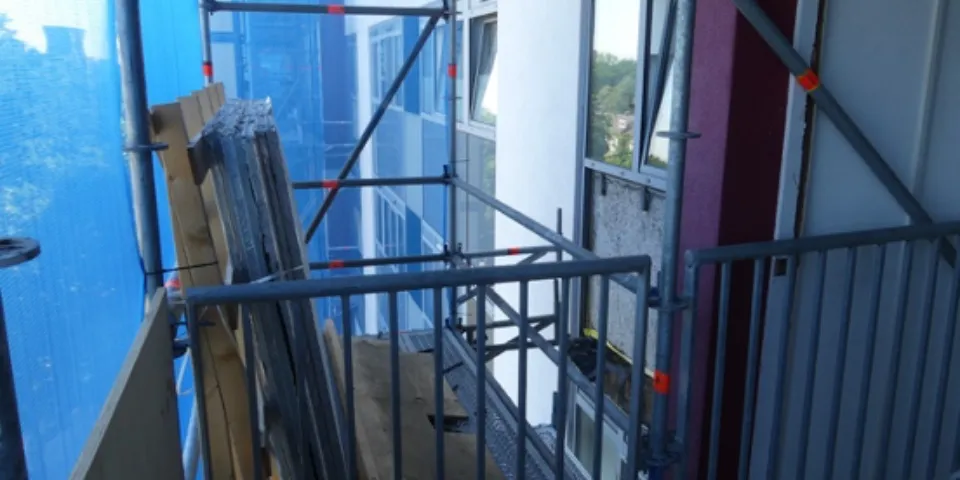
Materials stored on the scaffolding
So there is not only an increased risk of a fire starting, but also a greater risk of it spreading rapidly.
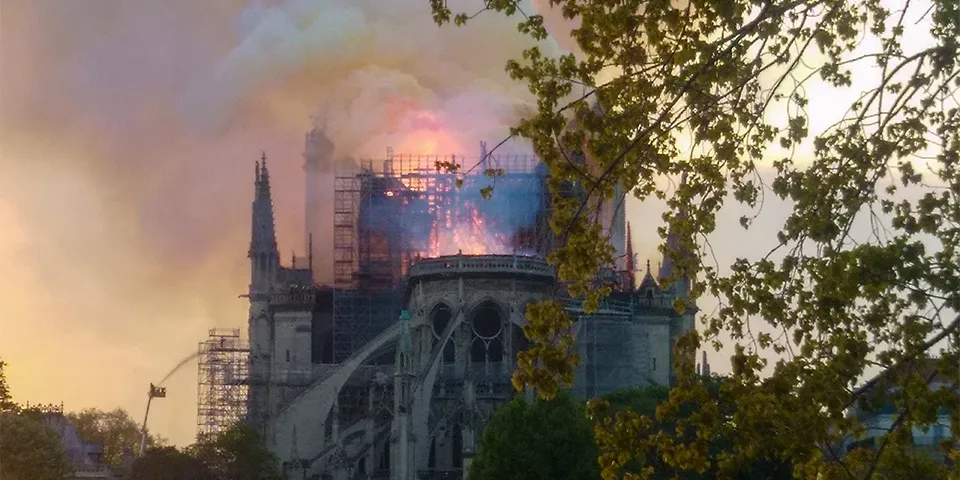
A fire may not fully develop until hours after ignition. A recent example (April 2019) is the fire at Notre-Dame in Paris, where the alarm was raised and a fire became apparent only about two hours after restoration work had stopped.
Escape routes are also often obstructed or restricted. Corridors and lobbies are used for storage, staircases are temporarily closed, and so on. This not only allows a fire to spread more easily, but also seriously delays evacuation. Not everyone living in these buildings is fully mobile, either. Delays increase the risk.
I will look at this in more depth in my June article. It is clear that safety on construction sites of this kind requires considerable attention, and perhaps frequent external inspections too.
https://www.internetconsultatie.nl/verzamelwijzigingbbl
Responses to the online consultation can be submitted until 21 March 2020.
Jos Lichtenberg
Jos Lichtenberg was a professor responsible for building technology and research in that field. He has been active in construction innovation for many years, including through Off Road Innovations, and is also involved in fire safety, both as a researcher and as chair of a platform on the economics of fire safety.
“Incendie de Notre-Dame-de-Paris 15 avril 2019” by Remi Mathis is licensed under CC 4.0
Question about this story? Ask your question
Keep following this
Get an email when a new story is published. No account needed.
- ThemeSafe and verifiable facade construction
- SubjectGeneral







