








Is fire safety in high-rise buildings being taken seriously?

In the Netherlands, attention to fire safety generally goes no further than ‘complying with the Building Decree’. However, this does not provide sufficient protection. The Building Decree offers guidance, but certainly no guarantees. There are too many weak points in our regulations, and the market is neither willing nor able to subject designs to critical scrutiny beyond the legal requirements. Fire drills are a source of amusement, and additional investment in safety is painful because it is for something that is very unlikely ever to happen. But is that justified? And what is the situation in the Netherlands? This critical article explores these questions, focusing on façades and residential buildings.
If you live in a block of flats with 100 apartments, on average you will experience a serious fire in one of the apartments once every 25 years. If you spend your whole life in such a building, that means it will happen more than 3 times on average, based on a life expectancy of 82 years. Recent statistics suggest that the likelihood is increasing, partly because of the many chargers and batteries in use. In the event of a fire, the aim is to contain it within a single apartment (a fire in a building) and enable the fire service to prevent it spreading to neighbouring apartments (a building on fire). Neighbours nearby, as well as those in adjoining corridors, lobbies and stairwells, will almost always face severe smoke conditions, be evacuated and experience moments of real fear. For less mobile older people in particular, this presents a considerable risk even outside the apartment where the fire is burning.
The Grenfell fire
Following the fire at Grenfell Building in London, just over two years ago, awareness grew that it is by no means a given that a fire will remain within a single apartment. In London, the façade allowed the fire to spread rapidly across almost the entire building, with the well-known tragic outcome.
Soon after the disaster, the question was raised in the Netherlands as to whether something similar could happen here. “Let’s wait for the investigation in the UK first,” was Minister Ollongren’s suggestion. But a year after the disaster, the investigation had still not been completed. A number of MPs grew impatient and, under pressure from their persistent critical questions in parliament, the minister instructed Dutch municipalities in November 2018 to draw up an inventory of buildings at risk. That was a good thing in itself, as another year has now passed and the British investigation is likely to continue for several more years. There are lessons to be learnt from interim findings. The Netherlands is lagging behind neighbouring countries such as Belgium and France, as well as the UK, where significant changes to regulations have already been implemented. In the UK, for example, combustible materials are now banned in façades above 18 metres. Existing buildings are already being upgraded on a large scale with government support.
Inventory of buildings at risk
I am highly critical of the inventory carried out, or still being carried out, in the Netherlands. In November 2018, Dutch municipalities were asked to report on the safety of ‘their’ sleeping accommodation buildings. The inventory is limited to residential or accommodation buildings with an occupied floor level above 20 metres, as well as buildings with cell functions, childcare facilities with beds and care buildings above 13 metres. My critical stance is based in part on feedback I have received from municipalities, the scant attention paid to developments abroad, and also on ‘logical reasoning’. After all, which municipality would welcome having to report a large number of ‘high-risk’ buildings and then confront their owners with a massive drop in value and/or pressure to take action?
The guidance provided to municipalities is also inconsistent. They were given an inventory tool developed by DGMR, which produces an assessment of a building. The nature and quality of the façade play an important role in the tool. In particular, external wall insulation using non-fire-resistant insulation beneath a render finish, and ventilated façades made from non-fire-resistant materials, are assessed as decisive negative factors. Although the tool looks robust, some elements are open to interpretation. This gives the assessor a degree of discretion over whether or not to award penalty points, and therefore whether to classify buildings as safe (green or yellow) or as high-risk (orange or red). The outcome thus depends on whether the assessor takes an approach that avoids identifying problems or one that seeks them out.[1]
The minister was initially due to report before the summer recess, and I assumed that a list of buildings deemed ‘suspect’ in terms of fire safety would be published. After all, research must be reproducible and verifiable. In practice, however, an Arcadis report, commissioned by the Ministry of the Interior and Kingdom Relations (BZK), appeared at the end of August, stating simply that municipalities had only just started the investigation and had generally not completed it. I find this remarkable, because based on my own experience, as set out below, I can say that the inventory can be carried out within a few weeks.
My own investigation
To get a feel for the inventory and the expected results, I carried out an inventory in my home city of Eindhoven together with Off Road Innovations. A random sample of 79 buildings, approximately 25% of the stock meeting the use and height criteria, was assessed using Street View and, where necessary, through an on-site inspection. It really is that straightforward. The findings showed that just over 10% of the buildings in this group were classified as orange or red, and therefore as high-risk. This does not mean that the buildings are definitively unsafe, but it does mean that further investigation is required and/or specific measures must be taken. Extrapolating from the Eindhoven figures, I identified approximately 35 buildings at risk out of a total stock of 330. On that basis, there must be hundreds, if not more than a thousand, buildings in the Netherlands that the tool will classify as high-risk, even using a cautious estimate.
Building traditions and the proportion of high-rise buildings vary by region and city, but I am convinced that the percentage of buildings identified in each municipality should be of the same order of magnitude, even allowing for considerable variation. Statistically, it is all but impossible for a larger municipality to have no buildings at risk. I was also encouraged in this view by a report from the municipality of Nijmegen. There, the work had been done properly and 62 buildings had been assessed as high-risk.[2]
Disappointing interim report
The report by Arcadis, commissioned by the minister, is an interim report. My suspicion that the tool can be used to avoid identifying problems is already borne out by the scant initial findings. It is striking, for example, that among the few early results, some larger municipalities report that they have no high-risk buildings within their boundaries. One municipality, on the other hand, has classified 22 buildings as red. In light of my experience outlined above, the methodology used for the inventory needs further scrutiny before any conclusions, however modest, are drawn. The report does not specify which municipality or municipalities are involved, leading me to conclude that the minister does not intend to report at that level either. This is a great shame, because it makes the investigation unverifiable and, in view of the points above, its findings unreliable from the outset.
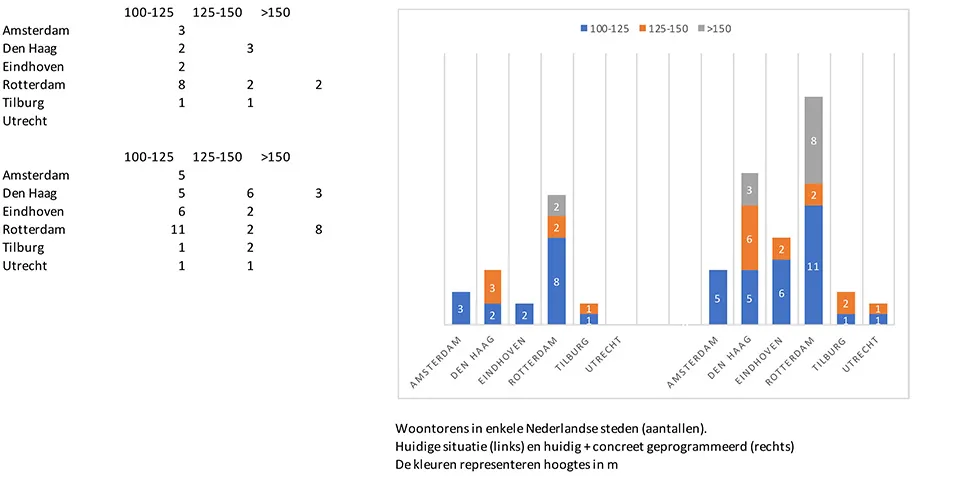
Another consequence is that all new buildings yet to be constructed will also be guided in the wrong direction, meaning that we will inadvertently build in a great deal of latent danger. This applies to the more than 500,000 high-rise apartments still to be insulated, as well as to a roughly equal number of new-build apartments to be added to the housing stock by 2040. The Netherlands’ ambitions for buildings over 100 metres illustrate this. See the accompanying figure.
Conclusion
If I may draw one conclusion, it is that despite growing concerns based on the evidence, safety still does not appear to be taken seriously. This is in contrast to what is happening in other countries. The general lack of urgency breeds suspicion. Or is delay a strategy to wear down opposition and criticism from the market, so that the issue ultimately ends up in the proverbial ‘doofpot’, both literally and figuratively?
I’ll be keeping an eye on it!
Jos Lichtenberg
Professor Emeritus, TU Eindhoven,
Co-initiator, Off Road Innovations
Chair, Slimbouwen
[1] Those wishing to use the tool can find it on the Ministry of the Interior and Kingdom Relations website
www.rijksoverheid.nl/brandveiligheidgevels. The tool and related documents can be downloaded there.
[2] Dinter, Mac van (2019) ‘De gevelplaat is nog altijd gevaarlijk’, De Volkskrant, 29 July 2019
Question about this story? Ask your question
Keep following this
Get an email when a new story is published. No account needed.
- ThemeSafe and verifiable facade construction
- SubjectGeneral







