








Let’s go to zero
Text Roel van GilsImage Soprema
Leading the way in sustainability and circularity
Everyone is talking about sustainability and circularity, but these are ‘merely’ means to an end: reducing the carbon footprint to zero. Wilbert Elissen, Managing Director of Soprema Nederland, explains. Soprema is taking a leading role globally and communicating this to the outside world through its ‘let’s go to zero’ campaign. The first steps are promising.
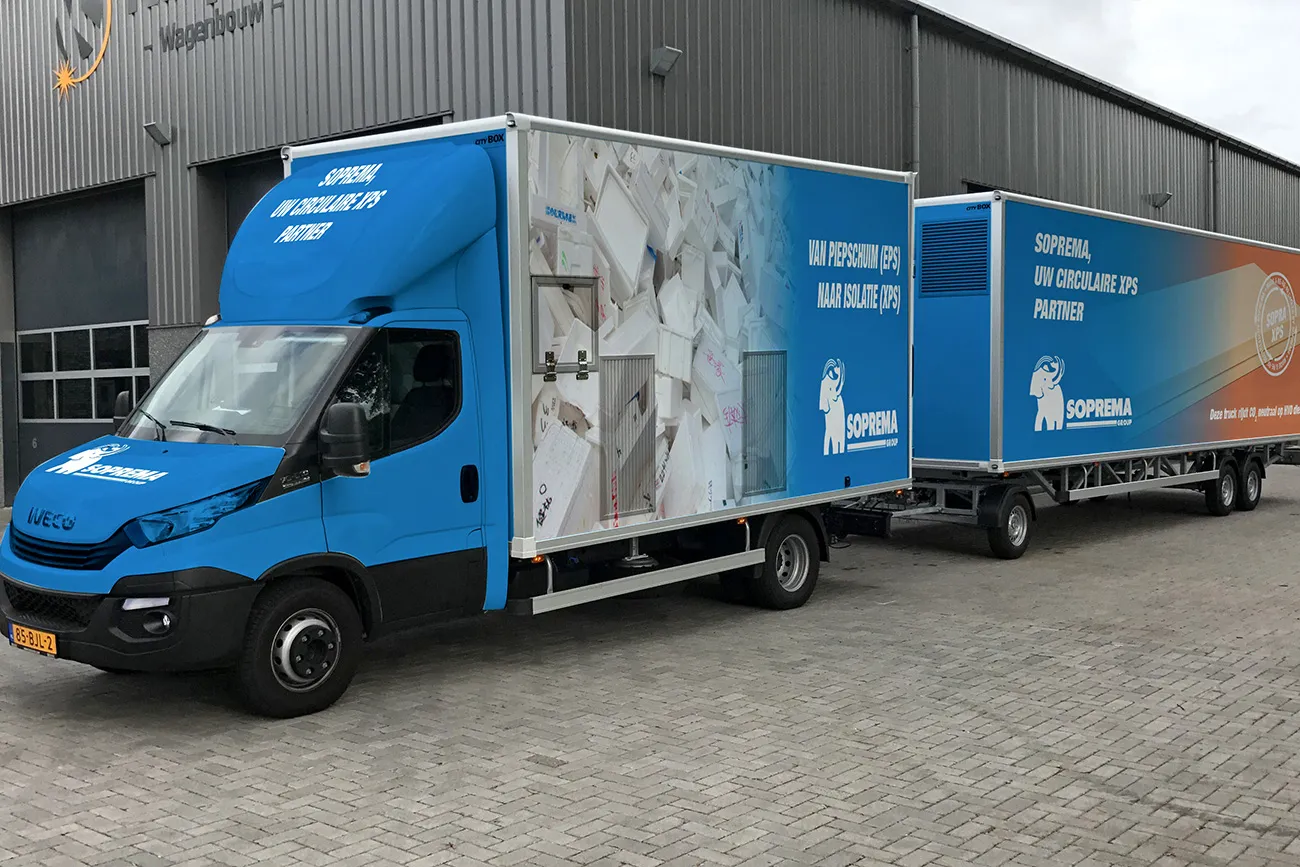
Soprema Group operates worldwide and has set itself the target of reducing its carbon footprint by 30% in 2027 compared with 2020. “We are aware that achieving this target takes more than simply switching lorries to HVO100 fuel, installing solar panels and moving to LED lighting,” Wilbert acknowledges. “We have already taken quite a few steps in the right direction. The acquisition of EPS Nederland, for example, means that we can now collect EPS on a large scale from the construction, food and packaging industries and use it to produce new XPS insulation boards at our factory in Tongeren.” These efforts have been rewarded with Cradle to Cradle certification.
100% bio-based
Soprema’s Pavatex wood-fibre insulation also has a very low carbon footprint. “We extract fibres from the sawdust and wood shavings and offcuts from conifer nurseries, then clean them with steam and press them into a finished product. By adjusting the pressure, we can produce anything from soft wood-fibre mats to rigid wood-fibre insulation boards,” explains Jacco Dwars, Sales Manager Insulation at Soprema Nederland. “Pavatex is an insulation product with by far the lowest environmental impact and is 100% bio-based. The factory is also located in the Vosges, in the heart of a sustainable forestry area, close to the raw material.”
Working with the value chain
Soprema is also a bitumen producer. “We have now reached the point where 40% of the raw materials we use are non-virgin,” says Wilbert. “We plan to take this further, but that also requires collaboration across the value chain. For example, we are going to invest in a recycling unit for used roofing materials in Grobbendonk, but we need the value chain to help ensure that old bitumen is collected. We are keen to start discussions on establishing these take-back streams.” Jacco adds: “Thanks to the value chain, we can already recycle EPS at our XPS factory, and we also use some polyester, in the form of the familiar PET bottles, in our PIR insulation. Together with the market, we are exploring the technical possibilities in an increasing number of areas.”
Longer service life or combined functions
According to Wilbert, several factors are important in reducing the carbon footprint. “A longer service life also lowers the carbon footprint,” he rightly points out. “This is another important area we are focusing on, along with achieving higher insulation values with less material and combining functions, for example where green roofs and retention roofs also help lower ambient temperatures. All the initiatives we launch in the coming period will come under the ‘let’s go to zero’ umbrella. Circularity is an important means, but ultimately the aim is to reduce our carbon footprint. And as a manufacturer, we are fully committed to that.”
Finally, Wilbert notes that architects and clients also have a role to play. “They need to make considered system choices to limit emissions. From 2024, we will make the carbon footprint per m2 visible for every product we supply, so that the right system choice can be made at the building design stage.”
A business enquiry for SOPREMA? Get in touch
Companies in this story
Keep following this
Get an email when a new story is published. No account needed.
- ThemeCircular facades with lower environmental impact
- SubjectGeneral
- CompanySOPREMA







