The art of bending aluminium
Bending aluminium profiles, beams and hollow sections calls for concentration and expertise, as well as the very latest techniques and machinery. Bending is a true craft, practised by the skilled team at BestBend for more than forty years. Rudi Vandevoordt, managing director of BestBend, brings us up to date on the latest techniques and methods, because the craft continues to evolve. What about bending with liquid metal?
BestBend invests heavily in the ongoing training of its employees and in developing new techniques and machinery. Vandevoordt: “We started out bending crash barriers and profiles for windows and doors, first with one machine and later with two. Today, drawing on that expertise, we use five machines to produce every type of bent component, from simple to more complex windows and doors, from rails to curtain wall profiles, for applications across a wide range of sectors. We go further than others. Our focus is not just on standard bending work, but above all on special projects that not every bender can handle.”
BestBend goes further than others.
Liquid metal
Architects keep coming up with new shapes that initially seem almost impossible, Vandevoordt continues. “That means we, too, are constantly pushing the boundaries. For standard bending work, aluminium profiles are generally filled with sand. Sometimes the required bend is so complex that the profiles ripple or break during bending when filled with sand. As an alternative, we fill the profiles with liquid metal. Its density is much higher than that of sand, reducing the risk of the profiles deforming.” Vandevoordt explains the process: “The profiles are first heated, then filled with liquid metal and finally cooled with water, so they are ready for bending. After bending, they are heated again so the metal liquefies and flows out of the profiles. The liquid metal is kept under water at all times, which means it can be reused each time. We are now also working to speed up this process, which could reduce the cost of bending.”
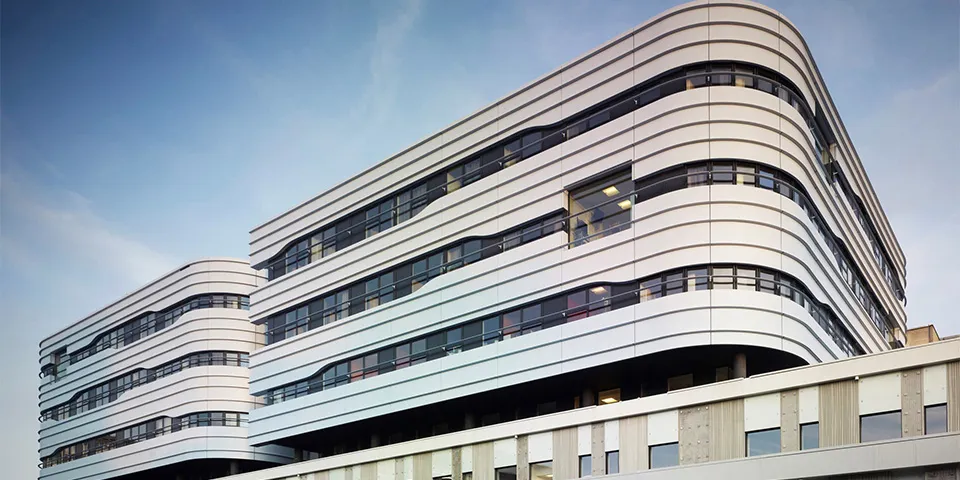
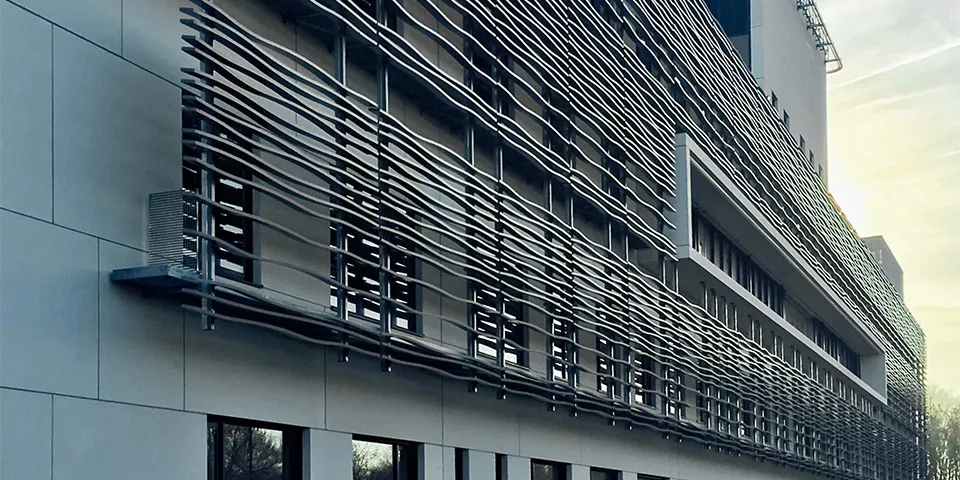
Vandevoordt: “At BestBend, we are committed to continuous development, including the integration of a new costing package and ERP package. Our aim is for customers to be able to calculate and track the cost of 80% of their enquiries themselves.” By continuously investing in new techniques and machinery, as well as faster and more efficient bending methods, BestBend is involved in some of the most impressive, and complex, projects, such as Algemeen Ziekenhuis Sint-Maarten in Mechelen. For this project, BestBend produced 65 kilometres of bent sun-shading fins in 53 different models. BestBend also carried out the bending work for New Atrium and Hudson Bay in Amsterdam.
Question about this story? Ask your question
Keep following this
Get an email when a new story is published. No account needed.
- ThemeFacade design and construction
- SubjectGeneral