Gevelbouw is part of Louwers Mediagroep: 45+ trade platforms in the Netherlands, Flanders and Wallonia. Trade magazines, websites, newsletters, video and podcasts, since 1987.
To deliver on BIM’s many promises, complete, consistent and accurate models containing the right data are essential. Until recently, the façade industry lacked the agreements needed to achieve this, making it difficult to recoup the costs involved.
Since 2018, VMRG has worked with its members to establish clear agreements on BIM in the form of an Information Delivery Specification (ILS). More and more parties in the construction industry have joined the initiative to exchange information on the basis of an ILS. The BIM basis ILS was the first step towards making information exchangeable, structured, unambiguous, accurate, complete and reusable. As a co-board member of the BIM basis ILS, VMRG is proactively contributing to this work. Together with its members, it has taken up the challenge of developing an ILS Gevel.
Better collaboration
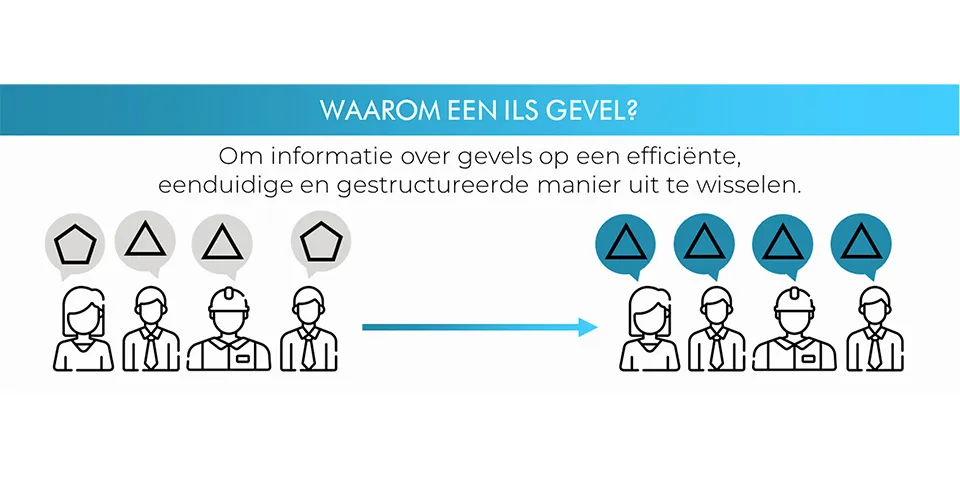
ILS Gevel builds on the existing basic agreements on BIM and is therefore not a new standard. It serves as a guide to better collaboration, enabling information about façade products to be exchanged efficiently, consistently and in a structured way. The agreements cover the object structure to be used, the exchange format and the safeguarding of object information. ILS Gevel was developed on the basis of common ground across the industry and draws on practical experience to secure the broadest possible support. As a result, it describes practical solutions based on experience, rather than an ideal future state.
Unambiguous information exchange
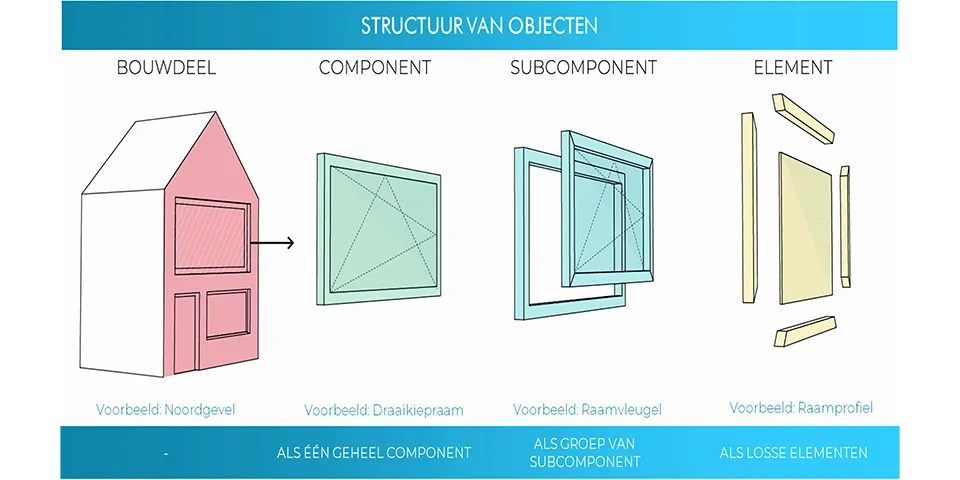
Work began with a clear definition of the purpose and scope of ILS Gevel. Its aim is to enable information about façades to be exchanged efficiently, consistently and in a structured way. To this end, a decomposition was developed, breaking an information carrier down into its constituent objects, together with the relevant definitions. The decomposition identifies various objects found in the façade industry, along with their definitions. ILS Gevel therefore covers products designed, manufactured and/or installed by the façade industry.
Object information
The information requirements for each object and its corresponding IFC entity were also considered. Object information is, in principle, captured in the appropriate properties and property sets defined in IFC. Where IFC properties are missing, these are grouped under Pset_ILS_Gevel. The principle is to record information at the level to which it relates. For example, the thermal transmittance coefficient (Uw) relates to the composition of the window and is therefore recorded at component level. ILS Gevel leaves the choice of object structure open, depending on the modeller and/or organisation, while requiring the object to be exported as at least one complete component.
Next steps
To develop ILS Gevel, the current 0.9 version was extensively tested internally by participating companies. Over the next six months, these companies will apply ILS Gevel 0.9 on projects and gather feedback from clients, construction partners and other stakeholders. This feedback will inform the development of a definitive ILS Gevel 1.0 version. In the meantime, ILS Gevel and its accompanying handout are available on the VMRG website. Together, we are working towards a process in which BIM pays off!
We use cookies to keep the site working properly. With your consent, we also use cookies for statistics and third-party banners. Read more in our privacy and cookie statement.