








Facade watertightness in practice
Text and images Kettlitz Gevel- en Dakadvies
Has anything changed in terms of the watertightness of facade constructions since the introduction of the Besluit bouwwerken leefomgeving?
Buildings must still be watertight under the Besluit bouwwerken leefomgeving (Bbl). This public-law requirement applies to a building’s external envelope, which includes its facades. But how are the regulations structured, how can compliance be tested, and what should you look out for? Here is a brief overview.
Legislation and regulations
The test method for determining watertightness is described in NEN 2778. In addition to this Dutch legislation, European rules stipulate that curtain walling, windows and doors must carry CE marking. One element of this CE marking is a watertightness test carried out in an accredited laboratory. Windows and doors are tested in accordance with NEN-EN 1027, while curtain walling is tested in accordance with NEN-EN 12155. Both test methods are aligned with NEN 2778. The test results are then used to classify a door or window system in accordance with NEN-EN 12208, and a curtain wall system in accordance with NEN-EN 12154.
At project level, the facade contractor must ensure that the performance of aluminium facade elements meets the specified watertightness requirements. These may be the minimum requirements in the Bbl or higher private-law requirements set out in the contract documents. The minimum test pressure is determined in accordance with NEN 2778 and depends on the building’s height, the surrounding buildings and the wind region.
Why carry out an on-site test?
For a client or contractor, laboratory test results are sometimes not sufficient to demonstrate the watertightness of a facade. This is because laboratory tests demonstrate only the watertightness of individual elements under ideal conditions, and do not test the building connections. To determine whether a facade construction actually meets the specified watertightness requirement, an on-site test can be carried out on a representative section of the project facade. The test is performed in accordance with the standards mentioned above.
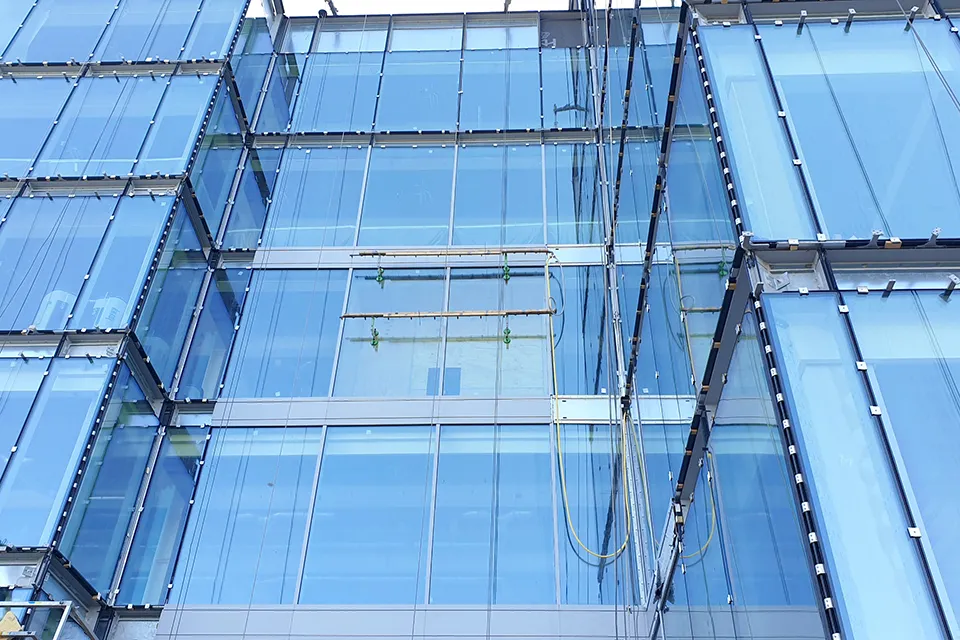
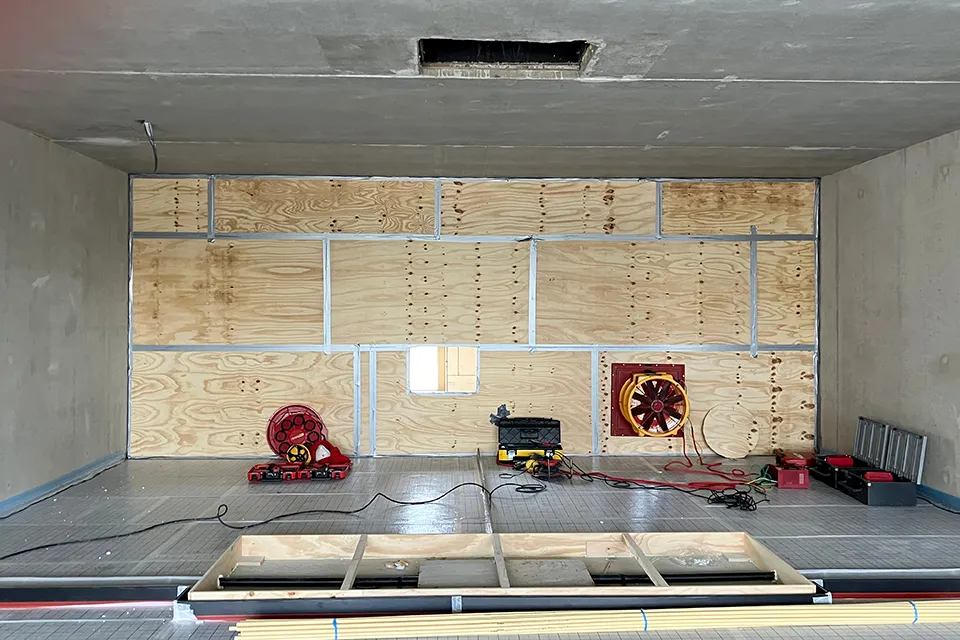
Our experience with on-site testing is that standard facade elements generally meet the specified watertightness requirements, but there are exceptions. After all, installation is carried out by people. Some types of facade element are particularly critical, especially where stringent watertightness requirements apply. These include special elements such as fire-resistant frames, sliding doors, double-action doors and doors with a low threshold, as required for accessibility under the Bbl. In addition to omissions in the facade elements themselves, there may be defects in the seals around them. On-site testing checks compliance with the watertightness requirements. For the test, an airtight chamber is built on the inside of the facade section (see photo), and a water-spray apparatus is installed on the outside (see photo), in accordance with the standards mentioned above.
Points to consider
To reduce the risk of watertightness defects, it is advisable to check the detailing for air permeability and watertightness in advance. It is also useful to carry out a laboratory test on a representative facade section before production starts, so that any issues with facade elements can be identified at an early stage. However, these results are not representative of real-world conditions. For this reason, it is valuable to build a mock-up of the seals to be installed on site and have it assessed. This provides insight into the actual installation process and any design difficulties. Finally, an on-site watertightness test can be carried out. It is advisable to include the facade finish in this test, so that the finished situation is tested. It is best to carry out the test as early as possible in the construction process. Potential issues and defects can then be identified in good time, when adjustments are often still straightforward.
In summary, the approach to achieving a watertight facade under the Besluit bouwwerken leefomgeving is unchanged, and watertightness remains an important consideration at every stage of the construction process.
This article was produced in collaboration with Kettlitz Gevel- en Dakadvies.
Question about this story? Ask your question
Keep following this
Get an email when a new story is published. No account needed.
- SubjectVMRG







