








First drone building inspections show promise
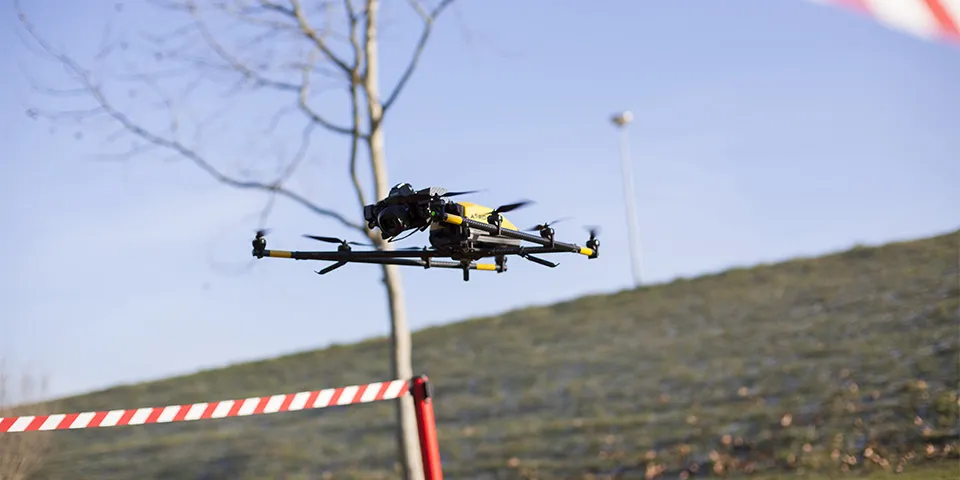
This spring saw the first legal drone flights in an urban area. They took place as part of the FaSA innovation project, a three-year initiative to develop a ‘Façade Service Application’. The project was launched by VMRG, OCTO and Aeroscan, working with 39 public and private organisations.
Stingo Huurdeman of VMRG: “FaSA is a platform that is innovating the physical property market through the use of digital tools such as sensors, drones and artificial intelligence. This makes it possible to provide continuous, objective insight into the technical and aesthetic performance of the façades of homes and commercial buildings. Innovation in façade construction is high on VMRG’s agenda. That is why VMRG is keen to contribute its knowledge of façade technology and maintenance to this project.”
Thorough preparation
The first pilots have recently been carried out as part of the FaSA project, involving a series of drone flights in residential areas. “That is quite remarkable,” explains Mark Nicolai of Aeroscan, “because these were the very first test flights in an urban area. We were the first in the Netherlands to receive permission for them from the Human Environment and Transport Inspectorate and the Ministry of Defence. A flight starts with thorough preparation, covering not only procedures and technology, but above all privacy and communication. These flights took place in a residential area, so residents are given very detailed information in advance, in consultation with the housing associations we are working with on the FaSA project.”
Privacy safeguarded
Privacy is taken very seriously during drone flights. Nicolai explains: “Before the pilot flights, tenants receive a letter from the housing association explaining the inspections. It emphasises that our focus is on the technical aspects of a home’s exterior, not on people or personal belongings. If people or, for example, vehicle registration numbers do appear in the images, they are blurred, and only the edited images are shared with the client. The raw files are deleted.” In addition, plans are drawn up before the pilot flights to show the route the drone will take. Information sessions are also held for local residents, where they can view the recorded footage. The initial response has been very positive. People find it great fun and interesting to see their own neighbourhood through drone footage.
Predicting maintenance needs
Inspecting a large residential complex is costly. A drone can do the job faster, more accurately and at lower cost. “We use drones that currently lead the field in terms of safety and technology,” says Nicolai. The drones fly at a suitable distance, while their cameras take aerial photographs of the roof, façade and window frames. The cameras capture images at very high resolution, clearly identifying deviations down to millimetre level. To build up a complete picture of a building, the images will eventually also need to be linked to ground-level photography. “In my ideal scenario, in a few years’ time we’ll detect a leak before it even becomes one,” says Dirk Huibers of Octo. “Then a tenant won’t need to report it. A contractor or façade specialist will be alerted straight away and can repair a potential leak before the damage gets worse.” Huurdeman adds: “This also means that façade maintenance will be carried out in a completely different way in future. Buildings will be monitored continuously. We will also develop new sensors for this project, enabling maintenance needs to be predicted very accurately. No more maintenance once it’s already too late, but preventive maintenance.” “But,” Huibers continues, “we’re not there yet. First, we need to turn the images into information and analyse it.”
Scaling up
The project will also examine what is needed to scale up these drone inspections to neighbourhood level, and how to do so as effectively and efficiently as possible. “We’re consulting with regulatory bodies about what’s needed to roll this out more widely,” says Huibers. “We’ve documented exactly what happened on all the pilot flights and are evaluating them. This will allow us to identify improvements to incorporate in the next phase. After the initial pilots, we’re very positive about the results. The flights were safe, the drones took excellent photographs and remained stable in wind speeds of force 5. We’re making huge strides technologically, more than we ever dared imagine.”
This project has also been made possible with support from Kansen voor West II and an EFRO grant.
Question about this story? Ask your question
Keep following this
Get an email when a new story is published. No account needed.
- ThemeCollaboration in the facade industry
- SubjectVMRG







