








Knowledge Table: Surface Treatment and Recycled Aluminium
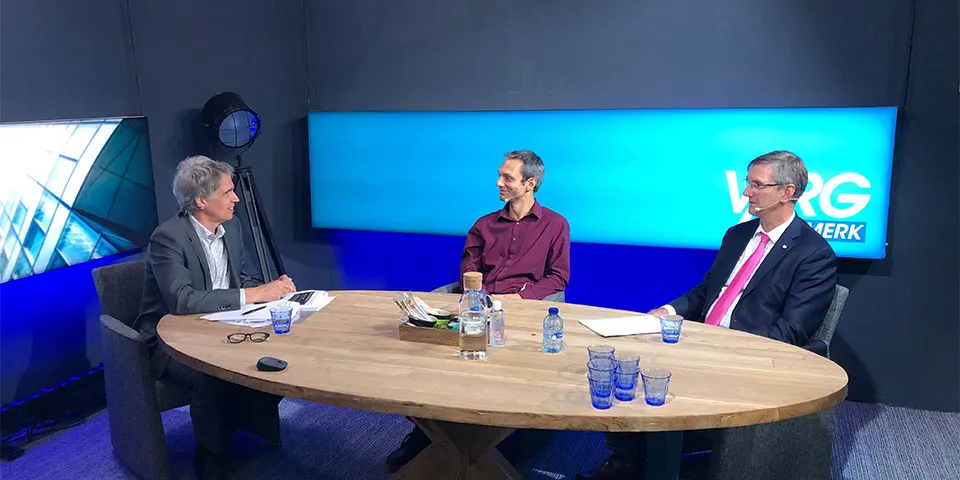
On 22 September, VMRG organised the Knowledge Table. Due to COVID-19, it was decided to hold an online event, with external speakers invited to join a panel in a studio and share their knowledge. VMRG member companies were able to watch the event via a livestream and ask questions. Members can also watch the event again via the dedicated login on the VMRG communications platform.
The agenda covered developments in surface treatment and the effect of recycling on the quality of aluminium, including its impact on surface treatment. Our guests were Egbert Stremmelaar, director of ION, the trade association for the surface technology industry, and Dr Alexander Lutz of the Electrochemical and Surface Engineering Research Group at Vrije Universiteit Brussel.
Developments
Surface treatment is essential for protecting aluminium and steel, but it is also important for aesthetic reasons. Environmental legislation and safety requirements are changing continuously and at a rapid pace. We are also making increasing use of recycled materials. These developments, as well as end users’ ever-higher expectations, mean that surface treatment is constantly evolving. Stremmelaar: “A coating is applied for three reasons. It protects against corrosion, has an aesthetic aspect and can add functionality to the substrate. Think of a nano-additive that makes a coating dirt-repellent, a coating that darkens when exposed to UV light, or one that also generates energy. It is
all possible nowadays.”
Recycling
Another topic at the Knowledge Table was the effect of recycling on the quality of aluminium.
Aluminium can be recycled indefinitely. The trend is for recycled aluminium to contain a growing proportion of used aluminium. But what effect does this have on the quality of recycled aluminium? For example, what does it do to colour and filiform corrosion? Lutz and his research group at Vrije Universiteit Brussel have spent years conducting intensive research into this on behalf of VMRG partner E-MAX, a producer of aluminium profiles.
Lutz: “Because recycled aluminium comes from different sources, it often contains higher levels of certain trace elements. Some of these trace elements can have a significant effect on the properties of aluminium. The more recycled aluminium is used as a raw material for new profiles, the more important it becomes to know exactly what each trace element does in the aluminium alloy and how it affects the quality of the aluminium.”
Environmentally friendly
Recycling also has implications for surface treatment. Stremmelaar: “The chemical systems currently in use are tailored to the current generation of substrates. Changes to the substrates will therefore require the chemicals to be fine-tuned, while legislation and regulations aim to replace SVHC/CMR substances as far as possible with alternatives that are safer for people and the environment. Adjustments are therefore needed on several fronts at once. Until now, a high level of contamination, including what Lutz refers to as trace elements, has been a major cause of visual defects in transparent coatings and adhesion problems with organic coatings.”
Colour
Lutz gives iron as an example of such a contaminant. “It is one of the elements that can make the metal appear darker after anodising. At the same time, iron is also needed to create a slight roughness, so that window frames are not mirror-like and an organic coating can adhere sufficiently. So we cannot remove iron from the alloy entirely. In recycled aluminium, the iron content can sometimes be slightly higher than in conventional alloys. If we were generally willing to accept aluminium that is minimally darker in colour, we could make products even more environmentally responsible. Our research also shows that the colour, lightness and gloss are affected not only by different alloying elements, but also by the parameters used during anodising.
For example, the lightness of a profile is affected by the current, bath temperature and anodising bath composition. Because anodising is a complex process, there are also variations in lightness (or colour) in different places on the same profile, as well as between profiles anodised at different times. The search for the perfect process is still ongoing. What is clear is that adjusting the anodising parameters can minimise potential colour differences in conventional and alloy-rich aluminium profiles. Surface treatment companies therefore have a major influence on the introduction of circular aluminium to the market.”
Adhesion
Contamination can also affect coating adhesion. Lutz’s research showed that adhesion is mainly determined by the pre-treatment. This term generally covers degreasing, pickling, desmutting and conversion, as well as all intermediate cleaning steps. With both conventional and recycled aluminium, a coating will not adhere properly if something goes wrong during pre-treatment or if it is not carried out adequately. It is therefore important to monitor these processes very carefully. Here, too, circular profiles can achieve results just as good as those obtained with conventional profiles.
Filiform corrosion
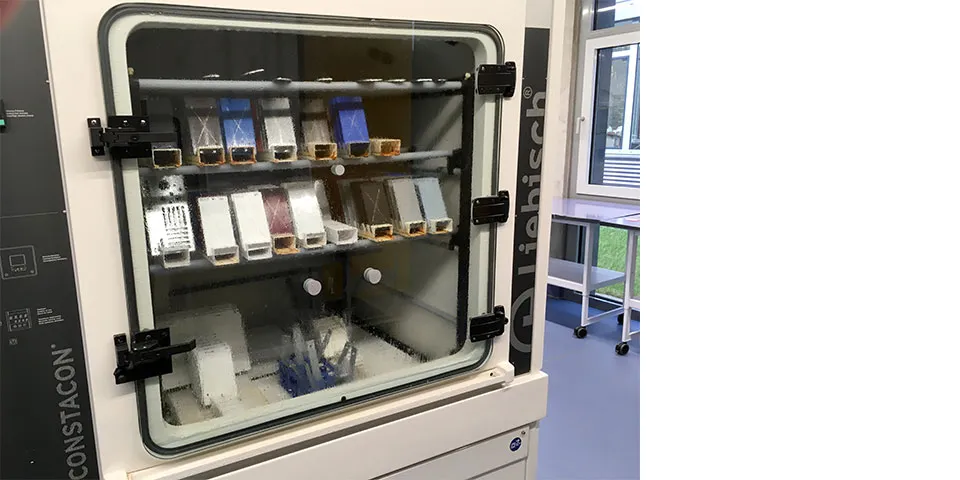
Lutz: “Over the past two years, we have conducted a great deal of research into filiform corrosion. Copper was long considered the culprit responsible for causing filiform corrosion, but this has recently been called into question. We therefore carried out a benchmark test. We had different alloys with varying copper contents treated and coated by different
European surface treatment companies according to their standard procedures. The results show that profiles with higher copper content do no worse than alloys with low copper content. There is, however, a difference between coaters. Our conclusion from this research is that the effects of pre-treatment have a far greater impact than small differences in copper content.”
Quality labels
The research shows that recycled aluminium can achieve the same quality as conventional aluminium. The quality of the surface treatment process plays a very important role in this. “Surface treatment is a skill that comes with experience,” says Stremmelaar. “The more experience a coater has, the better they can predict how a coating will perform in the long term. And that is exactly what the Qualicoat, Qualisteelcoat and Qualanod quality labels deliver. They bring together decades of experience from applicators around the world. Drawing on that experience and extensive testing, a technical specification is drawn up, which the applicator follows.” All VMRG Surface Treatment companies hold one of these quality labels, and VMRG Quality Mark companies also work with companies that hold these labels or hold them themselves.
Question about this story? Ask your question
Keep following this
Get an email when a new story is published. No account needed.
- ThemeCollaboration in the facade industry
- SubjectVMRG







