








NEN-EN 16034: The basis for CE marking fire and/or smoke-resistant windows and external doors

NEN-EN 16034 was published in October 2014. In The Official Journal of the European Union dated 28 October 2016, the European Commission announced that NEN-EN 16034 could be used for CE marking from 1 November 2016.
The Official Journal also stated that:
a coexistence period of 3 years had been established. CE marking would be mandatory from 1 November 2019;
for fire and/or smoke-resistant windows and external doors, NEN-EN 16034 may only be used in combination with NEN-EN 14351-1.
Which fire and/or smoke-resistant windows and external doors must be CE marked?
The scope of NEN-EN 16034 states that this European product standard applies to external doors and/or openable windows. Curtain wall elements with doors and/or openable windows may include side lights and/or fanlights. Curtain wall elements without any openable parts are outside the scope and must not be CE marked;
Role of system suppliers
System suppliers will make the following documents, prepared by a Notified Body, available to façade contractors using their system or systems:
ITT reports
classification reports
extended application reports (Field of Application) (for a complete range based on various test reports and assessments). Under NEN-EN 16034, these documents must be available to the façade contractor for 10 years. Use of the system supplier’s reports is generally agreed contractually between the system supplier and the façade contractor.
Role of façade contractors
Under the European product standard NEN-EN 16034, the manufacturer of fire and/or smoke-resistant windows and external doors must have its production and internal production control inspected by a Notified Body such as SKG-IKOB. Compliance with NEN-EN 16034 must be confirmed by a “Certificate of constancy of performance”.
The steps required to obtain certification are set out below.
Step 1: Production manual
The manufacturer must have a production manual setting out the procedures for Factory Production Control (FPC) followed within the company. The production manual must meet at least the requirements set out in section 6.3 of NEN-EN 16034. SKG-IKOB provides a checklist to give the façade contractor an overview of the requirements specified in the standard.
Step 2: Review of the production manual
Once the production manual is complete, it must be submitted to SKG-IKOB for review to ensure that it complies with the requirements of the standard.
Step 3: Implementing the production manual in your company
Once the production manual has been approved, the manufacturer must ensure that the procedures described in it have been implemented within the company before an initial inspection can be carried out.
Step 4: Initial inspection
The initial inspection carried out by SKG-IKOB comprises two checks:
a check that your Factory Production Control (FPC) is operating effectively, based on the production manual and NEN-EN 16034;
an inspection of a manufactured fire-resistant curtain wall element within the scope of NEN-EN 16034. This inspection assesses whether the curtain wall element has been assembled as described in the ITT documentation (classification reports and/or extended application report).
Step 5: Issue of certificate
The results of the initial inspection are assessed. If the result is positive, SKG-IKOB will issue the Certificate of constancy of performance.
On the basis of this Certificate of constancy of performance, the manufacturer may issue a Declaration of Performance (DoP) for its curtain wall elements and affix the CE marking to them.
What should the Declaration of Performance look like?
Since NEN-EN 16034 may only be used in combination with NEN-EN 14351-1, this creates the unusual situation in which products must be CE marked on the basis of two harmonised European product standards.
The Construction Products Regulation (CPR) sets out the information to be included in a Declaration of Performance (DoP) and the information to be reproduced on the corresponding CE marking. Combining the two product standards results, for a single product, in the following example Declaration of Performance and CE marking.
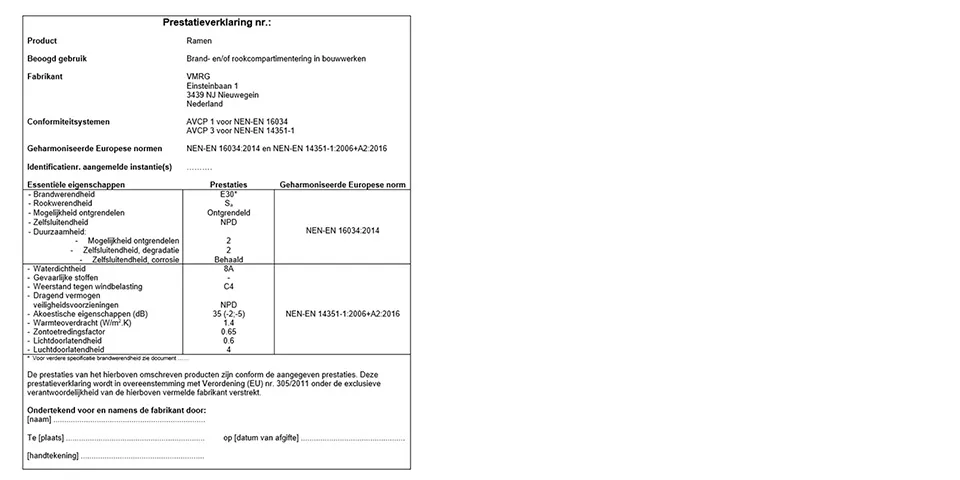
Example of a Declaration of Performance (DoP)
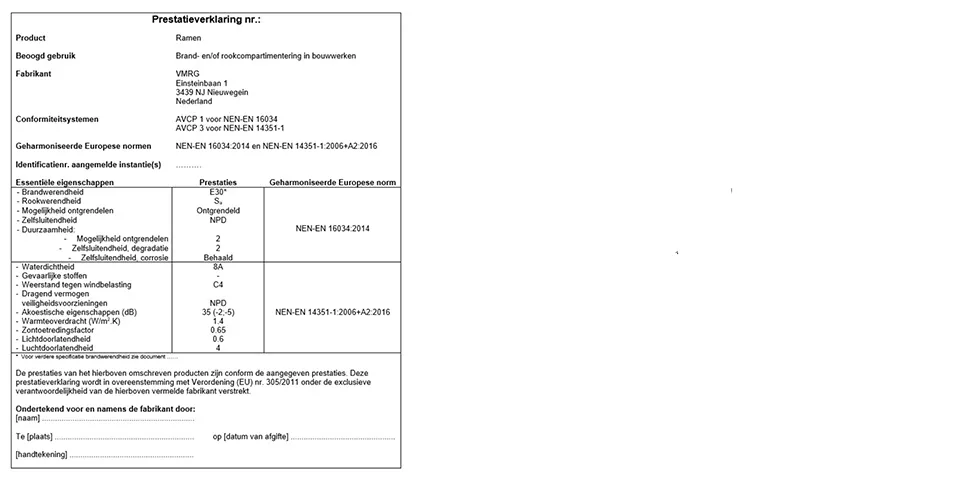
Example of a CE marking
Consolidated Declaration of Performance
The façade industry does not work with standard windows and external doors; every curtain wall element is unique. It is therefore advisable to prepare a consolidated Declaration of Performance listing the performance of multiple curtain wall elements, for example by brand.
The corresponding CE markings on the products look almost identical to those for a Declaration of Performance for a single product. However, for a consolidated Declaration of Performance, the brand of the relevant curtain wall element is stated on the CE marking after the unique Declaration of Performance number.
Question about this story? Ask your question
Keep following this
Get an email when a new story is published. No account needed.
- ThemeSafe and verifiable facade construction
- SubjectVMRG







