








Quality Assurance Act for Building
Quality assurance in construction involves monitoring the quality of design and execution to ensure the finished result complies with the requirements of the Building Decree. Under the current system, the municipality checks building plans in advance and supervises construction to ensure it follows the permit issued. Under the Quality Assurance Act for Building (Wkb), construction industry parties themselves are responsible for ensuring compliance with the requirements.
They do this using a quality assurance instrument applied by an independent quality assurer. The requirement to appoint a quality assurer will
be phased in, starting with all buildings in Consequence Class 1. After an evaluation period, a decision will be made on whether higher consequence classes will also fall under the Wkb.
Who it applies to and why
The new legislation applies to all parties in the construction supply chain: developers/clients (including architects and specifiers), builders, quality assurers and competent authorities.
The Quality Assurance Act has three aims:
- improving construction quality assurance;
- strengthening the consumer’s position;
- encouraging quality improvements and reducing the cost of failures.
The rules of the Quality Assurance Act have been incorporated into a general administrative order (AMvB) under the Environment and Planning Act: the Building Works and Living Environment Decree (Bbl), which replaces the Building Decree 2012.
Consequence Class 1
When it comes into force, the Quality Assurance Act for Building will apply only to buildings in consequence class 1. These include, in summary:
- Detached single-family homes, including ancillary functions (garage, home office);
- Houseboats;
- Holiday homes;
- Commercial premises of up to 2 storeys, including a small office/canteen;
- Small cycle and pedestrian bridges (not over national or provincial roads);
- Other structures that are not buildings, up to a maximum height of 20 metres (masts, antennae, etc.);
- Alterations to the buildings listed above also fall under consequence class 1 (unless exempt from the permit requirement).
Liability
On 14 May 2019, the Senate adopted the Quality Assurance Act for Building Bill. Under the original timetable, the Wkb was due to come into force on 1 January 2021. On 20 May this year, Minister Ollongren of the Ministry of the Interior and Kingdom Relations (BZK) proposed to the House of Representatives that this be postponed to 1 January 2022. Liability, which is governed by the Civil Code, is also currently due to come into force on 1 January 2022, but will apply to all buildings, not just those in Consequence Class 1, for which a contract to construct the building is entered into after that date. In contracts for building work, the contractor will remain liable after the Wkb comes into force for defects not discovered at handover, unless those defects are not attributable to the contractor. This liability cannot be excluded to the detriment of a private client. In other cases, it can be excluded only if this has been agreed contractually.
Dossiers
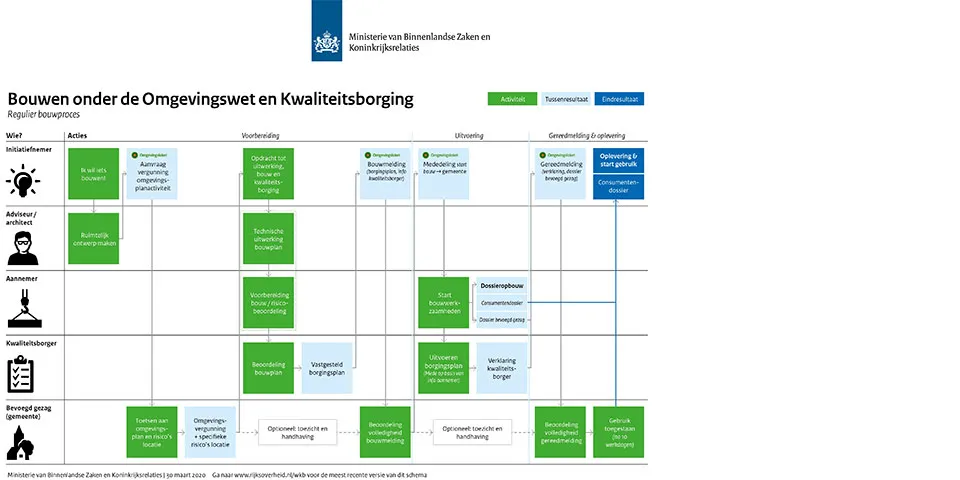
The Wkb introduces two dossiers: the dossier for the competent authority (public law) and the handover dossier (private law).
- When completion is notified, the permit holder must submit the dossier for the competent authority, together with the quality assurer’s statement, to the municipality. The dossier contains information relating, among other things, to structural safety and fire safety. The municipality can use it in the event of any future emergencies involving buildings.
- Under the new rules in the Civil Code, the contractor must provide the client with a handover dossier, also known as a consumer dossier. The law requires the dossier to contain information demonstrating that the building meets all contractual requirements. It must include drawings and calculations for the building, as well as information about its intended uses and the materials used. It must also contain information on the management and maintenance of the building. The law does not specify exactly what the dossier must contain. The contracting parties must agree this between themselves and set it down in writing.
For now, the dossier for the competent authority applies only to buildings in consequence class 1 for which an environmental plan activity permit is applied for from 1 January 2022.
No transitional provisions have yet been made for the ‘consumer dossier’. This means that all buildings handed over after 1 January 2022 must be provided with a consumer dossier/handover dossier.
The consumer dossier has four aims:
- demonstrate that the client receives what they purchased or agreed;
- provide guidance for establishing whether the work has been carried out properly and to a good standard;
- provide instructions for use and maintenance;
- identify points to consider when altering and/or renovating the building (such as openings, extensions and additional storeys).
Pilot projects
The Wkb changes the role of municipalities during the construction process. Municipalities can already gain valuable experience of the new legislation through pilot projects, together with contractors/architects, quality assurers and, where possible, clients. The Association of Netherlands Municipalities (VNG) will support municipalities in this work in the coming period. To this end, the VNG, in close cooperation with the Association of Building and Housing Supervision Netherlands, has established the Wkb Implementation Team. Pilot projects provide insight into and experience of working under a new system. All parties gain valuable practical experience during these projects, and potential bottlenecks in the system become apparent. VMRG is actively involved in pilot projects and welcomes information about companies taking part in them. Based on the experience gained, VMRG can inform the façade industry about potential implications in the future.
Question about this story? Ask your question
Keep following this
Get an email when a new story is published. No account needed.
- ThemeSafe and verifiable facade construction
- SubjectVMRG







