








Smoke leakage testing to EN 1634-3
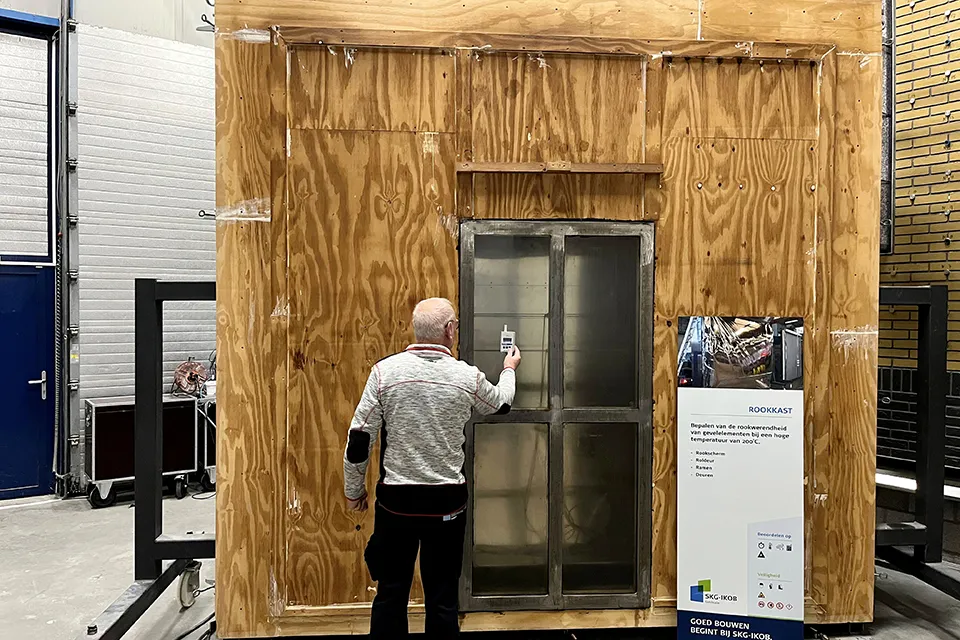
SKG-IKOB test facilities
For many, it is now obvious that a building’s overall fire safety concept goes far beyond the fire resistance of its load-bearing and separating elements. In the event of a fire, being able to escape safely is crucial. Smoke is harmful, contaminated air that makes breathing and seeing more difficult when escaping from a fire. It was once assumed that the smoke resistance of an element could be established by determining the fire resistance of a separating element against the integrity criterion (E). Those days are over, and a separate test in accordance with EN 1634-3 must now be carried out to determine smoke resistance. SKG-IKOB has this test rig, and since achieving accreditation, the industry has made good use of SKG-IKOB for this testing, keeping the rig busy.
Legislation and regulations
Until mid-2021, the Building Decree used the 1.5 x rule to determine smoke resistance. This assumed that smoke resistance (in minutes) was 1.5 times the integrity (in minutes). A separating element tested for 20 minutes for integrity would therefore have a smoke resistance of 30 minutes. This assumption is not always realistic, and the current version of the Building Works and Living Environment Decree (Bbl) therefore applies the 1.5 x rule only to existing buildings.
The Bbl refers, via an amended version of NEN 6075, to a more realistic method for determining the smoke resistance of building elements. Under this method, testing establishes the actual air leakage of a building element, after which its smoke resistance can be classified on the basis of the leakage rate.
One difference from the old method is that smoke resistance is no longer expressed in minutes. NEN 6075 specifies EN 1634-3 as the test standard, under which a building element can, following a successful leakage test, be classified as Sa (smoke resistant at ambient temperature, also known as cold smoke) or S200 (smoke resistant at elevated temperature, also known as medium-temperature smoke). NEN 6075 also describes how building elements not originally covered by EN 1634-3 can nevertheless be tested and assessed. Examples include service penetrations and joints, for which NEN 6075 specifies how they are to be tested and the maximum permissible air leakage.
The test rig is busy: the customer speaks
Marcel Boom, Technical Development Manager at Kawneer Nederland BV, has gained considerable experience of testing at SKG-IKOB. Marcel is therefore ideally placed to explain how the testing process works.
Marcel Boom explains: “As European regulations on fire and smoke resistance came into force on 1 November 2019, Kawneer needed to test for both fire and smoke resistance.
Kawneer chose SKG-IKOB for smoke resistance testing because of our longstanding relationship and the excellent support we have always received.
Before the test or tests, we worked with SKG-IKOB to draw up a test plan covering as wide a product range as possible. The configurations of the elements to be tested were determined on this basis.
As our customers use the test results as a declaration of performance for the mandatory CE marking, production control and sampling have to take place during the manufacture of the elements.
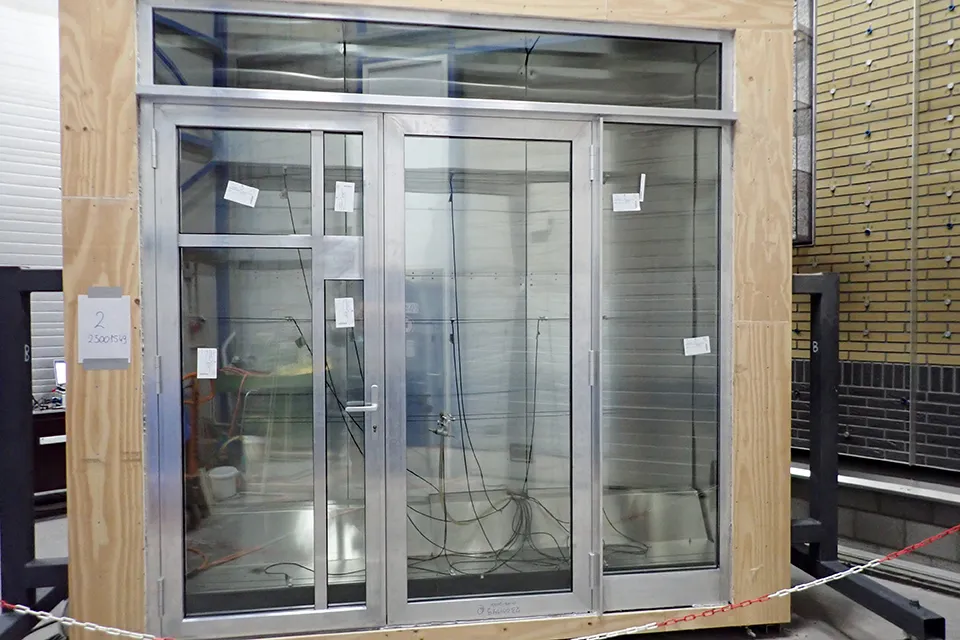
The test of a double door with toplight and sidelights, carried out on 27 March this year, took place in SKG-IKOB’s test chamber in Geldermalsen and achieved Sa and S200 classifications.
This test, together with the follow-up test or tests, will be included in an ExAp report in accordance with EN 15269-20 and a classification report in accordance with EN 13501-4.
Thanks to the good cooperation, we expect to complete the whole process by the end of this year and within budget.”
Question about this story? Ask your question
Keep following this
Get an email when a new story is published. No account needed.
- ThemeSafe and verifiable facade construction
- SubjectVMRG







