








VMRG | BIM maturity and best practice in façade construction
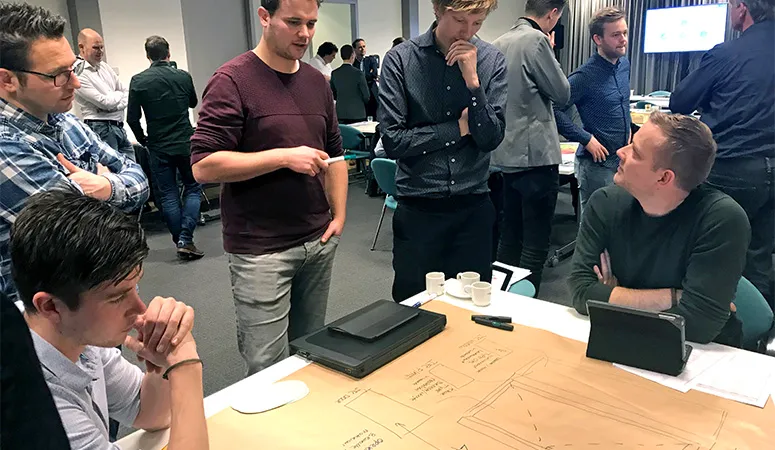
VMRG supports the adoption of BIM in the façade industry on several fronts. It has developed the BIM protocol and BIM execution plan, and its BIM working group is currently working on the Information Delivery Specification (ILS).
The BIM protocol sets out contractual agreements, while the execution plan sets out the collaboration agreements made between project partners. The BIM Working Group is developing the object structure, which describes what information needs to be included at each component level. For each parameter, it defines the meaning, the IFC classification it falls under and an example. IFC is an open data standard for BIM. The aim is to produce an ILS and object library for the most common façade products.
BIM research
To systematically improve the sector’s BIM maturity, we need insight into current BIM performance in façade construction. In 2016, the University of Twente carried out a sector-wide analysis of BIM maturity in the construction industry. It found that suppliers and manufacturers scored relatively poorly. Tasks, responsibilities and processes were not sufficiently defined, for example, and organisational objectives and staff training policies were lacking. Because the sector was under-represented in the research, the findings were not representative of metal façade construction. This led to Raysha Ramautarsing’s graduation research into BIM maturity among façade construction companies. For this qualitative study, thirteen companies were interviewed to assess their BIM maturity and identify best practice. The findings were analysed across the sector and fed back to each company individually, together with recommendations.
BIM in practice
The use of BIM in façade construction has increased significantly in recent years. More and more clients, such as the Central Government Real Estate Agency, make BIM a prerequisite for collaboration. However, façade contractors still lack insight into their BIM capabilities and performance, resulting in less efficient and targeted performance improvement. A lack of understanding of what BIM entails, significant differences in
BIM capabilities between project partners, and a lack of standards and agreements are barriers to the further adoption of BIM in construction (Siebelink, 2016). Siebelink’s research found that, on the one hand, clients are not asking for BIM often enough because they believe the construction supply chain is not yet ready for it. On the other hand, manufacturers say they mainly use BIM because they are asked to. When clients do ask for BIM, they do not have a clear enough idea of what they want to achieve with it or what they can do with it. Respondents from all construction sectors said that BIM is not being adopted widely enough because supply chain partners cannot keep up with the desired BIM working practices. Blaming one another leads to stagnation. Differences in BIM maturity between project partners, combined with companies’ lack of a clear vision and objectives of their own, reduce the value BIM adds and lead to underinvestment in resources.
Research findings
Figure 1 shows that façade contractors score highly on data exchange, management support, the presence of parties requesting BIM, and the available hardware and network. By contrast, BIM visions and objectives, procedures and work instructions are not well defined.
Figure 1 Average BIM maturity level in the metal façade industry (n=13)
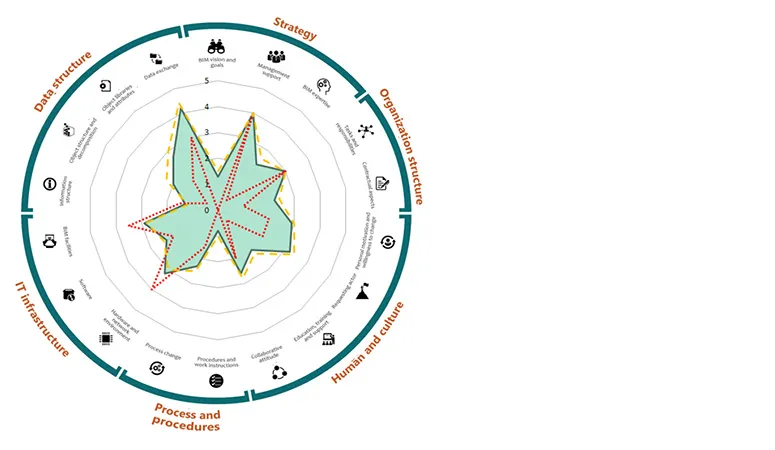
The respondents’ BIM maturity levels range from 1.6 to 4.0, with an average of 2.5, considerably higher than in the earlier sector analysis from 2016. However, as eleven of the thirteen respondents are members of the BIM Working Group (figure 1, yellow line), the measurement is not representative of the industry as a whole. It primarily maps the BIM performance of members already actively using BIM, and to a lesser extent that of the industry as a whole. The score means little in isolation and needs to be interpreted in light of what is desired. Every organisation should therefore formulate a BIM ambition.
The research indicates that market demand is the main reason façade contractors adopt BIM. Other drivers include gaining a competitive advantage, reducing the cost of failures, delivering a higher-quality finished product with maintenance options, and creating a more efficient data and production process.
Growing BIM maturity
Successful BIM adoption primarily requires changes to processes and organisation. First, every organisation needs to develop a BIM execution plan to integrate BIM into its internal processes. The execution plan developed by the BIM Working Group can serve as a starting point. The added value of BIM needs to be established and translated into organisational objectives and a BIM vision. BIM adoption can be accelerated by taking a more proactive approach and providing BIM support that is less dependent on demand. The project-based approach means that initial investment is currently a barrier. By assessing current and future resource requirements over the long term, organisations can make targeted investments. BIM maturity can be further increased by building on the data structure and agreements developed by the working group, and by establishing a document management system within each organisation.
Featured image: BIM Working Group
Question about this story? Ask your question
Keep following this
Get an email when a new story is published. No account needed.
- ThemeFrom facade model to production
- SubjectVMRG







