








VMRG online Expert Session ‘Developments in glass’
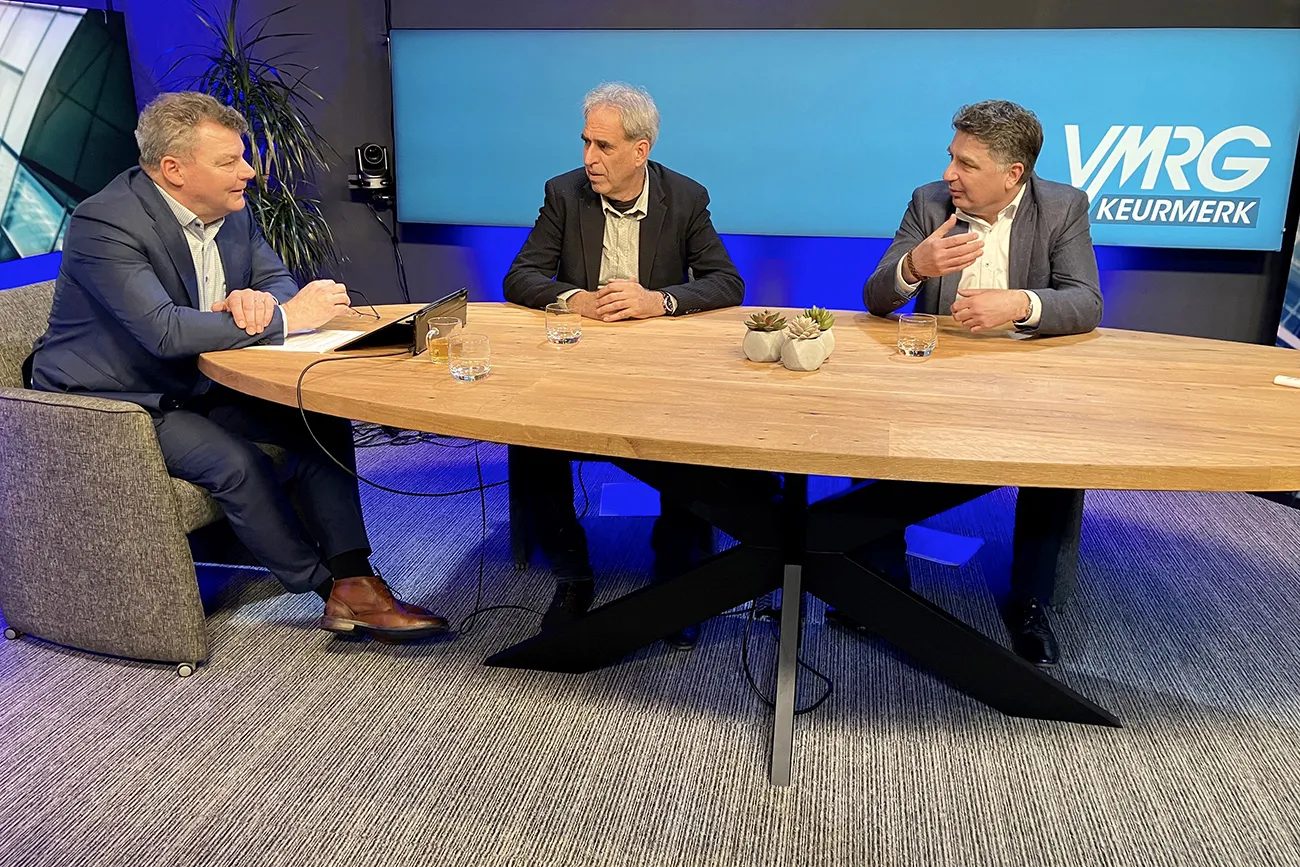
On 14 March, the VMRG online Expert Session ‘Developments in glass’ took place. Experts Roy van Leeuwen, director of Kenniscentrum Glas, and Harm Spronk, director of De Groot & Visser, joined Henk Zoontjens, director of VMRG, at the table. We look back at some of the questions discussed during the session.
The Besluit bouwwerken leefomgeving (Bbl) introduces a new method for determining daylight in buildings. What does this mean for the use of glass?
Roy van Leeuwen: The method for determining daylight is set out in NEN-EN 17037, ‘Daylight in buildings’. NEN recently published guidance on the standard in practice guideline NPR 4057, ‘Daylight in buildings, Guidance on NEN-EN 17037’. The daylight factor method determines the distribution of daylight across a space and sets requirements for it. This simulates the actual amount of daylight entering a building using a 3D model.
Under the new standard, calculations can use the actual LT (light transmission) value of the glass. HR++ glass will therefore achieve a higher daylight factor than triple glazing. Solar control glass has a negative effect on the daylight factor. As a result, these types of glass, with their lower light transmission, may no longer be suitable for certain buildings unless the design is adapted.
Lower-CO2 glass products are a new development. Are they of interest to the façade industry?
Harm Spronk: A circular façade should contain as many circular products as possible, and that includes glass. There is certainly demand for this from customers. Public opinion and the focus on CO2 reduction also make this more urgent. It would be good to be able to demonstrate that recycled flat glass is being reused in new flat glass.
What do we mean by lower-CO2 glass products?
Roy van Leeuwen: CO2 emissions can be reduced by improving the production process, using furnaces that consume less energy, switching to hydrogen or renewable energy, and recycling more glass. This means that fewer raw materials are needed and the melting temperature is also lower, reducing the energy required by the furnace. Some recycled glass goes straight back into float glass production, while other glass comes from industrial processes. The industry is now exploring whether other types of glass, such as laminated glass, can be used to make flat glass again.
What other innovations are we seeing?
Roy van Leeuwen: Another innovation is dynamic glass. Applying an electric voltage makes it possible to change its light transmission. LEDs can be used with dynamic glass to display images on the glass. This turns the façade into a means of communication, for example for advertising. Vacuum glazing is also a positive development: it minimises the amount of material used while achieving very good insulation values, which benefits its footprint. In fact, this takes us back to the thickness of single glazing. Vacuum glazing is currently used mainly in the renovation market, but is under active development.
Fire-resistant glass causes visual distortion. How does this work in practice?
Harm Spronk: All parties need to take into account in advance that fire-resistant glass distorts the view. Fire-resistant glass in an office overlooking a motorway can cause problems. The distortion varies from one pane to another. People looking out from these offices may then feel “seasick”. Managing expectations in advance is important. The glass supplier and façade contractor must warn the customer about the distortion, as architects and developers are not always familiar with it.
How do you assess the visual quality of glass?
Roy van Leeuwen: There is no independent product standard for fire-resistant glass. There is one for standard insulating glass, NEN 1279. The standard also requires a great deal of interpretation. Kenniscentrum Glas has produced a document explaining various aspects. These include the viewing conditions, such as a distance of three metres, viewing the glass straight on and in diffuse daylight, and ensuring that nothing is marked. Kenniscentrum Glas is also often asked to assess whether particular issues fall within the scope of the standard.
How does a customer know what quality to expect when there is no standard?
Harm Spronk: As a façade contractor, you can establish various aspects of a project in a number of stages. The first step is to provide glass samples to the customer and, once approved, have them signed off. This records what has been agreed, both technically and visually. This includes the colour of the spacer to be used and the edge finish. The second step, on large projects, is to build a full-size mock-up that also includes the selected glass. The parties then inspect and sign off the mock-up. It is important that both the customer and the architect are involved at this stage, to manage expectations. When production starts, for example of unitised façades, the parties can inspect the first production unit. The customer must understand that elements such as the glass, profiles and colour can no longer be changed at this point. The final step is to install and present a benchmark on site. At this stage, only minor execution details can still be adjusted. If questions arise during construction, the parties can always refer back to the samples, mock-up, production units and benchmark that have already been approved.
How can a glass supplier stand out?
Roy van Leeuwen: A glass supplier can stand out by knowing its product and its customer, and by recommending the right products. I think there is still a great deal of room for improvement in the glass industry.
Question about this story? Ask your question
Keep following this
Get an email when a new story is published. No account needed.
- SubjectVMRG







