








Environmental legislation for façade construction

From data to a Category 2 card
The companies affiliated with VMRG are probably familiar with VMRG’s work on Category 2 cards, or cards containing industry data, in the National Environmental Database (NMD). This article clearly explains how VMRG moves from a request to a Category 2 card, including why some processes take longer than might initially be expected.
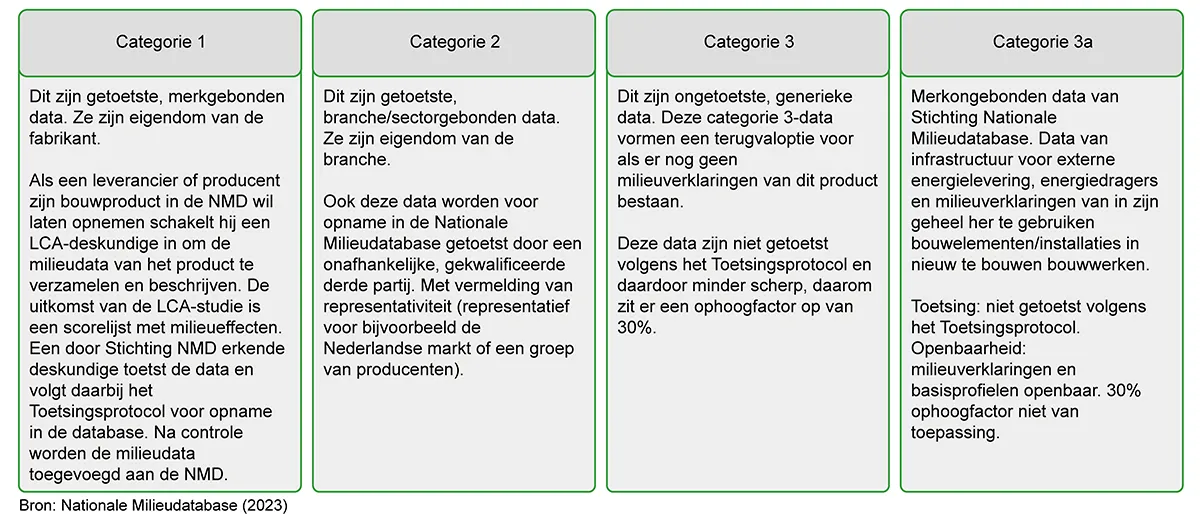
It is sometimes thought that there is no need to produce Category 2 cards when manufacturers can also produce their own Category 1 cards. In practice, however, Category 2 cards are important to the industry.
Industry cards
Architects and consultants submit permit calculations at an early stage, often before contractors have been selected for specific packages. For these early calculations, an industry average can be used, in the form of Category 2 cards, to demonstrate that the requirements are met at building level. Category 2 cards are used extensively, including by manufacturers without the budget or staff to produce their own cards.
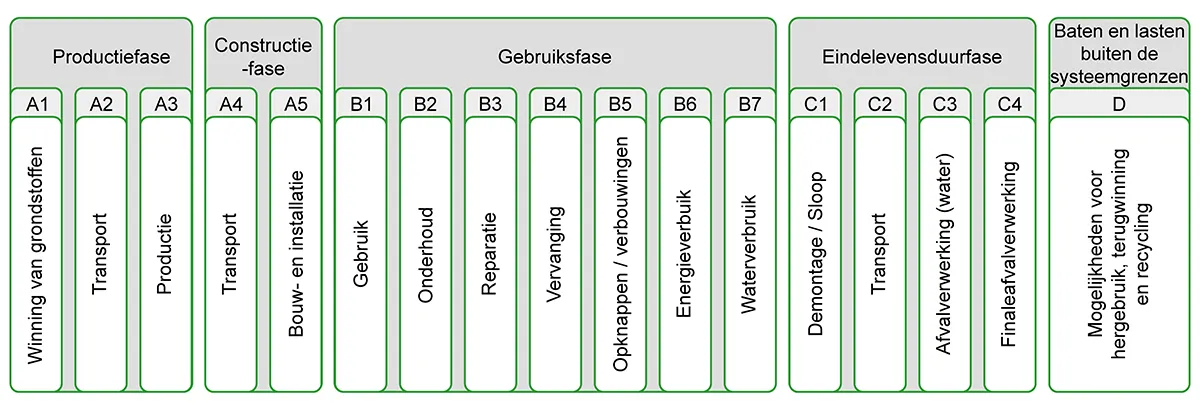
As explained earlier this year in Gevelbouw 1, a card for the National Environmental Database is produced in accordance with EN 15804. This standard describes how to carry out a Life Cycle Assessment (LCA), with additions set out in the Dutch PCR NEN-EN 17213:2020. This contains the Dutch calculation requirements for windows and doors.
Method
The industry data represents the members (façade builders) of the VRMG.
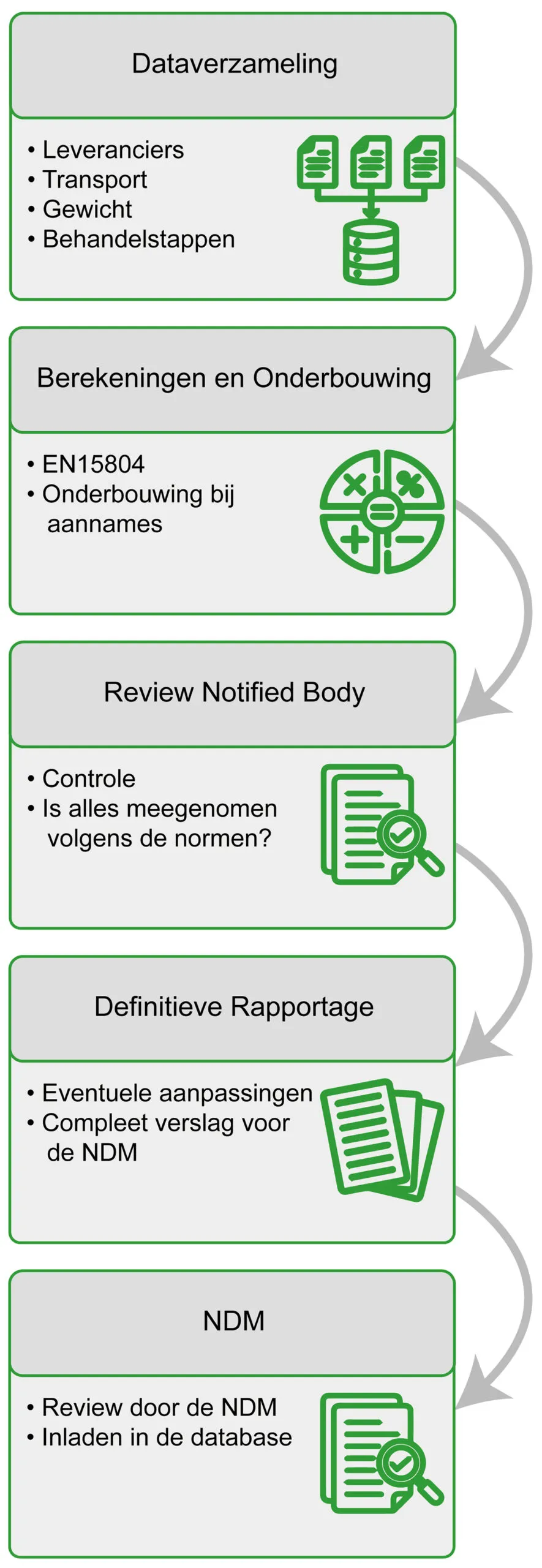
VMRG requests all A1 data from façade builders’ suppliers, such as systems companies. Broadly speaking, the following components are included, with details required on the specific material, quantity in kilograms or m2, supplier and mode of transport:
- aluminium outer shell;
- aluminium inner shell;
- aluminium glazing beads;
- surface treatment;
- corner cleats;
- thermal breaks;
- other rubber components; and
- fixings.
The systems companies are surveyed among VMRG members, with results weighted by market share. This is used to create a fictional VMRG window. These systems companies supply a fictional VRMG façade builder based at the average VMRG location in the Netherlands. The locations of the systems companies and the modes of transport are therefore required. An energy survey of all VMRG members provides insight into the amount and types of energy and/or gas required to produce one window. For the other LCA stages, the specific cleaning products used for the façade are also considered, for example. Together with the standards mentioned above, this data provides sufficient input for producing a robust EPD (Environmental Product Declaration) using LCA software.
Representative picture
Put briefly, it may seem straightforward for all parties to provide information. In practice, however, the information is held in different places and has to be collated internally. Not all companies are immediately willing to disclose their suppliers either. In such cases, VMRG signs a non-disclosure agreement, or NDA (Non-Disclosure Agreement).
It is also important to build a representative picture from all the data. For example, energy consumption figures from a large number of members are needed to establish a fair average. The more members provide this information promptly, the faster the overall process can proceed.
The calculations also take time, of course. VMRG has invested in training its staff to carry them out in-house. This gives it greater flexibility when preparing calculations.
Once VMRG is satisfied with the calculations, it submits them, together with the supporting data, to a notified body. The notified body checks every step to ensure that all the standards have been applied, the data is reliable and no steps in the process have been missed. The notified body charges for its work, making this an expensive undertaking, and can take up to 3 months to deliver its findings. The conclusion may be that some changes are still needed. VMRG then revises the calculations or provides further explanation of the supporting evidence.
Producing environmental cards for the National Environmental Database takes a great deal of time and money. This makes industry cards particularly important for smaller companies.
Question about this story? Ask your question
Keep following this
Get an email when a new story is published. No account needed.
- ThemeCircular facades with lower environmental impact
- SubjectVMRG







