








Environmental legislation for façade contractors

Sustainability strategy: standardisation
Sustainability debates often focus on laws, regulations, standards and guidelines. Examples include tighter MPG scores (Environmental Performance of Buildings) and the EPR scheme (Extended Producer Responsibility) for flat glass. These measures are intended to make the entire construction sector more sustainable.
A common goal is standardisation: agreements on products, services or processes. More standards could make it easier to connect what we produce now with what we produce in the future. They could also improve alignment between the inputs and outputs of different companies. But what exactly are standards?
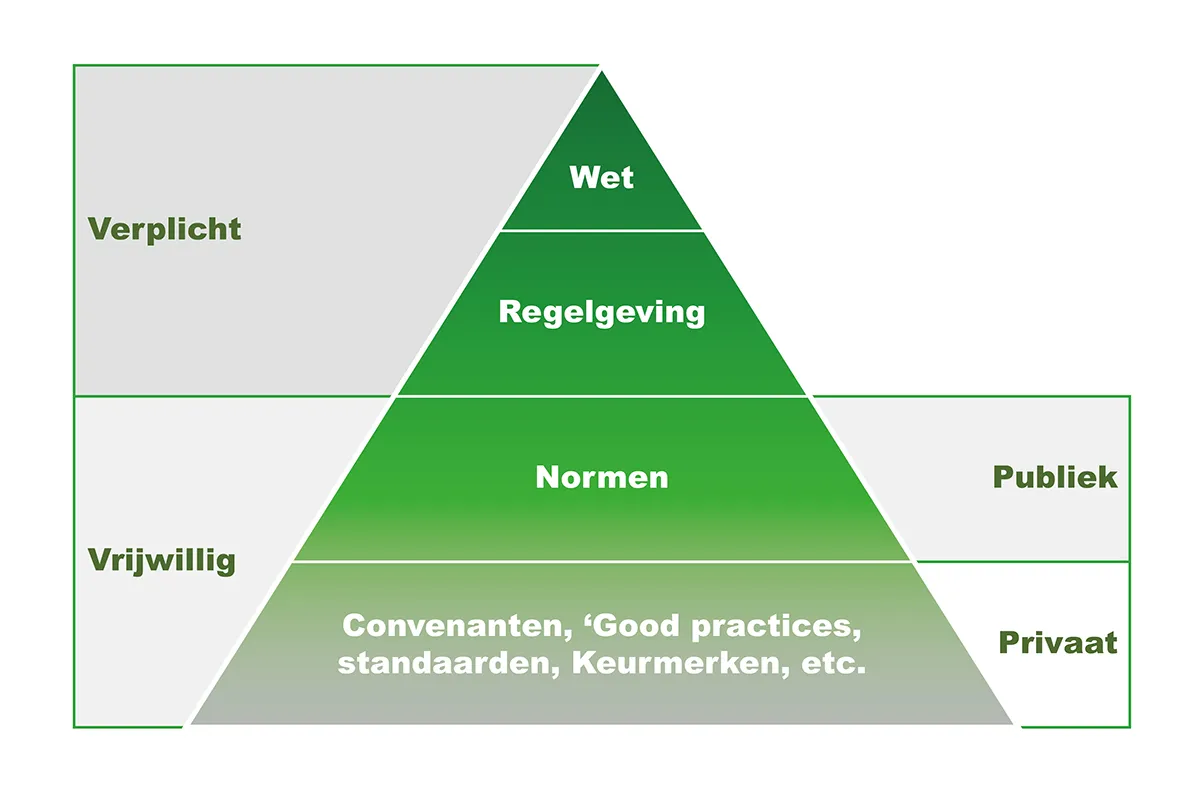
We need to distinguish between laws, regulations, public standards and private standards. Everyone is required to comply with laws and regulations. Public standards, such as technical standards, are voluntary, while private standards are developed by businesses.
Laws and regulations
A law is a formal, democratic decision made by the House of Representatives and the Senate, setting out a general framework. Regulations are the more detailed, practical rules for implementing it, drawn up by the government or a minister.
A good example of standardisation required by law and regulation is the USB-C charger. All manufacturers of consumer products supplied with a charger must comply with these regulations and can no longer design proprietary chargers.
Standardisation
Voluntary standardisation is often referred to as standardisation through technical standards. This is standardisation in which a body appointed by the government facilitates discussions between stakeholders, with a standard as the end result. In the Netherlands, NEN is the body appointed by the government. These standards are guidelines and there is no obligation to follow them. However, many standards are made mandatory by clients, or an industry agrees to work in accordance with a particular standard. In practice, then, there are limits to how voluntary they are.
Private standards
Finally, there are private standards. These are usually developed by the industry itself, as companies want to agree on a certain level of quality or way of working. A good example in the façade industry is the VMRG Keurmerk. Companies holding this quality mark are required to deliver in accordance with the quality agreements made between them.
Benefits of standardisation
With USB-C chargers now mandatory as a European standard, the days of a drawer full of different cables and plugs are over. Not every device even comes with a charger these days. Large companies resisted the change for a long time, as every charger sold meant a profit. Being able to charge all devices with the same charger has major benefits not only for the environment, but also for consumers.
Standardisation could also work in façade construction. As a practical example, consider fixings. If these were standardised across the entire façade sector, companies would never have specialist fixings left over after a project, need less storage space and tie up less value in stock. Employees would know straight away which values to use, and installers would only need to carry one size of tool. For the owner of the façade, it would be clear how repairs should be carried out, and at the end of its service life, a dismantling contractor would know how to remove the façade components. This would be an extreme example of standardisation, but there are certainly opportunities in the façade industry for the different stakeholders.
Clients could agree on a standard way of specifying work. Asking for the same values and calculations on every project would make it easier for companies to provide them and give them greater certainty. Public and semi-public bodies could adopt the same way of working everywhere, ruling out differences between municipalities, for example. Façade contractors could use the same installation method every time, so that other parties know what to expect when repairs are needed.
The advantage of formalising this is that all stakeholders can contribute, and the agreed approach will not be deviated from in future. For standardisation to succeed, it must remain workable over the long term.
Important for façade construction
Almost all voluntary standards and technical standards originate in industry. A problem or challenge is identified, and the most suitable way to address it is sought. Within the public domain, NEN offers various products that could provide an answer. In the private sector, industry associations can play a major role.
This also means that, as a stakeholder in the façade industry, you can have a say in how these standards are developed. Have any ideas or suggestions? Speak to someone at your industry association. Some agreements are already in development but are still open for consultation with the market, and your input is always welcome. Keep an eye on your industry association's newsletter!
Question about this story? Ask your question
Keep following this
Get an email when a new story is published. No account needed.
- ThemeCircular facades with lower environmental impact
- SubjectVMRG







