








Environmental legislation for the façade industry

From Life Cycle Assessment to the Environmental Performance of Buildings
The European and Dutch regulations are constantly changing. Whenever changes are relevant to façade contractors, VMRG shares them with its members.
The terminology used in these regulations can sometimes be difficult to understand. This article therefore explains some of the underlying data and assessment methods.
Life Cycle Assessment
We want to use the world’s resources sparingly and make good choices. The Life Cycle Assessment (LCA) method was developed to determine a product’s environmental impact. The results of these calculations can be used to improve products and production processes. This means products can become increasingly environmentally and climate friendly.
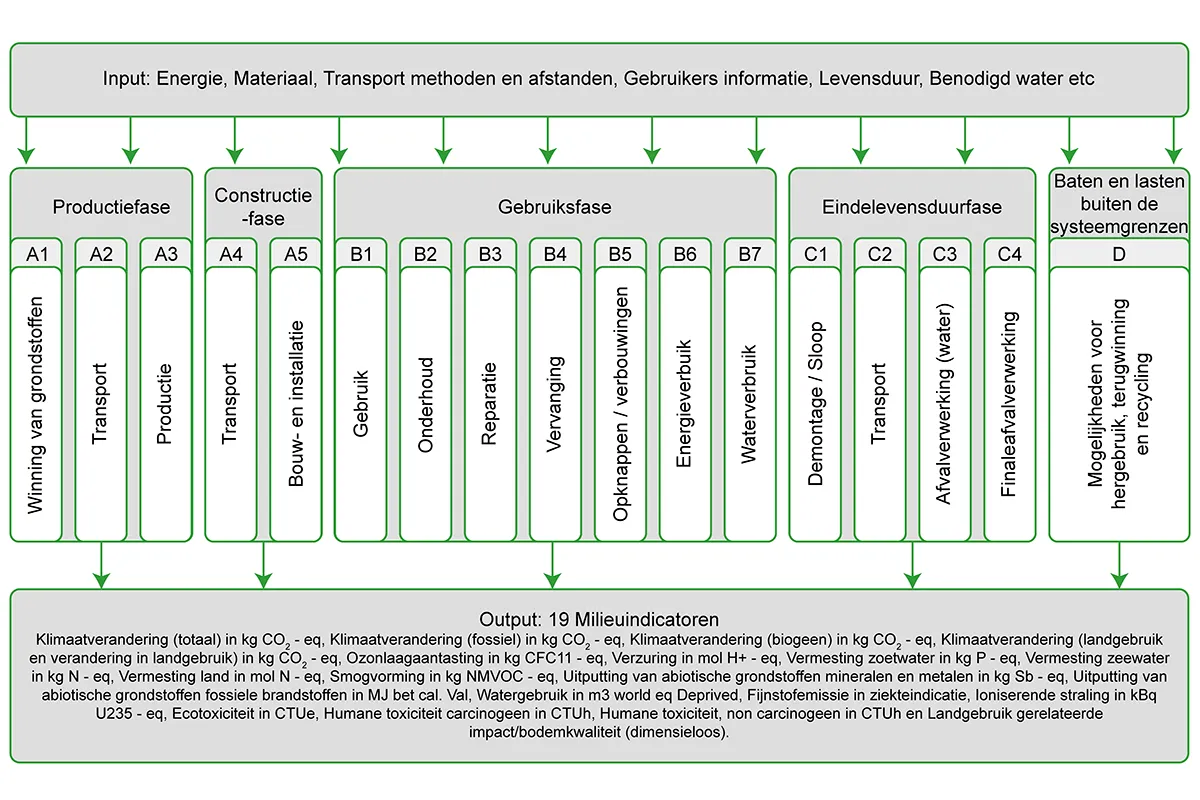
An LCA calculates the environmental impact at the different stages of a product’s life cycle. These stages are divided into modules A1 to D (see image). In Europe, including the Netherlands, EN 15804 is used as the assessment method for life cycle analysis calculations. For specific product groups, such as windows, doors and sliding doors, additional assumptions have been laid down at European level in the Product Category Rules NEN-EN 17213:2020.
For the Dutch market, the ‘Dutch Supplement to Product Category Rules NEN-EN 17213:2020 Windows and Doors’ has been developed (see also the article ‘New rules for LCAs’ elsewhere in Gevelbouw). Among other things, it sets out the reference dimensions, whether the use of a crane during installation should be included, how transport is calculated, how the impact of cleaning is calculated, and how to deal with the replacement or repair of components. The environmental impact of 1 m2 of window is always calculated back from a reference size.
The LCA produces 19 different indicators showing the environmental impact of the product.
EPD and MKI
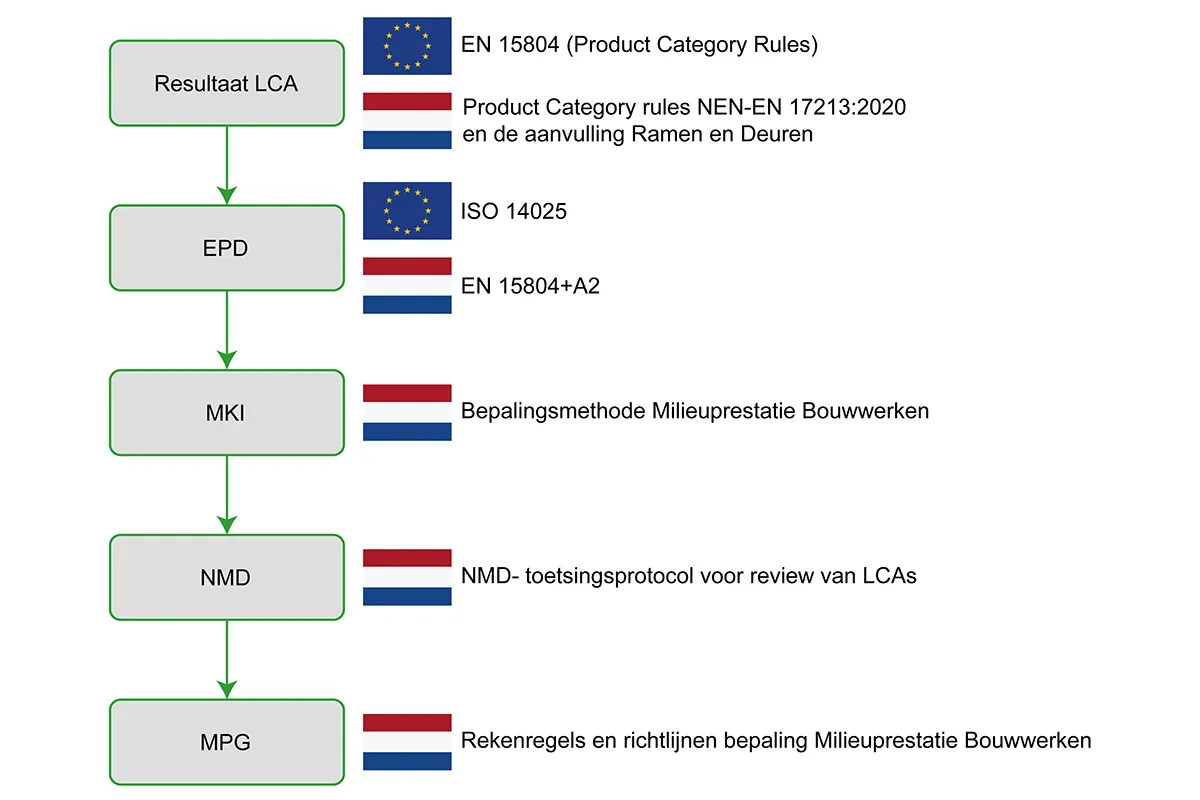
The results and calculations of an LCA may contain commercially sensitive information. ISO 14025 sets out, through the Environmental Product Declaration (EPD), a standard for how companies can present and share these results.
To make the results of an LCA easier to understand and interpret, a method has been developed in the Netherlands to convert the 19 indicators produced by an LCA into a single figure, the Environmental Cost Indicator (MKI).
Each environmental indicator has a weighting factor. These weighting factors are set by Dutch policy and may change depending on research and policy objectives.
National Environmental Database
These EPDs and their associated MKI scores can be submitted to the National Environmental Database (NMD) after review by a notified body. The database distinguishes between three categories:
- Category 1 cards are company-specific cards. An LCA is carried out using actual data from a company and its suppliers.
- Category 2 cards are industry averages. LCA data from participating companies are used to calculate an industry average, based on average distances, average weights and average materials used. Default values are often used for category 2 cards. After all, these calculations cannot take into account all company-specific information, such as green electricity or different waste scenarios. In some cases, this means that a less favourable scenario has to be assumed.
- Category 3 cards are generic material or product cards. They are based on standard information, with 30% added to the result for this scenario. These cards are included in the NMD to fill gaps.
Environmental Performance of Buildings
To calculate the impact of an entire building, we add together the MKIs of all the different products in the building. The result is the Environmental Performance of Buildings (MPG) score. The current limit for new homes is 0.8 euros/m2/year. The government’s aim is to tighten this limit in due course.
How is the MPG score used? When a building is designed, calculation tools are used to determine how it can be built within the limit of 0.8 euros/m2/year. This calculation must be submitted with the application for an environmental permit. Architects and consultants often use category 2 and 3 cards because the specific products and brands to be used are not yet known. Category 1 cards can be used at a later stage.
Working together
This legislation is important during the preparation stage for consultants and clients, and a better score on a category 2 or category 1 card therefore directly leads to more work.
To achieve a better score as a company (cat. 1), it is useful to carry out an LCA to establish the current situation and identify where improvements can easily be made. For example, work with national or European suppliers, invest in green electricity or try to use less material.
Work together with one another and the trade association to collect data for a category 2 card. At the initial calculation stage, no specific company is selected (category 1), but products may be ruled out if they score poorly on category 3 cards. Reliable category 2 cards benefit the entire industry.
Question about this story? Ask your question
Keep following this
Get an email when a new story is published. No account needed.
- ThemeCircular facades with lower environmental impact
- SubjectVMRG







