








FaSA makes facade inspections possible from the office
A pilot was recently carried out to test an innovative way of inspecting the facade of an office building in Leiden. Drone photography and a laser scanner were used to map the entire facade. The results are being processed into a 3D model, allowing the inspection itself to be carried out from behind a desk.
The pilot is part of the Facade Service Application (FaSA) project. For three years, Aeroscan, Spotr.ai (Octo) and VMRG have been working on objectively measuring the technical and aesthetic performance of building envelopes. Drones and artificial intelligence are among the technologies being used.
3D model
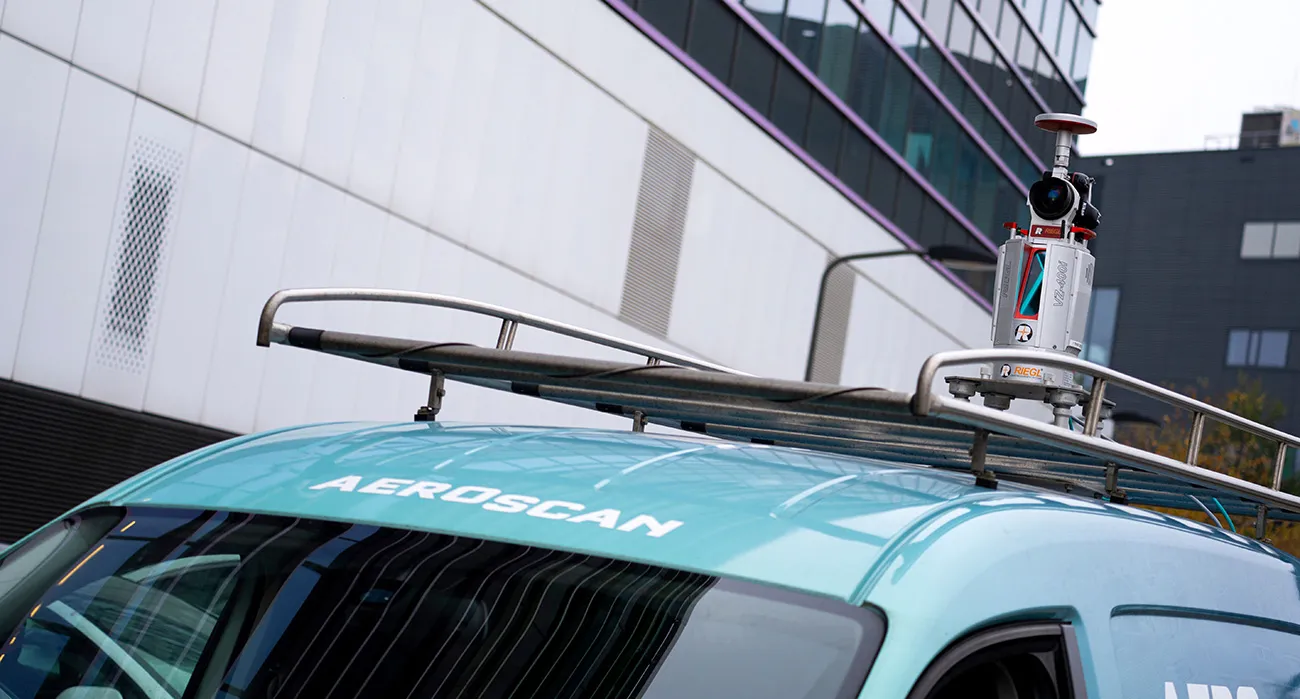
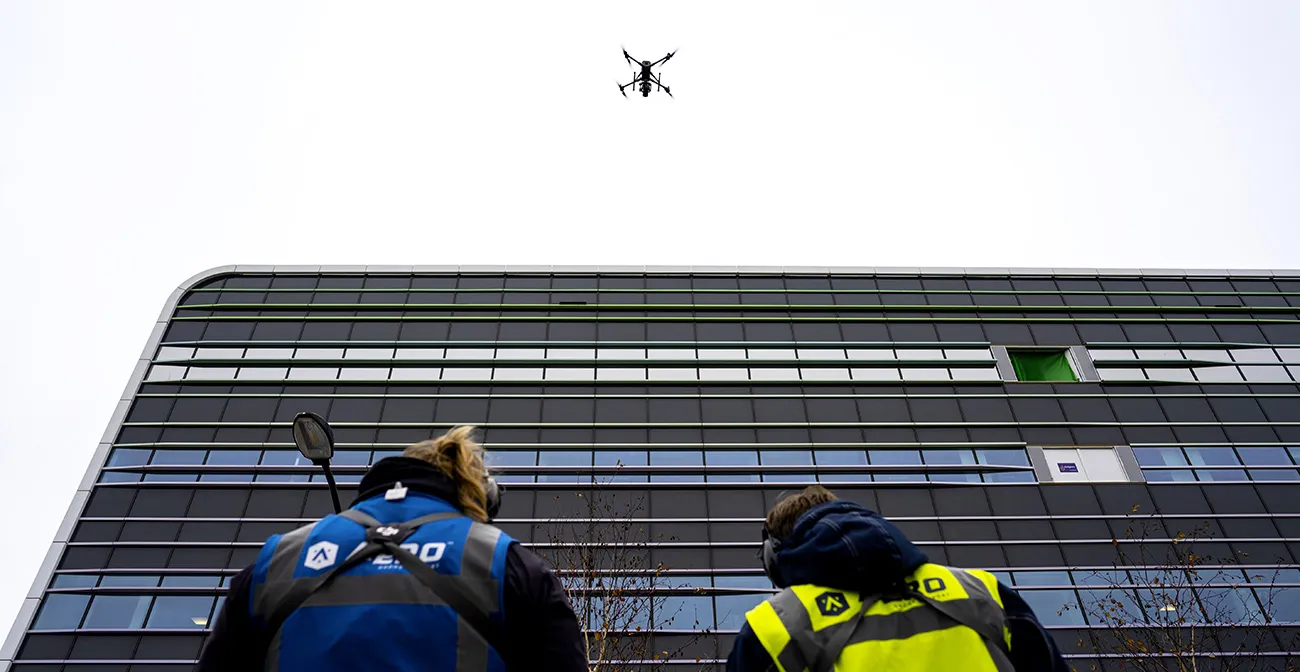
Pascal Schrijver of Geveladvies Ingenieursbureau, which was commissioned to inspect the external facade in collaboration with Gevelbeheer Nederland, explains that this is a visual inspection. “As usual, we do this from a gondola that travels around the entire building, carrying two technicians. They inspect everything, including the seals, connections, panels and glazing beads, to check for defects or damage and see whether any components need replacing. We also commissioned Aeroscan to map the building using a drone and a laser scanner as part of the pilot.” Stefan Quak of Aeroscan explains how the process works on site. “A team of specialists captures as much of the facade as possible. This means collecting image data of every angle and component so that we can reconstruct it digitally as accurately as possible. We do this through photography, both to identify defects and to help create a 3D model. We also use laser scanning, which provides an efficient way of recording the object's geometry. This also contributes to the 3D model. The laser scanning and photography are carried out both from the ground and from the air. The laser scanner is mounted on top of a car that drives around the building. A team operates a professional drone to take photographs.”
Accurate measurements
The data collected is then anonymised, with people made unrecognisable, for example. An accurate 3D model is delivered a few weeks later. “The 3D model can be converted into building components,” Quak explains, “so that the quantities and dimensions of each component are known. It can also be used to carry out an inspection using the photographs, digitally recording defects in 2D and 3D and automatically translating their effects into condition ratings (NEN2767).” Schrijver adds: “If we can see not only defects and damage in this model, but also the exact measurements, then we can order the right replacement materials straight away. We can now make a sound comparison between the results of the different inspections, and we are naturally very keen to see what that shows.”
Visual technology
Quak does not see this process as an immediate replacement for the current one. “I see it primarily as applying this visual technology to the existing process and its users. Our software supports the preparation of a long-term maintenance plan. It is great to see several parties, including facade partners and inspection firms, embracing it and using it for their clients.” Schrijver sees a future for this technology in facade construction. “A drone inspection lets you carry out a survey much faster and makes you less dependent on the weather. An inspection using a gondola takes one to two weeks for a project like this, while a drone takes one to two days. The advantage is that office work can continue as usual, whereas a gondola inspection depends on the weather. Two of our own knowledgeable staff are in the gondola. They can now carry out the inspection from their office chairs. In an ideal world, you would fly a drone every year and overlay all the data to see what has changed, for example wear, ageing or specific defects. If a problem arises in the meantime, you can immediately investigate its possible cause in detail.” Quak agrees that follow-up inspections would then consist solely of collecting data to monitor degradation. “This can be done with standard drone photography, which the inspector or building manager can easily carry out themselves. That is why Aeroscan now offers a Drone-as-a-Service product, providing users with an easy-to-use drone, along with training, servicing, maintenance and permits, so they can collect new photographs themselves for follow-up inspections. The photographs are uploaded to our Twinspect software and linked directly to the correct location in the 3D model, giving you up-to-date data. You can then immediately use that data to record defects, condition ratings and an up-to-date long-term maintenance plan.”
Efficient
Schrijver sees drone inspections as a way to generate large amounts of data more safely, sustainably and efficiently. “The question for now is how much detail you can get from the 3D model. We may be able to see that something is wrong without having enough detail to assess it fully. Even so, this would be useful, as you could inspect those areas more closely using a gondola without having to access the entire facade. But naturally, we hope the drone will eventually be able to take over the entire inspection. We are certainly interested in exploring whether, in the future, we could carry out interim inspections ourselves using ‘Drone-as-a-Service’, with the right training.”
FaSA
Quak says that the FaSA project has already generated considerable experience with this new technology for facade inspection and management on residential properties and historic buildings. “That makes the step to offices a smaller one. Of all the property sectors, offices may be the best fit for this technology. They require detailed inspections and are often difficult to access from the outside. We want this new technology to become part of the existing inspection process and the organisations involved. That is precisely why FaSA was launched a few years ago.”
FaSA is made possible in part by support from Kansen voor West II, EFRO subsidy.
Question about this story? Ask your question
Keep following this
Get an email when a new story is published. No account needed.
- ThemeExtending the life of existing facades
- SubjectVMRG







