








The circular façade economy: taking the lead together before voluntary becomes mandatory
The exploratory study into the circular potential of façade construction has recently been completed. But what does this mean for the façade industry?
One thing is clear. If we continue as we are, façade construction will not be far enough along by 2030 to be 100% circular and 100% CO2-neutral halfway through the century. That may be possible for individual façade components, but not for complete façade elements.
Still short of 100%
Worse still, even if every circular measure currently under consideration is implemented, compensation will still be needed in 2050 to get close to 100%. This is clear when the results of the calculations in the study are measured against the circularity and climate targets set by the Dutch government and Europe. This covers all relevant measures, from recycling, product design and logistics to financing, value retention, subsidies and tax measures. It is worth noting that this assessment is based on current knowledge.
Demand for circular materials
In addition, too much of the material that is urgently needed is still being lost from the loop, making it difficult to achieve façades with an ever higher proportion of material from circular sources. Material is sent to other continents, used in lower-grade applications or other loops, or still partly sent for incineration or landfill.
Forecasts point to a growing need for buildings, and therefore a growing ‘façade stock’, up to 2030. In principle, that is good news for façade companies. But it means that everything removed from façades will be needed, and more, to go back into façades through reuse or recycling.
How long will it remain voluntary?
The Dutch government and Europe are also increasingly inclined to use financial measures to influence behaviour, such as putting a price on CO2 emissions. In future, simply ‘carrying on as before’ will affect profitability. Much is still voluntary for now. The question is not whether that will remain the case, but for how long. The inclusion of environmental performance calculations in the Dutch Building Decree is a good example. They may not always be complied with, and the threshold values may be generous, but these calculations are mandatory. The point is that the threshold values are to be halved in stages by 2030. Companies whose environmental performance is not up to scratch will gradually find themselves under pressure. This is avoidable for façade construction, provided the right steps are taken now.
Exploratory study
The circular potential was not assessed and conclusions drawn overnight. The Ministry of Infrastructure and Water Management and the Ministry of the Interior and Kingdom Relations commissioned an exploratory market study to examine the transition to a circular façade economy in greater detail. The study was completed last summer.
The following trade associations were closely involved in carrying out the study: Vereniging Metalen Ramen en Gevelbranche (VMRG), Vereniging Kunststof Gevelelementenindustrie (VKG), Nederlandse Branchevereniging voor de Timmerindustrie (NBvT), Vlakglasrecycling Nederland (VRN) and Algemene Branchevereniging Hang- en Sluitwerk (VHS). The research consortium, led by Alba Concepts, also interviewed around 50 member companies and stakeholders. The study considered all the factors that could play a role in improving circularity. One example is ‘design for disassembly’: how easily can components be dismantled without damage? Another is the impact of changing material flows, with more material recovered from the façade stock for new façades or reuse.
Scenarios
The study also took into account the influence of different scenarios.
The first scenario considered the effects of taking action on ‘product (design) and organisation’ across various circular business models. This is largely within companies’ control, but further collaboration can create synergies and reduce costs, particularly in logistics.
The second scenario examined the barriers and opportunities involved in improving circularity from a financial perspective. Could the availability of templates for alternative financing, contract and valuation models help drive progress? Digital tools and platforms such as Cirlinq, which give you a dashboard of your façade stock, can also help significantly increase the residual value of a façade.
The third scenario looked at ‘institutional frameworks’, in other words how legislation and regulations can make a positive contribution. The study examined the impact of extended producer responsibility, the extension of collective agreements to an entire industry, subsidies such as MIA/Vamil and tax measures. It also found that legal issues such as copyright, the division of tenders into lots and ownership rights can hinder circular business models.
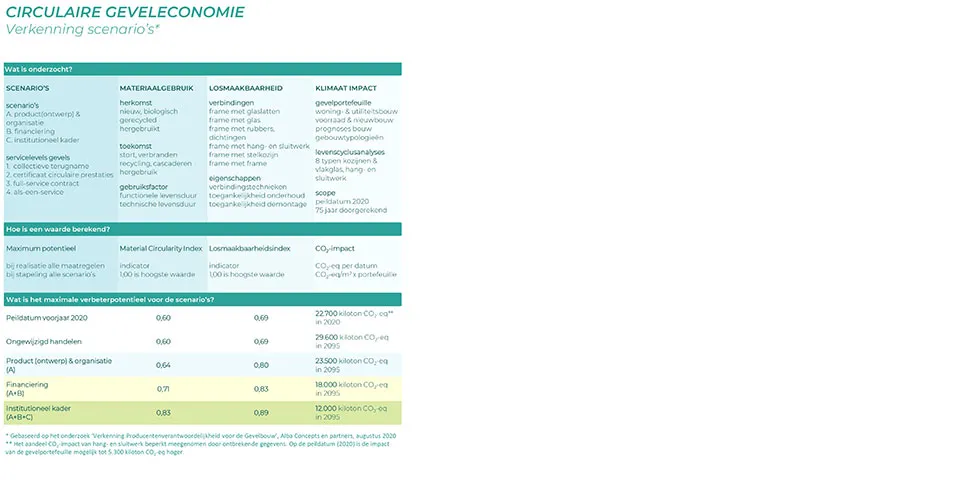
See the table above for a brief overview of the issues examined.
Enormous potential
The façade industry therefore has enormous potential to improve circularity and reduce CO2 emissions. Of course, the industry has been working on circularity and CO2 reduction for years. Recycling systems for parts of the façade have been available for some time. Existing certification schemes already set some requirements in this area. And what about trading companies that have organised their own take-back of façade products and materials? Or manufacturers that have embraced new business models, from take-back obligations and service contracts to façade leasing? The circular façade economy builds on this experience, knowledge, tools and more.
Completion of the exploratory study marks the start of working with all parties to make progress. An important next step is to reach a circular façade economy chain agreement, setting out binding commitments. In a ‘circular façade economy’, what was once a window, door, frame or curtain wall becomes part of a façade again in the next cycle. Achieving this requires a national recycling system for metal, plastic and timber façades, including flat glass and hardware. An important part of the agreement will therefore be the development of collective, industry-wide extended producer responsibility, or a collective take-back system, for façades. This will provide better control over raw materials and ensure they are kept within the façade sector. Companies are being asked to help shape the system, including its quality requirements and certification. A Generally Binding Declaration (AVV) will then prevent unfair competition. The industry associations need the government’s support to achieve this.
Platform bringing industry associations and government together
A Circular Façade Economy platform bringing industry associations and government together will then provide a forum for ongoing dialogue and enable the industry to realise the full potential of façade construction step by step through innovation projects and measures. In short, taking action now will make a world of difference to the position of façade construction in 2030.
Question about this story? Ask your question
Keep following this
Get an email when a new story is published. No account needed.
- ThemeCircular facades with lower environmental impact
- SubjectVMRG







