








TU Delft students unveil prototype of modular, energy-producing apartment
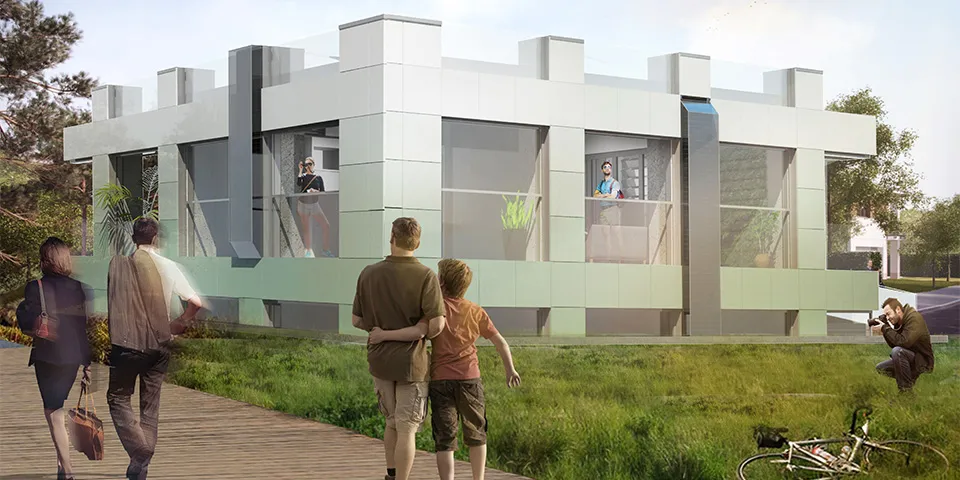
The TU Delft MOR (Modular Office Renovation) team, made up of 54 students, unveiled a prototype on 31 May 2019 that transforms an inefficient office into an apartment that produces more energy than it uses. VMRG and VMRG members De Groot &Visser, Metaglas, VPT Versteeg and Smits Rolluiken en zonwering are involved in the project.
The team will take the prototype to Hungary in July 2019 to compete in Solar Decathlon Europe 2019 (SDE19), an international student competition for energy-efficient homes. Built by the students themselves, the prototype is a full-scale section of an inefficient office converted into a 50 m2 apartment with a 25m2 courtyard garden.
From inefficient offices to A+++ homes
“We see two major challenges in the built environment in the Netherlands: the large number of inefficient offices and the strong demand for affordable homes for first-time buyers,” explains Siem van Sluijs, partnerships manager for the MOR team and an architecture student. “Around 55% of all offices in the Netherlands have an energy rating below C and therefore perform poorly. A recent change in regulations means that offices with an energy rating below C will be banned from 2023. In addition, one million homes are to be built by 2030. Our prototype could help address these challenges,” says van Sluijs.
Net positive
The prototype is based on a modular, ‘net-positive’ apartment. “By net positive, we mean that the building produces more energy than it uses, for example. The air entering the building is also filtered to create a healthy indoor climate, and food can be grown inside the tower,” explains Scheenaart. The MOR team focuses on 5 aspects of net positivity: energy+, water+, air+, biomass+ and materials+.
Modular design
The entire renovation of office buildings can be carried out using four modules: a façade module, a bathroom/kitchen module, a bed/desk module and a wall module. This makes the renovation of poorly performing offices accessible and affordable. The modules can also be easily reused in other buildings. Since residents have individual requirements and preferences for their homes, they can arrange the modules to suit their needs. For example, the apartment can be made larger or smaller, and an extra bedroom or bathroom can easily be added. This makes the design highly future-proof.
Question about this story? Ask your question
Keep following this
Get an email when a new story is published. No account needed.
- ThemeCollaboration in the facade industry
- SubjectVMRG







