








VMRG | Images sought for Façade Service Applicatie image recognition model
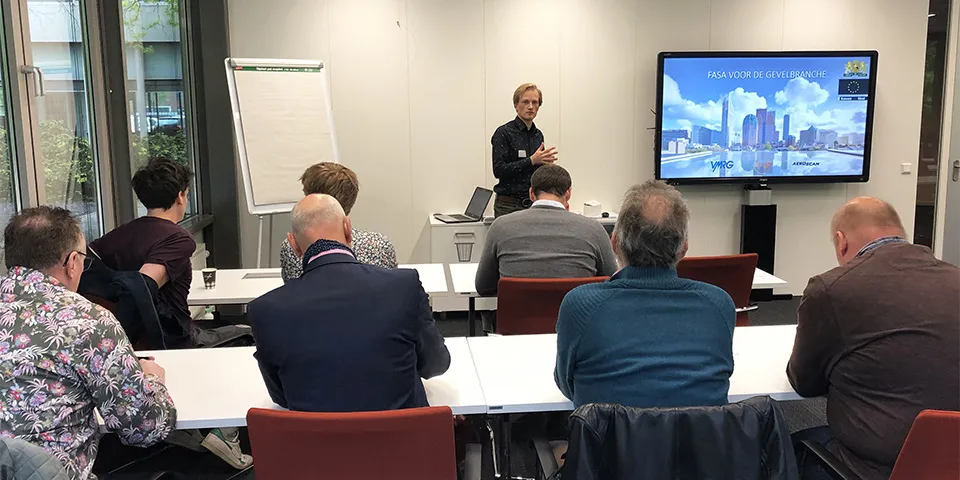
The FaSA (Façade Service Applicatie) project got under way in mid-2018. VMRG, Octo and Aeroscan are working with industry partners and research organisations to monitor the condition of the building envelope using digital technologies such as drones, sensors and artificial intelligence. To ensure FaSA meets the specific requirements of non-residential construction, an initial meeting with façade contractors, maintenance companies and suppliers was held in early May.
The parties involved enthusiastically began exploring what FaSA could mean for non-residential buildings and which defects it could help identify. The next steps will be determined based on the results. The first step is to collect images of façade defects to train the image recognition model, with the technology then to be tested in pilot projects.
Circular principles
The insights gained through FaSA will better enable property managers, housing associations and façade product manufacturers to take a strategic approach to maintenance and performance. More efficient and effective use and management of materials based on circular principles is not only a societal aspiration, but increasingly a business necessity. This requires value creation to be decoupled from materialisation, which can be achieved through new business models and service contracts. With this extended involvement in products, façade contractors need performance monitoring, maintenance optimisation and objective evidence of performance, for example for financiers.
Objective NEN2767 inspections
Where maintenance is still often reactive or planned, a condition-based approach promises more targeted, efficient maintenance that prevents degradation and consequential damage at an early stage. Predictive maintenance enables companies to anticipate future degradation and discuss solutions with customers rather than problems. FaSA makes condition assessments during NEN2767 inspections more objective and increases the speed, accuracy and accessibility of inspections. The project will also focus on making aesthetic condition measurable, an aspect currently underrepresented in NEN2767. It will also investigate which tools are best suited to identifying aesthetic and technical defects, and what information is needed to inform decision-making.
Image recognition models
Octo and Aeroscan are currently working with housing associations on a programme to develop sensors, image recognition models and drone flight procedures. After obtaining permission to fly drones in built-up areas, they successfully completed several pilots. The pilots show that, compared with sample-based manual inspections, the inspection rate across an average portfolio can rise from 3% to 81%, enabling more accurate decision-making. The 3D visualisation Aeroscan can create from the images provides a highly accurate picture of current conditions. Octo uses algorithms capable of recognising and classifying objects and defects with pixel-level accuracy, a highly advanced capability.
Do you have images of façade defects? You can contribute to this innovative project by submitting them with a description of the defect. Please contact Henk Zoontjes at [email protected].
*This project is made possible in part with support from Kansen voor West II, EFRO subsidy.
Question about this story? Ask your question
Keep following this
Get an email when a new story is published. No account needed.
- SubjectVMRG







