








Water tightness of façades in practice
Text and images Kettlitz Gevel- en Dakadvies
Has the introduction of the Besluit bouwwerken leefomgeving changed anything regarding the water tightness of façade constructions?
Buildings must still be watertight under the Besluit bouwwerken leefomgeving (Bbl). This statutory requirement applies to a building’s external envelope, which includes its façades. But how did the regulations work again, how can compliance be tested, and what points need attention? The following is a brief overview.
Legislation and regulations
The test method for determining water tightness is set out in NEN 2778. In addition to this Dutch legislation, European rules stipulate that curtain walling, windows and doors must bear CE marking. One element of this CE marking is a water-tightness test carried out in an accredited laboratory. Windows and doors are tested in accordance with NEN-EN 1027, and curtain walling in accordance with NEN-EN 12155. Both test methods are aligned with NEN 2778. The test results are then used to classify a door or window system under NEN-EN 12208 and a curtain walling system under NEN-EN 12154.
At project level, the façade contractor must ensure that the performance of aluminium façade elements meets the specified water-tightness requirements. These may be the minimum requirements under the Bbl or a potentially higher requirement under private law set out in the contract documents. The minimum test pressure is determined in accordance with NEN 2778 and depends on the building’s height, the surrounding buildings and the wind region.
Why test on site?
For a client or contractor, laboratory test results are sometimes not sufficient to demonstrate the water tightness of a façade. This is because laboratory tests demonstrate only the water tightness of individual elements under ideal conditions, and do not test building junctions. To assess whether a façade construction actually meets the specified water-tightness requirement, an on-site test can be carried out on a representative section of the project façade. The test is carried out in accordance with the standards mentioned above.
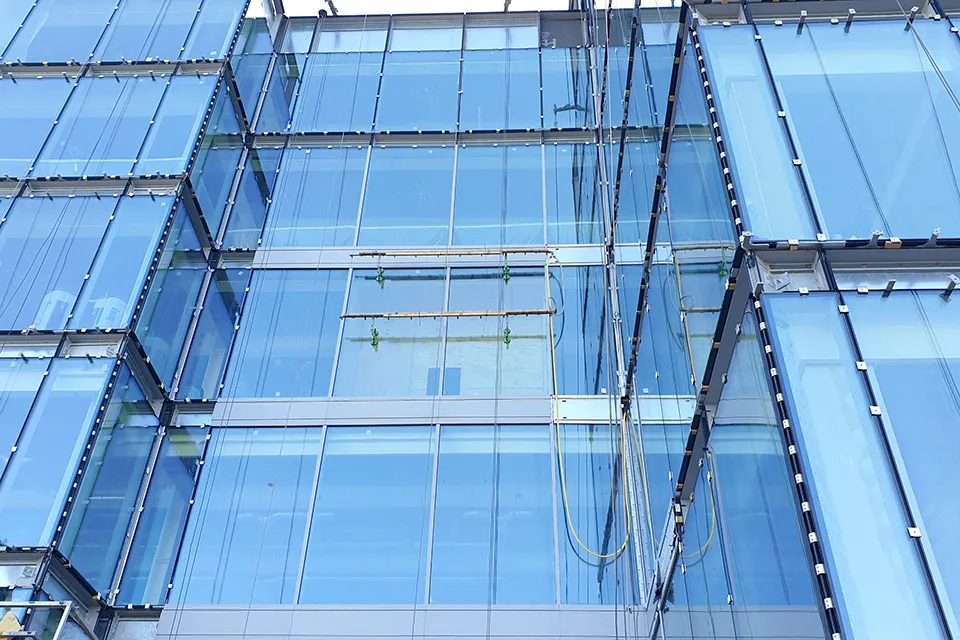
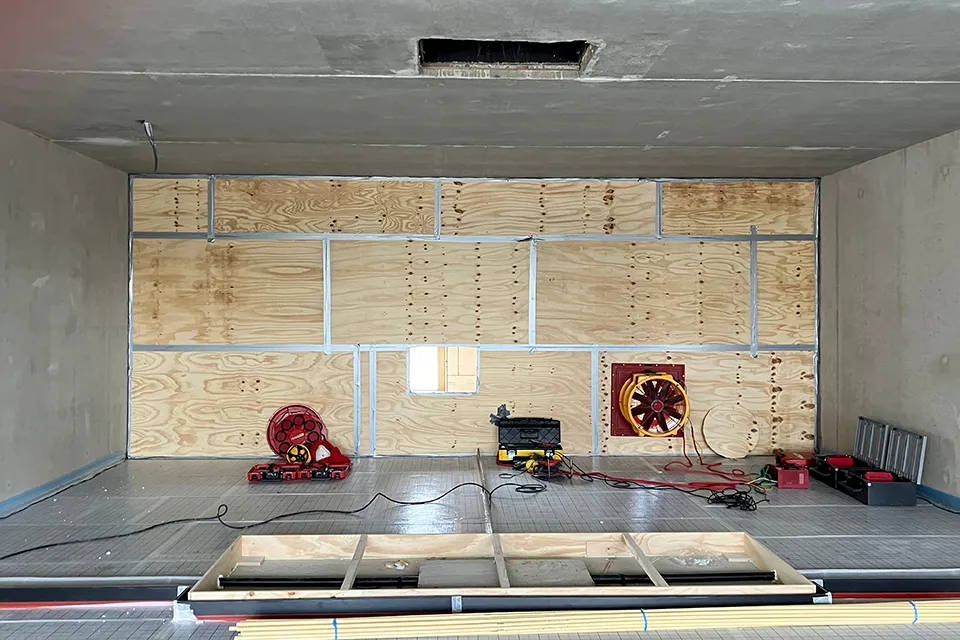
Our experience with on-site testing is that standard façade elements generally meet the specified water-tightness requirements, but there are exceptions. After all, installation is still a human endeavour. Certain types of façade element are critical, particularly where high water-tightness requirements apply. These include special elements such as fire-resistant window frames, sliding doors, rebated double doors and doors with a low threshold, as required for accessibility under the Bbl. In addition to omissions in the façade elements themselves, there may be defects in the seals around them. On-site testing checks compliance with the water-tightness requirements. For the test, an airtight test chamber is built on the inside of the façade section (see photo), and a water-spray apparatus is installed on the outside (see photo), in accordance with the standards mentioned above.
Points to consider
To limit the risk of water-tightness defects, it is advisable to check the detailing for air permeability and water tightness in advance. It is also useful to test a representative section of the façade in a laboratory before production begins, so that any issues with façade elements can be identified at an early stage. However, these results are not representative of real-world conditions. For that reason, it is valuable to build a mock-up of the seals to be installed on site and have it assessed. This provides insight into the actual installation and any design challenges. Finally, an on-site water-tightness test can be carried out. It is advisable to include the façade finish in this test, so that the completed façade is tested. It is best to carry out the test as early as possible in the construction process. Any issues or defects can then be identified in good time, and adjustments can often still be made easily.
In summary, the approach to achieving a watertight façade under the Besluit bouwwerken leefomgeving is no different from before, and remains an important consideration at every stage of the construction process.
This article was produced in collaboration with Kettlitz Gevel- en Dakadvies.
Question about this story? Ask your question
Keep following this
Get an email when a new story is published. No account needed.
- SubjectVMRG







