








Online expert session ‘Improve the environmental performance of your product’
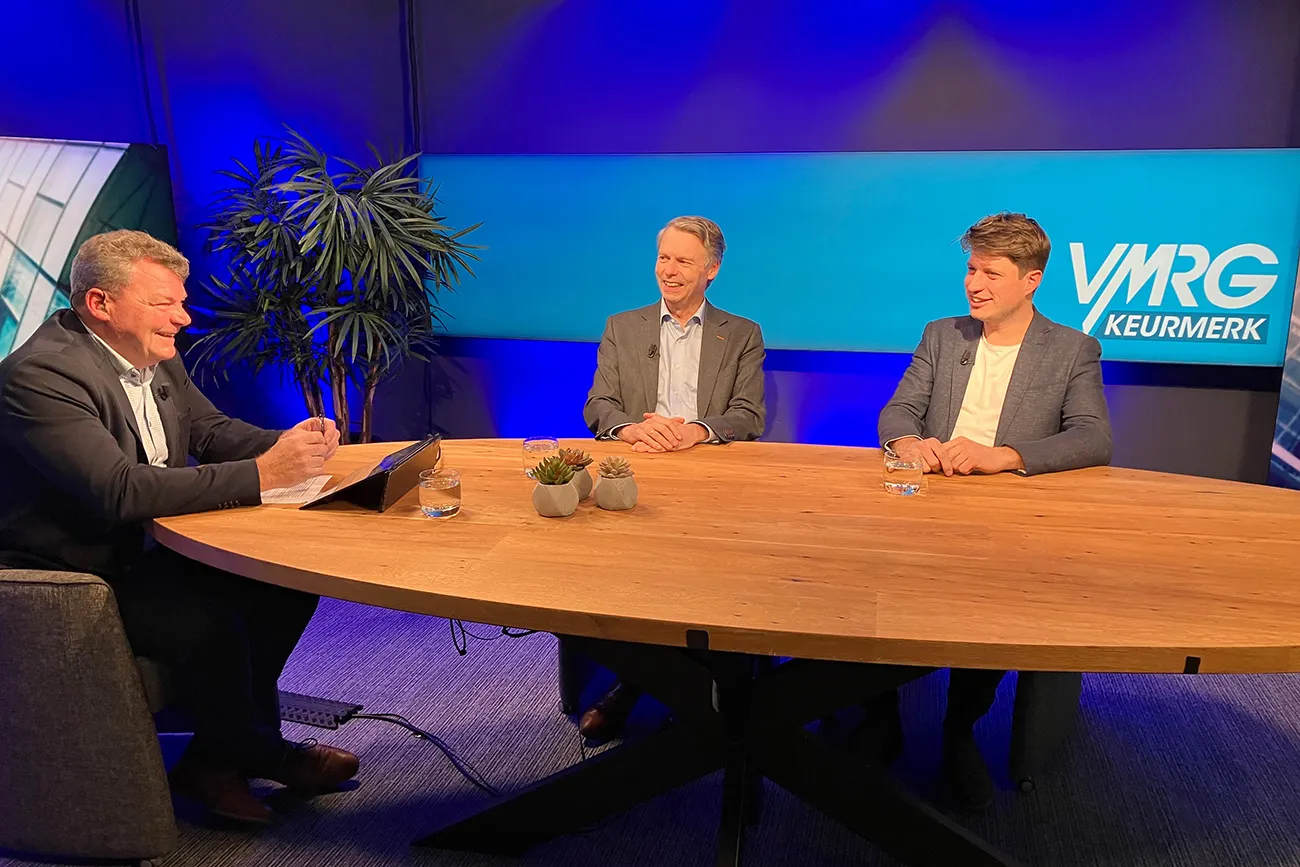
On 14 November, the VMRG online expert session ‘Improve the environmental performance of your product’ took place. Experts Mantijn van Leeuwen, director at NIBE, and Martijn Veerman, circular façades specialist at façade contractor Alkondor Hengelo, joined Henk Zoontjens, director at the VMRG, at the table. We look back at a selection of the questions discussed during the session.
Why is environmental performance important?
Van Leeuwen: Because of the energy and materials transition we are undergoing. The climate is changing as a result of our actions, and if we do nothing, a large part of the Netherlands will be under water in the foreseeable future. Things need to change, and we use environmental performance to express our impact.
Why is improving environmental performance important for businesses?
Veerman: European legislation is coming in that will require businesses to report on sustainability (CSRD), with the reports being audited by an accountant. This will start with large companies. Contractors will turn to their suppliers for information about the sustainability of raw materials. I also see a trend among investors and building valuers: a building’s value increases when sustainability measures have been implemented.
Europe has decided that a Life Cycle Assessment (LCA) is the only system for determining a product’s environmental impact. How does this relate to the Environmental Product Declaration (EPD)?
Van Leeuwen: The EPD is the declaration at product level, which is what the manufacturer provides. It is based on the LCA, the underlying study.
What is the difference between the approach to producing an EPD for a façade contractor and for a supplier?
Veerman: Façade contractors receive semi-finished products and make them into a product. A façade contractor’s processes consume energy, for example to heat a factory and office. However, the greatest environmental impact occurs in the process from raw material to semi-finished product. That part therefore lies with our suppliers. Some suppliers produce semi-finished products containing a wide range of different raw materials, which makes it particularly difficult for them to produce EPDs.
So it is not really possible to achieve good overall environmental performance unless the entire supply chain works together?
Van Leeuwen: Environmental performance is indeed determined by the entire supply chain, with 80% of the impact occurring on the raw materials side. It is therefore essential that producers of raw materials and semi-finished products also provide their data.
How can a business carry out an LCA in practice?
Van Leeuwen: NIBE gives businesses the option of doing this themselves using our software. We can see a shortage of LCA specialists coming, especially now that a requirement is on the way. To do it yourself, you need a technical degree at higher professional education level, as well as sufficient experience and knowledge of the sector, products and production process. NIBE will teach you the rest.
How does Alkondor approach this as a façade contractor?
Veerman: We engaged a consultant. This company uses NIBE’s software, carries out the LCA calculations, understands the regulations and what data is needed, and knows how the report should be compiled. It also ensures that the correct data is entered in the National Environmental Database and kept up to date.
What does such a process involve?
Veerman: The entire process needs to be mapped, from raw material extraction through to, in our case, reuse. You then look at each ‘stage’ and consider which raw material is needed, which operations are carried out, how long a machine takes and how much energy it uses. The heating of the factory and office floor area must also be included. The energy generated by the business itself must then be deducted. You need to assess what transport takes place and which vehicles are used. For the process before the semi-finished product reaches our company, we rely on a systems supplier to provide the data we need. Data must also be provided for the entire maintenance process. For this, we use the VMRG Quality Requirements. The expert we have engaged then uses all this data to carry out the calculations.
What measures can a business take to achieve a better LCA score?
Van Leeuwen: By minimising material use, recycling or reusing waste to a high standard, using green electricity and more sustainable transport (electric vehicles, hydrogen), reducing the number of transport journeys, making its own production emissions-free or low-emission, reusing packaging materials and using electric equipment on site, a business can improve its overall score by around 20-25%. The rest is down to the systems supplier or raw material supplier.
The results of businesses’ LCAs are entered as product cards in the National Environmental Database (NMD). For businesses without their own product cards, the VMRG provides industry cards based on averages for the façade sector. The VMRG is currently updating its existing industry LCAs and expanding them, for example to include curtain walls, before entering them in the NMD. The VMRG has also purchased software and trained staff to support its members on environmental performance.
Question about this story? Ask your question
Keep following this
Get an email when a new story is published. No account needed.
- ThemeCircular facades with lower environmental impact
- SubjectVMRG







